

Adapted Physical Education (APE) 101
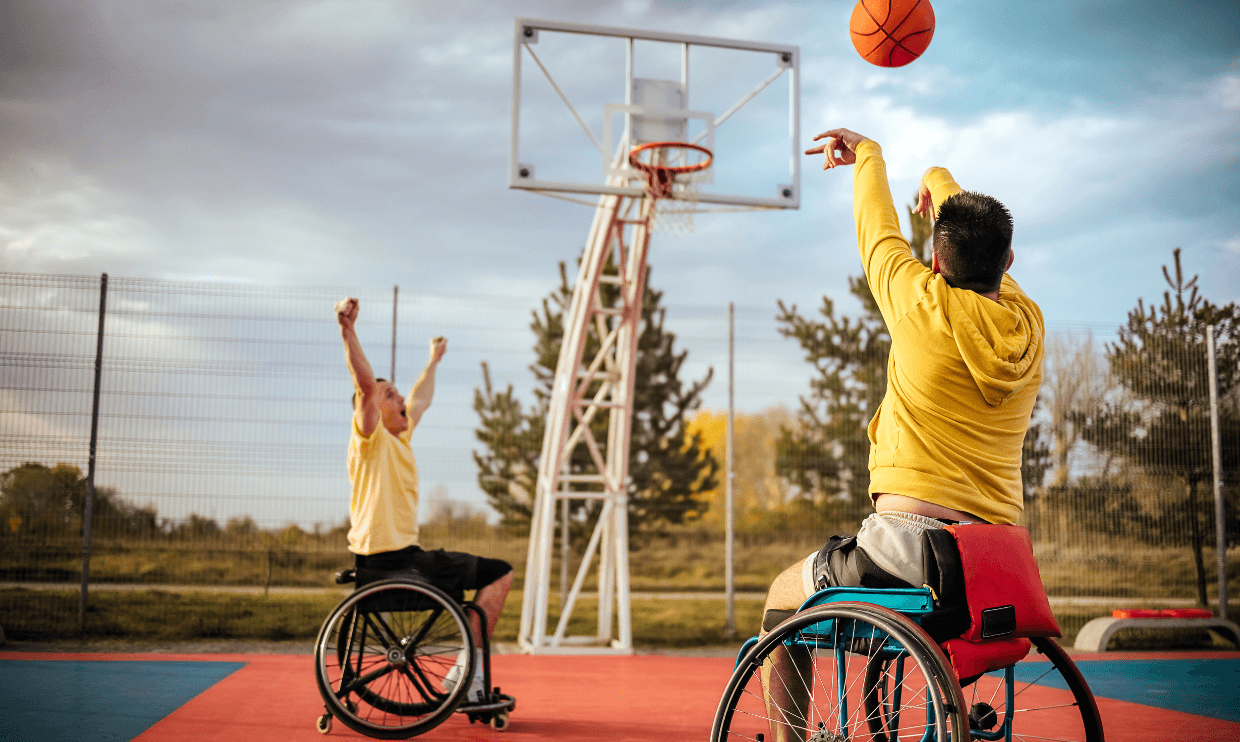
It’s true — exercise really is good for everyone. Per the CDC, a robust physical education program provides numerous benefits to children, including greater aerobic capacity and motor skills, better focus, improved mental health, and more social connections. Unfortunately, the physical fitness of children with disabilities — and research in this field — remain underserved.
But, the emergence of adapted physical education (APE) as a field and direct service in the last few decades means that children with disabilities have more options than ever before. To help us better understand what APE is, how it benefits a child, and more, we spoke with Melissa Bittner, PhD, a professor of APE and kinesiology at California State University, Long Beach; Sarah Pelangka, BCBA-D, PhD, special education advocate and the founder of Know IEPs; and Cheryl Stein, an active APE service provider based in California. For information on how to incorporate APE into your child's IEP, read our follow up article here.
What is adapted physical education (APE)?
All children in the US attending a public school must take physical education in some form starting in kindergarten and through high school, though each state has different requirements; California, for example, requires two years of PE in high school, with additional elective programs available. These requirements also apply to children with disabilities, regardless of their specific type of disability. But what that looks like for a child depends heavily on their ability, their IEP, and their service providers. Their age group also determines how much physical education they must get in minutes each week, per the law.
Under the Individuals with Disabilities Education Act (IDEA), students with disabilities must have access to appropriate physical education. This can include regular PE or, when a child’s disability-related needs require it, specially designed or adapted physical education included in the IEP.
IDEA states that physical education means:
- (i) The development of—
- (ii) Includes special physical education, adapted physical education, movement education, and motor development.
If a child needs specially designed PE, such as APE, because of their disability and the IEP team puts it in the IEP, the school must provide it. So, what exactly is APE?
As Dr. Bittner explains, “Adapted physical education is specially designed physical education instruction for a student with a disability whose needs cannot be adequately addressed through general PE alone. Physical education means physical and motor fitness. It means fundamental motor skills, and fundamental motor skills are things like running, jumping, kicking, striking, galloping, aquatics, dance, and sports. And of course, we want to do these things for a lifetime.” Dr. Bittner goes on to tell us that this definition of PE is no different for students with disabilities. But not every student can safely or successfully access a general PE environment. “Physical education is really the only content area that’s specifically called out within the definition of special education. It needs to be specially designed if students are not able to safely and successfully access general physical education.”
Admittedly, the IDEA standards leave a lot of room for interpretation and do not include precise requirements for what APE looks like or how to train specialists qualified to teach it. The National Consortium for Physical Education for Individuals with Disabilities (NCPEID) developed a unique set of standards in the 1990s for APE teachers to follow, called the Adapted Physical Education National Standards (APENS). The 15 total tenets provide frameworks and metrics not only to help students achieve but also to hold APE teachers accountable with clear expectations of ethics and collaboration with other teachers, service providers, and educators.
How is APE provided and what does it look like?
Just as its name suggests, APE can be adapted to a variety of needs depending on the child’s disability, comfort, and skills. All sources interviewed for this article agree that students with disabilities, except under specific medical or sensory circumstances, should be included in general PE as much as possible in the least restrictive environment. This can take a few different forms, including inclusive PE with the general education PE class, as well as push-in services, where the APE teacher helps integrate the child into the general education PE class using the appropriate combination of accommodations, guidance, and adaptations to help them meet their IEP goals and PE standards.
In this clip, Stein explains the benefits of different APE environments for students’ needs.
“With the right accommodations and modifications, every child can be included in some way in their general education PE class,” says Stein. “[They] have that opportunity for socialization and for exercise and learning their own likes and dislikes in relation to exercise and fitness.”
Each form of instruction provides its own benefits, and no two students will need the same services to thrive through movement. Stein and Dr. Bittner add that not every district will have the same range of services, but that should never factor into what a child needs. “Placement is going to be individualized, and it needs to be documented in the IEP,” says Dr. Bittner. “It’s not determined solely by diagnosis or staffing or convenience or district standard delivery model — it should be based on the individual.”
Push-in APE in general PE
Can a student participate in general PE and receive APE? Yes! Both Stein and Dr. Bittner say that, ideally, a child eligible for APE is still participating in general PE as much as possible. What that looks like reflects a wide spectrum of need. “For a long time, people would say, ‘They can climb the playground, they can run, they can skip, they can hop, they can jump, [so] they can do all these things, they’re fine.’” But APE was created to go deeper than how many sit-ups a child can do or how well they run. “If they don’t respond [in class] or they’re eloping to the playground, they need some supports.”
Push-in services, as the name suggests, means the APE teacher brings their services to the child within the general PE class with a more hands-on role than simply consulting on goals, accommodations, and skills. Many students, Stein says, benefit from push-in services as they transition from individual or small-group instruction. As an APE teacher, Stein says, “I can push in and help make the modifications in class, and I’m there to support in the class.”
She emphasizes that this means that the general PE teacher is still leading the class, and the students receiving APE are still following the class lesson, but tailored to their needs. “This is not pulling five kids on the side and doing something separate. Push-in service means I should be able to come in and coach a small team that they’re working on the lesson for that day. [If] I need to pull aside to work on a specific skill, I can do that for a second. But we want to get back in and we want to be included in the class.”
Another benefit of push-in and inclusive APE, Stein adds, is exposure for the general ed kids to their peers with disabilities, and nurturing their own skill development in communicating and collaborating with students with disabilities during a lesson. If a child uses an Augmentative and Alternative Communication (AAC) device, for example, their peers may perceive it as the student getting to use an iPad or tablet during class. Providing instruction to non-disabled peers on how a child communicates and expresses themself with an AAC device thus creates opportunities to improve communication and for the entire class to better understand how to work toward meeting both physical and social PE standards.
Stein says, “Sometimes kids are scared to talk to kids who have different disabilities or alternative forms of communication. When they see an adult who’s playing in the game and then modeling how to communicate with that individual, it makes it less scary for some people or breaks down that wall so that they feel more comfortable.”
Pull-out services
For some students, the general PE environment itself can make it difficult to participate or learn, even with additional supports. In those cases, APE may be provided as a pull-out service, where the APE teacher provides instruction outside of the general PE class with a learning plan that reflects each student’s needs.
Both individual and small-group APE instruction fall under pull-out services. Individual APE for students, sources say, should come only after other formats have proven to interfere with a child’s learning and achievement of their IEP goals.
Dr. Bittner explains, “A pull-out class is where the APE teacher pulls out students on their caseload [at the same school]. Maybe the general PE students are doing a basketball unit, and the student over here is spinning to get their sensory needs met, and it’s not safe for them to be playing five-on-five basketball, and so that teacher might pull out the four students on their caseload.”
Pull-out services, Stein says, can help students who may react to a larger general PE class with anxiety or dysregulation. Demonstrated physical ability, as we’ve stated, isn’t enough to pass PE. “Maybe they can do all the ball skills, maybe they can do all the locomotor skills,” she says, “but maybe they can’t socialize properly in the group, and they need time to practice turn taking, give and take, sharing equipment.”
More often than not, pull-out services are temporary and are meant to help a child develop the skills and confidence they need to re-enter the bigger PE class. “In a small pull-out session, we can work on specific skills. Some kids are more socially aware and they need to work on certain skills, so the pullout makes more sense so that they can build the skill and bring it back to class. Everything is individualized for the child,” Stein says.
When a smaller APE group may help
Group APE, also called an APE class, is considered a more restrictive environment under IDEA, and it is meant for children to access APE instruction from an APE teacher (or a qualified PE teacher, depending on local and state requirements). “Class size is a huge factor in determining the right APE environment for a child,” Dr. Pelangka notes. The decades-long trend of expanding and/or combining PE classes means that the ratio of teachers to students is far higher in PE than for other subjects, making it harder for students with higher support needs to feel both safe and included.
The option for a small group setting will depend on how many students at the school receive APE and whether the IEP team believes it to be better for the student; as both Stein and Dr. Bittner point out, many APE teachers work on a consultation and/or case basis, meaning they may serve students at multiple schools throughout the week. Groups may also depend on the children’s levels of need, as students should be with peers of similar needs so that the games or activities suit their skills and goals.
Dr. Pelangka and Bittner add that the reason a child may need a smaller APE setting often has less to do with their motor skills and more to do with sensory, social, emotional, or behavioral needs. If a child has severe anxiety that prevents them from participating or even staying in class, for example, they may benefit from doing PE in a smaller, more controlled environment or independently at home.
“Maybe they need many repetitions that can’t reasonably be accommodated to occur in a large class. Maybe they need a more controlled or low-distraction environment. Maybe there’s a student with autism with some sensory needs [or] the student needs specialized equipment,” says Dr. Bittner.
Social skills for children with autism or other developmental disabilities, Stein says, can also warrant more direct attention in a pull-out or smaller group instruction. In some cases, the students may have very developed motor skills but aren’t able to collaborate and demonstrate them with peers.
“If they don’t have the social skills to access that PE class, then we need to look at what’s going on. There’s a few kids that stim with a ball, so they have ball skills or locomotor skills because of their own personal interests. But when kids don’t genuinely have an interest in other peers, it impacts their reciprocal ball skills. Just because I can catch doesn’t mean I can throw and catch with you, and I cannot access PE just because I can throw a ball against a wall and catch it,” Stein says. Facilitating lessons such as sharing equipment or asking others to pass them the ball can happen in a small group before the student is eventually integrated into the general PE class.
Both Stein and Bittner say that while an APE teacher can serve as both a teacher and service provider, additional steps with the child’s school and IEP team may need to be taken to ensure IDEA compliance. “You cannot provide legally compliant, modified 1-on-1 or small-group instruction while simultaneously supervising a massive general education PE class,” says Stein, adding that “if the student doesn't receive their specified modifications or minutes because you are managing the [broader class], the district is in violation of federal law (IDEA).” A child’s IEP team can write the need for an APE teacher and an APE-only class into the child’s IEP, she adds, “but that would be taught as a restricted, contained class. That’s most restrictive, and that’s what we were trying to avoid.”
But, Stein continues, in most cases these more restrictive environments should work toward helping the child reintegrate into a PE class with peers: “Starting point should be participation with nondisabled peers to the maximum extent possible. Group or inclusive instruction is generally appropriate when the student can meaningfully participate with supplementary skills, adapted instruction, and supports.”
When does a child need individual APE?
Drs. Pelangka and Bittner both say that, most often, parents or teachers may seek individual APE instruction to accommodate a child’s sensory and anxiety needs rather than a physical need. For example, a child’s stimming could create a safety issue, or a child might elope from the PE area; in such cases, individual APE might be requested.
“The only time I’ve ever seen students pulled for one-on-one [services] is because they’re so overstimulated sensory-wise that they’ve completely shut down and refused to participate, even in a small APE class,” says Dr. Pelangka.
But one-on-one services, Dr. Pelangka adds, need documented structure and a clear plan for the student hopefully rejoining the broader class. “What shouldn’t be happening is the student is off to the side walking the track or just completely doing their own thing with a para. That’s not successful or conducive to anything related to PE, really, other than they’re getting movement. That’s very restrictive because you’re completely removing the social aspect of PE,” Dr. Pelangka says. “The goal should always be to get integration back.”
Additionally, just because the instruction may be with one student at a time doesn’t mean that the APE teacher must act alone. Consulting and collaborating with a student’s other service providers, such as their PT or OT (more on different specialists to come), can help APE teachers tailor lesson plans to a child’s physical and emotional needs. “[APE teachers] can ask for help and consult and collaborate with behavior specialists or with the OTs,” says Dr. Pelangka. If a child needs individual PE due to a behavior-related challenge, the APE teacher has the right to request support. This may look like incorporating OT skill-building into lessons, bringing a para or an aide into the lesson, or adapting exercises to self-regulating movements.
APE during general PE, recess, or another part of the school day
All sources interviewed for this article agreed with the IDEA principles of “least restrictive environment” and trying to maintain as many children with disabilities in a general education PE setting as possible. However, Stein says, APE specialists can also consult with or work directly with a child outside of just the class period. In elementary school, for example, Dr. Pelangka says APE teachers can make modifications to their APE services for children based on what they may observe during recess. In some cases, children may benefit from “pre-teach” sessions, during which they practice their APE skills outside of their regular PE class period, including during recess or passing periods.
But recess or lunch periods can’t replace PE instruction, and students should also be able to enjoy their free time. The structure of having a teacher to steer and modify lessons on the fly, Stein says, makes regularly attending a PE period invaluable to the student and their IEP goals. “There’s a teacher, so we can have a guided lesson where these pragmatic opportunities are going to happen. We don’t have that at lunch, and we don’t have that at recess. It’s a very unique environment for that, and super important.”
Is APE inclusive?
The standards for APE also reflect IDEA’s endorsement of the least restrictive environment, so inclusivity is always the goal. All sources interviewed agree that some of the biggest wins in their students’ journeys came from activities or initiatives that pushed inclusivity. As sources have mentioned, APE’s priority is to provide dynamic and effective PE education to students with disabilities, no matter what that may look like. Sometimes, simply attending the general PE class doesn’t mean that students with disabilities get accessible and effective PE, and facilitating that accessibility isn’t always consistent. “I’ve seen so many kids [with disabilities] in PE and they’re ‘included,’” says Stein, “but they’re off to the side with a para,” or simply grouped together and separated from the broader class.
Thankfully, it appears that school districts are starting to make larger-scale efforts to integrate students with disabilities into PE with nondisabled peers. Special Olympics, in collaboration with SHAPE America and NCPEID, created the Unified PE Playbook to give schools concrete guidance on lesson plans, assessment tools, and other resources for creating more inclusive PE classes for all students. In fact, a lack of effort to include students with disabilities in general PE classes goes against a PE teacher’s professional objectives.
California also has its state standards, the California Physical Education Model Content Standards, which emphasize social skills as part of PE for every grade level; all students must develop capacities for self-responsibility, social interaction, and group dynamics in order to excel in PE. As Stein explains, “If you don’t have kids that have unique needs in your class, then you’re not even able to teach the standards. Sometimes people are like, ‘Why is this kid here? Why can’t they be somewhere else?’ As a PE teacher, you really need to step back and realize your standards require you to not only teach every student, but you need this diverse population in your class to meet your standards.”
What does an APE session involve?
Well, it depends. The whole point of APE is that no session looks the same because no two students have the same needs and skills. A one-on-one session for a student with high anxiety won’t look like a small group session that may include both a student with a vision impairment and a child who uses a wheelchair. And, of course, these sessions will differ from that of a child who participates in a general PE class with modifications or APE teacher guidance.
“In many ways the answer is, ‘There’s no single required format,” says Dr. Bittner. While APE has standards and goals as a service, she adds, there is no universal APE curriculum, meaning that an APE teacher can incorporate as many strategies as they see benefiting their students. “A typical session might look like the APE teacher starts off with a lot of visuals that you may not see in general PE. Maybe the teacher has to review their list of rules and expectations every day,” she says, which may require visual aids depending on the student’s reading or developmental level.
What exercises the APE teacher uses will also depend on the child’s physical and cognitive abilities. For some students, they may prefer doing jumping jacks, while others do high hand claps. Measuring a child’s movement may also look different, such as going by time rather than by specific distances or numbers of repetitions. “In adapted PE, we like to do things by time rather than reps, because if I were to say, ‘I want everyone to do 10 repetitions of jumping jacks,’ student A might be able to crank out 10 jumping jacks in 10 seconds, but for student B it takes them five minutes. However much you get done is how much you get done, and that’s okay.”
In practice, when Stein is leading an APE session, she starts with the same preparations that any child needs before physical activity, like a warm-up with stretches. For younger kids, that might include music as well, and tying activities to popular songs. Creating a sense of consistency around the lessons that may change, she says, can help students mentally prepare for both their PE class and the transition to their next class. “I’ll lead the stretches so that it’s appropriate for their age group, and then we move onto a skill-building activity. If we’re working on, let’s say, striking, depending on the student they [might] need modified equipment, and we’ll practice with a balloon, like a soft toss and a strike, soft toss and a strike. At the end of class, we move to a net and we get to play with the balloon, utilizing that skill. And at the end, I always do a sticker, because students know that when they get to pick a sticker at the end, we’ve completed the session. I try to keep the beginning and the end always the same.”
Dr. Bittner adds that the activities in an APE class, pull-out session, or just consulting for a child in a general PE class should always align with the child’s IEP goals. “It might look like direct instruction, particularly with demonstration of one or two of IEP-related skills, because we’re a service, and we want to make sure that the students are obtaining their goals throughout this academic year.” It can also be monitoring and indirect instruction, such as checking in with the general PE teacher to make sure the child is still working on physical and social skills.

Examples of skills an APE teacher might work on:
- Running at a determined pace, including walking and jogging
- Jumping, including the steps necessary for jumping, such as balance, skipping, and hopping
- Balancing on one leg
- Throwing and catching balls, both individually and to others
- Motor planning and coordination for compound movements
- Improving strength, endurance, and physical fitness, including executing certain exercises for a determined time period — e.g., doing jumping jacks or star jumps for 30 seconds
- Taking turns with other students during a group activity
- Communicating and collaborating with peers during a group activity or game
- Developing sensory strategies to help a child self-regulate during PE
- Accepting when they or their team doesn’t win during a class activity
- Supporting and cheering on peers
Stein adds that PE teachers are still teachers and can insert small details or touches into their lessons to help build students’ other skills. Creating a clear agenda for the class to review before class, whether it’s written or visual, for example, helps students with their reading skills, listening skills, and how to better tell time. “I’m a teacher,” Stein says. “I’m a PE teacher, I’m an APE teacher, but I’m a teacher. Any time I have an opportunity to help students learn to count, to learn to color match, to sort things, to learn their rainbow, to spell their name — this is me. This is not every APE teacher, but any time I can help a child grow universally, if I can do it in a session, I’m going to try.”
APE teachers
The name “teacher” can be a little misleading. While APE teachers must already hold a bachelor’s degree in an applicable field, such as kinesiology, as well as their state teaching credential, APE teachers are considered direct service providers. What legally required certifications an APE teacher must hold in order to provide services varies by state. Connecticut, for example, does not require an APE-specific credential, so a certified general PE teacher can serve as an APE for a child’s IEP. California, by comparison, legally requires all APE educators to obtain an additional certification.
The best known and only nationally recognized certification is the Certified Adapted Physical Educator (CAPE) certification, created and authorized by the NCPEID. California, unlike most states, also offers the Adapted Physical Education Specialist Credential (APESC) from the state’s Commission on Teacher Credentialing in order to provide APE services. Multiple universities, including CSU Long Beach and CSU Los Angeles, offer an Adapted Physical Education Specialist Credential (APESC) program to complete their APESC credential. “This is not a standalone credential,” says Dr. Bittner. “It must be added on to either a single-subject PE credential, an ED specialist credential, or a multiple-subject credential here in California.”
Are APE teachers expected to understand the impact of low muscle tone, dyspraxia, or other brain/body issues common in many developmental disabilities?
Yes, depending on their background. In states like California that require a specialized credential, APE teachers do take courses on how different forms of disability impact a child’s physical, emotional, and interpersonal skills. For states where that credential isn’t legally required, the APE teacher needs a baseline set of skills. “The adapted PE teacher should have preparation in physical education and background knowledge in special education,” says Dr. Bittner. “They should know disability characteristics and assessment. They need to know how to provide direct instruction, behavior support, and how to collaborate.”
The coursework for CSU Long Beach’s program, for example, involves many hours of study and practical experience with students with disabilities in a variety of forms; aspiring APE teachers can’t pass without completing a set number of hours observing APE teachers across age groups from 3 to 21 years old, student-teaching their own classes, and fulfilling multiple classes that examine physical and developmental disabilities. For APE, understanding the unique abilities and skill sets of students with disabilities is one of the certification’s 15 standards, including conditions that affect muscle tone, cognition, and neurotype, on top of physical ability.
Other core aspects of the program involve building nimbleness and a capacity to collaborate, given that, Dr. Bittner says, most APE teachers consult with and serve multiple schools throughout the day or week across age groups: “We often have five or six different schools that we are managing. You’re teaching preschool at one school; you drive down the street to your next school, and you have 18- to 21-year-olds who are in a transition program. That’s a very different skill ability, to be able to bounce back and forth.”
Can an APE teacher do an assessment to determine whether the student needs APE or PT?
Only an APE teacher can provide an APE assessment, just as a PT or OT would evaluate only for needed services in their own area of expertise. In practice, both Stein and Dr. Bittner say that APE teachers may be asked to do an informal and observational assessment by a child’s OT or parent. The results might then prompt the family to ask the school for an APE teacher to formally conduct an assessment, using some of the tests mentioned and consulting with other service providers a child may have. APE teachers can successfully collaborate with PTs as well as other specialists, but they do not provide the same services to a child and cannot replace each other if a child needs both.
APE vs physical therapy — what’s the difference?
At a glance, APE may just look like the same kinds of exercises done by a child who needs accommodations or supporting services like physical therapy and occupational therapy. But because APE straddles the line of being both a federally mandated academic subject and a direct service, Stein emphasizes that their main differences lie in the educational background each specialist holds and how that influences the skills they’re meant to help a child develop and the goals they lay out for a child.
What is the difference between APE and PT?
One common misconception, sources interviewed for this piece say, is that a child can get the same benefits and work on the same skills with a physical therapist (PT) that they can from working with an APE teacher. Granted, Stein says, there is a lot of overlap. But neither service, she emphasizes, can provide the child the other’s skills, goals, and long-term development. “A lot of times, kids who need PT also need APE,” she says. “It can be tricky [when] they are able to function at their best level in PE, but the stairs are still really hard for them.”
In this clip, Stein discusses how APE teachers collaborate with other IEP service providers.
The differences start with training. A PT must hold a clinical doctorate degree in order to practice, requiring years of lab work, classroom study, clinical experience, and state board certification. PTs provide a related service for a child with an IEP, meant to help “decrease muscle pain and improve strength and range of movement through developmental activities like crawling or walking, adaptive play, water therapy, flexibility exercises” in order to help a child better access their special education curriculum. The skills a PT might help a child work on include helping them use adaptive technology or physically access and navigate the campus environment through balance, coordination, and muscle development.
An APE teacher, by comparison, does not hold a doctorate and cannot make a diagnosis for what may cause a family to seek out APE for their child. Additionally, APE teachers provide a direct service meant to tailor a child’s PE education to suit their abilities while helping the child’s school meet IDEA and SHAPE standards. APE teachers focus on both the physical skills needed to meet PE standards and the social skills kids need not only to play a game together but also to navigate their school and community at large. “We are teachers, and [PTs are] medical professionals, so we really depend on them a lot,” says Stein. “Their knowledge is indispensable and very important for us.”
Dr. Bittner adds that understanding the nuances of a student’s service needs also means understanding what each specialist provides the student. While APE and PT may co-occur often, many students in APE may benefit more from other services, including occupational therapy. “Occupational therapy is fine-motor movements,” she says. “The hands, sensorimotor self-care, independent school functioning. Another service might be orientation and mobility for students who are blind or [have low vision for] safely accessing traveling and environmental orientation.” The work APE teachers do, she adds, cannot be done in a vacuum.
How should the APE teacher collaborate with PT, OT, and Orientation & Mobility specialists?
As with most IEP teams, collaboration is key, and teamwork isn’t just for students. In Stein’s experience, keeping open dialogue with a child’s other service providers, such as their OT or orientation and mobility specialist (O&M), both within and outside of scheduled IEP meetings can be a huge boon to meeting a child’s APE goals. If an APE teacher has a new lesson plan in mind for a student, they might want to consult with the child’s PT to check the child’s progress with PT skills and recovery.
This can be especially beneficial for students with complex needs, where each service provider’s efforts and decisions need to be documented and addressed in the IEP. “Oftentimes you’ll find that they engage in a discussion during the [IEP] meeting to parse out, for example, ‘Should I be working on running in a straight line in APE, or is that something PT needs to support first?’ So parents need to make sure, if there are multiple service providers, that they’re in close discussion and that things are making sense.” Those discussions should all be documented in the IEP under consult collaboration, she adds. “Make sure that those minutes are clearly articulated. Don’t fall for, ‘Oh, we talk all the time’ or ‘Even though it’s not in the IEP, we’re always talking.’ Well, then put it in the IEP. If you’re already doing it, then memorialize it.”
Between meetings, Stein says, APE teachers can always reach out to make small day-to-day changes.
“When it comes to PT and even OT, they help me with safety, because they have a more intimate knowledge of the medical side of things. Maybe I’ll write out some exercises,” says Stein, “and I might ask PT, ‘Can you look over this for this particular kiddo and make sure I’m not asking them to do anything that is out of their range and that would be medically inappropriate?’ Sometimes kiddos have hypotonia or certain disabilities that have a wider range of motion at a joint that makes them at risk of dislocation, so PT can really help make sure that we’re staying safe.”
Close collaboration and even overlap often come when a child is younger and still developing foundational skills. If an OT is helping a child with a fine motor skill in order to hold a pencil or other classroom supplies, and a PT is helping a student with holding on to a banister or walking aid in order to safely go up and down stairs, an APE teacher might want to coordinate and focus on helping that child effectively hold PE equipment, such as a bat or racket. Dr. Pelangka adds that APE teachers shouldn’t be afraid to collaborate with other service providers on skills beyond just physical ability. “If there are some sensory [challenges] going on, OTs can support in that regard, and behaviorists can consult and support as well,” she says, which also helps students keep continuity in their skill-building.
Where APE teachers can then reciprocate and help OTs, PTs, and others is in how they help translate the skills a child is working on in services to their day-to-day lives. A child who uses an assistive gait trainer when walking may work with a PT on skills such as ambulation and walking in a straight line. But in APE that student now learns how to coordinate walking while also throwing, catching, and communicating.
“We’re good at breaking down concepts, standards, and teaching, where they’re trying to specifically help a child with either gross motor or fine motor in relation to their school setting.” Another example, Stein says, is helping a child develop their ability to jump. “Initially, we both work on that foundational-level jump, but eventually I need kids to be able to jump so they can do hopscotch or so they can do it rhythmically with a jump rope.” A PT, by comparison, may just work to help a student safely jump from the curb or when using the school’s playground equipment.
Why is PE just as important as math?
APE in itself is not an academic subject and class, but a service to help students with disabilities achieve their federally mandated physical education. Students may have a disability but can still successfully participate in general PE classes with minimal APE services, with or without accommodations. Per anecdotes documented in the American Association for Physical Activity and Recreation’s eligibility position statement, a child with spina bifida with low motor scores can still participate in general PE (with accommodations) due to their developed social and participation skills. Inversely, a child with autism or anxiety may need a more restrictive APE environment. But PE, as with all other academic subjects, is a mandated subject by federal law and explicitly part of IDEA and a child’s IEP.
Dr. Pelangka, Stein, and Dr. Bittner all recognize that for a child with more significant support needs, many parents may want to prioritize addressing challenges in other academic subjects before PE. “It’s an academic subject, just like math, English, and science, and needs to be treated as such,” says Stein. “California and Ed Code state that every elementary child up until through sixth grade gets 200 minutes of physical education every two weeks. Once they get to seventh grade, that’s 400 minutes every two weeks that they are required by law to receive and have access to.”
Only in very severe medical circumstances should families forgo pursuing APE services, and even then, Stein says, there are so many other benefits to PE than breaking a sweat. “Even those medical exemptions that occur, that are so extreme they say no physical activity, still have to be looked at like each year. The doctor’s note needs to be evaluated to make sure, ‘Is this continued?’ Even the student that’s medically fragile should have access. They still benefit from somebody singing songs with them and doing movement activities and practicing turn taking, even if it’s hand over hand.”
Not providing a child access to PE can also often interfere with many aspects of a child’s development beyond their measurable assessments and IEP goals. Dr. Pelangka adds that the more physically freeing environment of PE allows children who may struggle with communication in the classroom the space to engage with others. Kids with ADHD, she explains, can often struggle to focus in a traditionally static learning environment but become much more calm and outgoing when allowed the space to move and regulate themselves. Positive interactions with others are also a huge part of every child’s development that PE can often more easily facilitate than other academic subjects due to its format and unique setting.
“Students realize, ‘Oh, I can do this.’ It creates a new hobby and a new pastime, and then it lends itself to more positive social experiences because there’s skill-building in those activities. When we think about students matriculating to middle school and high school, and there are no playgrounds, there are no swings, there are no structures to climb and go on slides . . . it’s a space where there is more natural interaction,” says Dr. Pelangka. “You’re not sitting in a room having to be quiet, and the teacher is lecturing. You’re able to converse and engage, and missing that opportunity and those experiences isolates kids.”
Speaking from experience, both Stein and Dr. Pelangka have had IEP meetings where they believed PE wasn’t receiving the same amount of attention as other academic subjects, including the logistics of a child’s accommodations. What works in the classroom, Stein says, doesn’t always translate to other environments. “I’ll say, ‘How do you see that in PE?’ Thinking about an accommodation that happens inside a classroom but not across academic subjects because not all academic subjects are inside a classroom,” she says, isn’t serving all the student’s needs. The biggest benefits of PE, in fact, can come from what can happen outside the classroom.
In Stein’s words, all the skills that manifest in PE apply to how a child navigates not only the rest of their school day, but the world at large. “We are having to communicate out loud with each other; we are having to share space and solve problems on a daily basis. Dealing with disappointment, dealing with different personality types on a team.” The presence of children with disabilities, she says, also contributes to how their nondisabled peers develop their own collaborative skills.
“Maybe I’m a stronger athlete in a certain skill — how do I help my teammates so that they’re more competitive? What do I do as a person? How do I challenge myself as a student to share my knowledge with other students?” These same challenges to thinking apply to, for example, a group project in social studies or an extracurricular club. When students feel empowered to help others, Stein adds, “they really grow as human beings.”
Meaningful participation in PE
Ultimately, the type of APE support a child receives should come down to what they need to meaningfully participate in PE — not simply whether they have a disability. And meaningful participation isn’t only about physical skills. If turn-taking, communicating with teammates, or navigating a group is making it difficult for a student to participate in general PE, those are skills that APE can help a child develop, too.
In fact, Stein says, social skills are part of the SHAPE America national standards under Standard 3, which reads as follows: “Through learning experiences in physical education, students develop the social skills necessary to exhibit empathy and respect for others and foster and maintain relationships. In addition, students develop skills for communication, leadership, cultural awareness, and conflict resolution in a variety of physical activity settings.”
The standard also provides age group–specific goals but generally includes consistent and crucial life skills, such as showing respect to others, communicating with teammates, engaging in collaborative problem-solving, and demonstrating compassion and support for others. As with every other academic subject, APE and PE provide students a spark of possibility and the chance to learn about themselves and others far beyond what the lesson of the day entails.
APE can give a child space to work on specific skills, whether that’s turn-taking, improving coordination, managing sensory overwhelm, or learning how to navigate a larger group. But needing APE doesn’t necessarily mean needing to leave general PE.
As Dr. Bittner explains, “Far too often, students get labeled, ‘disability equals APE’ and ‘neurotypical equals general PE.’ That’s not the case at all. We want students with disabilities to participate with their nondisabled peers as much as possible. Just because someone has a disability doesn’t mean they can’t participate in general PE in a meaningful way.”
And that opportunity to participate can benefit everyone in the class. As with every other academic subject, APE and PE give students the chance to learn about themselves and one another far beyond the lesson of the day.
“When I [see] kids get that magical moment, it’s about everybody learning, everybody being a teammate,” says Stein. “They [are] so happy together as a team, communicating effectively together, and I think that translates into every job, into every group work. How do we communicate effectively? How do we incorporate everyone, no matter their ability or what they have to offer? We all have to learn to appreciate the gifts and talents that come, no matter how small they may seem in that moment. They can help us all grow individually, and I think PE really has this unique opportunity to do that.”


Unlock more with Undivided
Turn knowledge into action that benefits your child
Get Membership


Author