

Strength-Based IEPs with Dr. Caitlin Solone
Strength-based IEPs focus on the strengths and skills your child already has instead of focusing on limitations or deficits, positioning students with disabilities as valuable, capable, and contributing members of their classrooms and communities.
Dr. Caitlin Solone — education advocate, teacher educator, and faculty at UCLA — talked with us about why vision statements can be transformative tools, why strength-based IEPs are more important than ever, and how to navigate the least-restrictive environment now that many kids are back at school. For some highlights, check out the clips below or watch the full recording with transcript here.
Why are strength-based IEPs important?
As many of us know too well, society tends to take a deficit-based approach to disability, which creates a limited view of what children with disabilities can achieve in school and throughout their entire lives.
By building IEPs that are focused on children’s strengths rather than deficiencies, we can help create a learning environment that allows our children to grow into the capable people they are.
These words don’t have to define our kids. With the support of Dr. Solone and all the parents who joined us, we now have several tools and strategies at hand that we can bring to future IEP meetings. As Dr. Solone said, “Creating strength-based IEPs will help people see your children as individuals who make up an important part of our community and society.”
Because IEPs are the documents that teachers first read when they get new students, IEPs shape their first impressions of our kids. Dr. Solone explained that many educators are trained to write IEPs that only focus on the details of a child’s disabilities and the tasks they’re unable to do, which forms the trajectory of that child’s entire school career.
Traditional IEP language often includes statements like, “Charlotte has a five-second attention span,” or “Annica has severe autism and frequent tantrums, bites and kicks when frustrated, and does not have a conventional means of communication.” Dr. Solone asked, do these student profiles provide information that will help these students thrive? Unfortunately, without showing teachers your child’s entire being, the answer is usually no. And that’s where strength-based IEPs come into play.
Strength-based IEPs foster self-determination, self-efficacy, self-control, and academic achievement.
They are effective because they focus on the whole child — not just a child’s disabilities.
Focusing on the whole child means writing IEPs in a positive way that honors a student’s abilities, possibilities, interests, and support needs.
Focus on your child's strengths
Explicit and implicit biases, or conscious and unconscious attitudes and beliefs, shape how we all understand disability — and this includes how schools and IEP teams decide what our children are or are not capable of.
As parents and members of our children’s IEP teams, asking ourselves questions to shift our own perspectives will help us pinpoint and communicate our child’s strengths to the rest of the IEP team — thus challenging the biases that are limiting how our children are perceived in school.
This means changing our mindset and language from “My child can’t complete this task” to “How can we make it possible for my child to complete this task?”
Ask yourself, “What are my child’s strengths? How can we use those strengths to support this specific IEP goal?”
When you’re identifying your child’s strengths, remember to focus on the whole child — not just percentages, numbers, and data from school records.
Once you identify your child’s strengths, own the fact that you know your child’s abilities and passions better than any other person on the IEP team. As one parent shared with us, “We know better than anybody if our child can be pushed or challenged further, and that should be reflected in the IEP goals.”
Strength-based vs. deficit-based
Turn strengths into IEP goals
During our small-group explorations, one parent of a child with dysgraphia shared that her son is a great typist. Yet her child “was forced to write a sentence five times before he was allowed to type. It was like he was being punished, instead of encouraged to learn his way. During distance learning, typing is the only option, so he’s typing all of his work and thriving.” Typing is clearly one of this child’s strengths, and should be presented to the IEP team as a skill to help him achieve writing goals.
Another parent shared that her child is nonverbal, but can communicate with sign language. The ability to sign is a strength, so the parent can develop a goal for her child to learn more signs.
Yet another parent shared that a goal for her child is to memorize phone numbers using music. Get creative! If your child responds to music or is skilled at singing or playing an instrument, you can incorporate music into their goals.
Vision statement
Developing a strength-based IEP includes writing a vision statement about the future you want for your child. “It’s what we want out of life for our child and what our child wants out of life,” Dr. Solone said. Unfortunately, vision statements are not automatically included in IEPs; in fact, Dr. Solone has never seen them included in any California school district, which is all the more reason for us to advocate for their inclusion. If vision statements were incorporated into every child’s IEP template, we as parents would have a new way to communicate goals to the IEP team and receive more effective support. As one parent put it, a vision statement represents a “stepping stone to a successful life.”
When you’re writing your statement, consider using these kinds of phrases:
- Obtain meaningful employment
- Volunteer in the community
- Take part in meaningful social activities
- Develop meaningful friendships
- Pursue post-secondary educational opportunities
“Establishing a vision statement early [in a child’s life] helps the IEP team stay grounded in what matters and the destination where you and your child want to go,” Dr. Solone said. Transition plans later in a child’s school career often include similar ideas as a vision statement, but as Dr. Solone said, this “transition period” really starts before kindergarten, because K–12 education in its entirety helps students transition into adulthood.
If your child’s school does not include a vision statement in their IEP, you can request that it go into the parent comment section or addendum, or be added as its own section. Dr. Solone recommends asking your child’s IEP team if they’d like to collaborate on the vision statement with you, but it’s perfectly acceptable to write it on your own if there is resistance from the team.
Practice writing a vision statement before your next IEP meeting. Write at least one goal you would like your child to work on in the coming year that will help you reach the end goal you envision for your child.
Need a template for including your vision statement in your child's IEP? Check out the one Dr. Solone helped create for Undivided members:
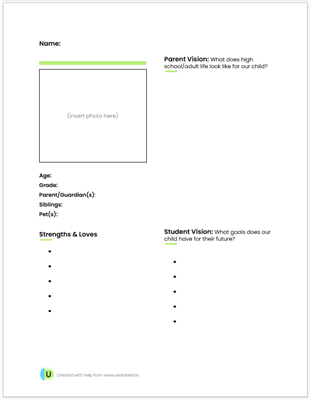
During our explorations, one parent visualized her son picking up his backpack and happily going to school without fear of bullying, shaming, or being left out.
Think of one word that describes how you want others to view your child. Multiple parents said they wanted their child to be seen as “capable,” “independent,” and “happy.”
We are so grateful for every parent who explored strength-based IEPs with us, shared their experiences in IEP meetings, and amazed us with stories of all that their children can and want to do.
Inclusion
Need more IEP support? Undivided can help you understand the services your child may be entitled to, learn how to advocate while fostering collaboration, and get expert tips so you can enter your IEP meeting feeling prepared and confident. Become a member here.
For more information on strength-based IEPs, read our article How to Develop a Strength-Based IEP!


Unlock more with Undivided
Turn knowledge into action that benefits your child
Get Membership


Author