
Undivided Resources
Article

10 Ways Schools Can Help Kids with IEPs Make Friends

Published: Sep. 4, 2025Updated: Sep. 19, 2025

Featured image
School is where our kids spend the majority of their day, so naturally, it’s a place where we want them to make friends and feel like they belong. As much as we wish schools would take charge of helping our kids socialize, it usually takes some parent advocacy work to actually make it happen (which probably comes as no surprise to most parents)! Parents can encourage schools to develop kids' social skills and foster friendships in a variety of ways. Here are some ideas to discuss with your IEP team.

1. Write socialization goals into the IEP.

Kids with communication challenges often need situations created where they can practice conversation with partners who have good communication skills — not just in the speech therapy room but with people the same age (including peers who do not have disabilities). Whether as a parent you propose your own IEP goals or try to tweak the goals your child’s teacher proposes, see our article Socialization Goals in the IEP for helpful guidelines and example IEP socialization goals written for every age.

2. Write inclusive academic IEP goals.

Even when not specifically about building social skills, your child’s IEP goals can foster interaction with other kids. Try adding “with typical peers” or “with same-age peers” to your child’s academic goals so that they can practice the skills they’re working on with their classmates. Karen Ford Cull, Undivided Content Specialist and parent, would say to her IEP team, “This is a great goal, but can my child do it with kids instead of grown-ups?” For a step-by-step breakdown, see our article 4 Steps to Write Inclusion into Your IEP Goals.

3. Use Core Content Connectors.

If our kids are at the back of the classroom learning something totally separate from the rest of their class, how will they be able to socialize and make friends? All students should have access to grade-level content so they can be educated with their peers. If students with IEPs are not at grade level, the curriculum can be modified to a different but related standard using the same subject matter. Core Content Connectors are tools that teachers can use to help teach the state standards with less complexity, so students who need modifications can work on the same content as their peers, even when they are still mastering basic skills.

Talk to your child’s teacher about what their peers are learning in class and how to pinpoint essential ideas that your child will benefit from. If you have a child in middle or high school, talk to the teacher about making sure modifications are age-appropriate and don’t alienate them from their peers, like avoiding worksheets that use cartoon characters or frilly fonts.
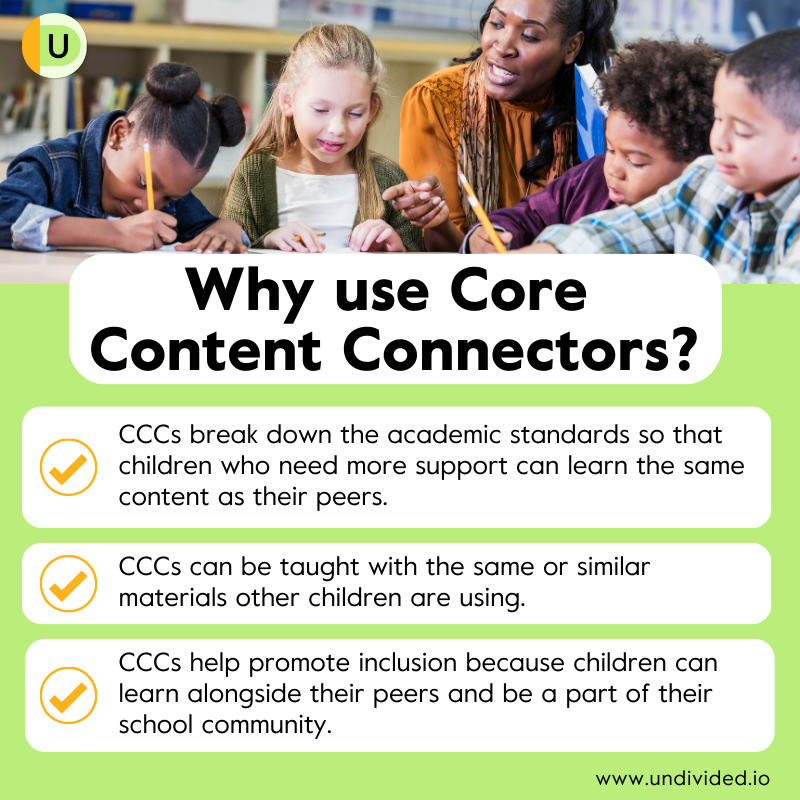
What are Core Content Connectors and how do they help?

4. Use Universal Design for Learning.

Similar to CCCs, Universal Design for Learning helps kids with extra support needs learn alongside their peers. Teachers who develop lesson plans with UDL in mind think about the different kinds of learners in their classroom — do some kids learn better visually or need auditory supports? — and plan for alternate ways that students can access the content or demonstrate what they’ve learned, so nobody feels left out.

Dr. Caitlin Solone says, “When we plan with all kids in mind, then every child thrives in a deeper way in a classroom because it opens up doors for not just our students who have more significant support needs but all kids who are struggling with learning or struggling with engagement or struggling to be a part of their classroom community. So it really does open up the doors for everybody in a class when we can really start to plan with the students with the most significant support needs in mind.”

If you want to support your child’s teacher(s) in incorporating UDL, you can request teacher training in your child’s IEP.

5. Provide appropriate aide support.

Helping kids socialize when they have a 1:1 aide is a delicate balance. Aides can help kids with developing social skills and initiating conversations with peers, but over-relying on an adult can create more communication barriers. The key is helping your kid develop independence, so work closely with your IEP team on what that looks like. JoAnn Ford-Halvorsen, Director of Student Services, says, “We want to be really explicit about where they continue to need that support and the areas that they don't, so we're having conversations of where we can start to fade some of that support.” Find some specific ideas for how aides can support student independence in our article Paraeducators 101.

6. Ask peer volunteers for support.

Your child’s IEP can’t dictate the education of other kids at school, but you can write in opportunities for peer support. For example, if your sixth grader needs help transitioning between classes, you could request a peer volunteer who has the same next class to walk with them instead of a 1:1 aide, creating opportunities to socialize along the way.

Dr. Mary Falvey reminds us, “It’s important that if there are AAC systems involved that you have them out of the backpack, so the child can communicate because they have their AAC in front of them to communicate with their peer.” Peer training on AAC can even be included in the IEP, as Dr. Sarah Pelangka explains:

7. Provide support for extracurricular activities.

Finding kids with shared interests is one of the best ways to foster friendship. Help your child look for clubs that overlap with their interest areas, such as sports, choir, drama, cooking, or the school newspaper. If the school doesn’t offer anything your child is interested in, consider starting a lunchtime club. Most clubs are sponsored by a teacher, so you can talk with your child’s teacher or another staff member about creating meaningful social opportunities. Find more information about lunch clubs in our article Socialization and Inclusion: Nurturing Authentic Peer Relationships.

The school should provide your child’s IEP supports during extracurricular activities if they are necessary for your child to participate, such as a 1:1 aide or visual supports. If your child needs to audition or try out first, the school should provide access to reasonable accommodations during the audition process too so that your child has the same opportunities as their peers.

8. Provide inclusive placement.

In the special education world, inclusion means making sure students with IEPs have as many opportunities as possible to be in a general education environment with their typically developing peers. A 2020 study found that students in a fully inclusive environment not only performed better academically and made more progress on IEP goals, but they also had more social interactions throughout the school day. Talk with your IEP team about making your child’s education more inclusive. This can look like pushing therapeutic services into the classroom instead of pulling students out for sessions, or including students in a mainstream PE class with accommodations instead of segregating them. And if your IEP team says inclusion isn’t possible for your child, point them to these 5 myths of inclusion!

9. Build disability awareness and acceptance.

Part of helping kids make friends means creating a school-wide culture of respect for diversity and other people’s differences. Does your child’s school celebrate different disability awareness days, invite adults with disabilities to come share their talents, or host inclusive assemblies and activities? Our article Nurturing Disability Acceptance in Your Child’s School provides plenty of activity ideas for all ages, including tips on talking to peers about disability and advocating for more inclusivity and awareness in your school district.
Education goal
Be an advocate within the school system
9 steps
You want to make a difference in your school district, not just for your own child but for other kids with disabilities, but how? Follow Undivided's step-by-step guidance with actionable advice and expert tips for getting involved.

10. Connect kids with their neighbors.

Dr. Falvey says two main things are needed for kids to make friends: close proximity and frequent opportunities to socialize. When kids with disabilities attend their local public school, their classmates are often kids from their own neighborhoods. Outside of the school day, kids can recognize familiar faces and have an easier time connecting at the local playground or at community groups like scouts and sports leagues.

Many of these socialization supports can be written into the IEP, which makes it easier to hold the school accountable for providing them. If you have other ideas for helping our kids make friends at school, we’d love to hear them!

Contents


Overview

1. Write socialization goals into the IEP.

2. Write inclusive academic IEP goals.

3. Use Core Content Connectors.

4. Use Universal Design for Learning.

5. Provide appropriate aide support.

6. Ask peer volunteers for support.

7. Provide support for extracurricular activities.

8. Provide inclusive placement.

9. Build disability awareness and acceptance.

10. Connect kids with their neighbors.
Blue asterisk
Liney circle
Join for free

Save your favorite resources and access a custom Roadmap.

Get Started
Tags:

Author

Brittany OlsenUndivided Content Editor

Reviewed by:

  • Adelina Sarkisyan, Undivided Content Editor and Writer
  • Lindsay Crain, Undivided Head of Content and Community

Contributors:

  • Karen Ford Cull, Undivided Content Specialist and Education Advocate
  • Dr. Caitlin Solone, education advocate and academic administrator for the Disability Studies program at UCLA
  • JoAnn Ford-Halvorsen, Director of Student Services
  • Dr. Mary Falvey, Emerita Professor from the Division of Special Education and Counseling at California State University Los Angeles and a national authority on inclusive education
  • Dr. Sarah Pelangka, BCBA-D and owner of Know IEPs

Promise Image
Each piece of content has been rigorously researched, edited, and vetted to bring you the latest and most up-to-date information. Learn more about our content and research process here.
A Navigator is your Partner at each turn
Every Undivided Navigator has years of experience supporting families raising kids with disabilities or parenting their own. Partner with an Undivided Navigator for a free Kickstart to learn first hand what support feels like!
tick-icon
Expert-driven content, guidance, and solutions.
tick-icon
Member events and office hours with real answers, plus access to our private parents' group.
tick-icon
Priority to begin a free Kickstart of the Undivided Support System with a dedicated Navigator.
“It’s so helpful to have one place that you can go to get many answers.”–Leeza Woodbury, with Navigator Kelly since 2020
*Currently offering Navigator Kickstarts to residents of California
Beta
Andy AI Search Icon