

Regional Center Respite and Specialized Supervision 101

Our families rely on many avenues of support, including school, therapies, and after-school child care to balance work and child care (and maintain a reasonable level of family happiness). Check out what services are available from Regional Center to help support you and your child.

Respite
What is respite?
A Regional Center may fund in-home respite services for the purpose of providing parents with relief from the ongoing care and supervision of their child with developmental disabilities. The number of respite hours provided is based largely on the extent of the child’s care needs, as well as extenuating family circumstances. Additional respite hours may be available on an emergency basis, e.g., due to a family health emergency or for parents to attend trainings or conferences related to the child’s disability.
How are respite hours decided?
Many Regional Centers use an assessment tool to calculate how many hours of respite a family should receive. (Most Regional Centers have a link to this assessment tool on their website.) There are several issues that can arise from this approach. First, the service coordinator might fill out the assessment tool without input from the family, and could make assumptions about the child’s needs and limitations that lead to a miscalculation of how many hours the family should receive. Second, many of these written assessment tools are based on a scale that assumes a maximum number of hours per month or quarter, whereas in reality there is no longer a statutory cap on the number of respite hours a family may receive.
The number of hours authorized is supposed to be tailored to the family’s specific needs, not a standard number of hours. When considering hours for respite, Regional Center coordinators look at: What are the family needs? Do they have other kids? Are there things that they need to do for their child with a disability above and beyond their other kids? Do parents need time to spend with each other?
Finally, and on a related note, the tool itself can gloss over the nuances of families’ particular needs by limiting eligibility to families who can check off specific boxes on the form. Again, the number of hours awarded must be tailored to the family’s specific and individual needs. You may wish to request that the assessment tool be filled out during the IPP and with your input. You may also ask for a copy of any Regional Center policies addressing how respite is calculated and what exceptions are available. If you disagree with the Regional Center’s decision regarding your respite hours, you may file a request for fair hearing.
What if you need more respite hours?
Many parents find themselves in need of additional respite support, especially when their children are home from school, e.g. during winter and summer breaks or during public health emergencies. Some families experience difficulties in finding individuals willing to come into their homes to provide respite services, or have concerns about bringing in outside providers, especially families with immunocompromised household members.
Some exemptions you might request include:
- Additional funding for respite services if parents’ needs for relief have changed.
- A waiver to the requirement that the respite provider live outside the home so that a roommate, extended family member, adult sibling, or other person without legal responsibility for the child may provide respite services.
Requesting additional services or hours starts with updating your child's IPP.
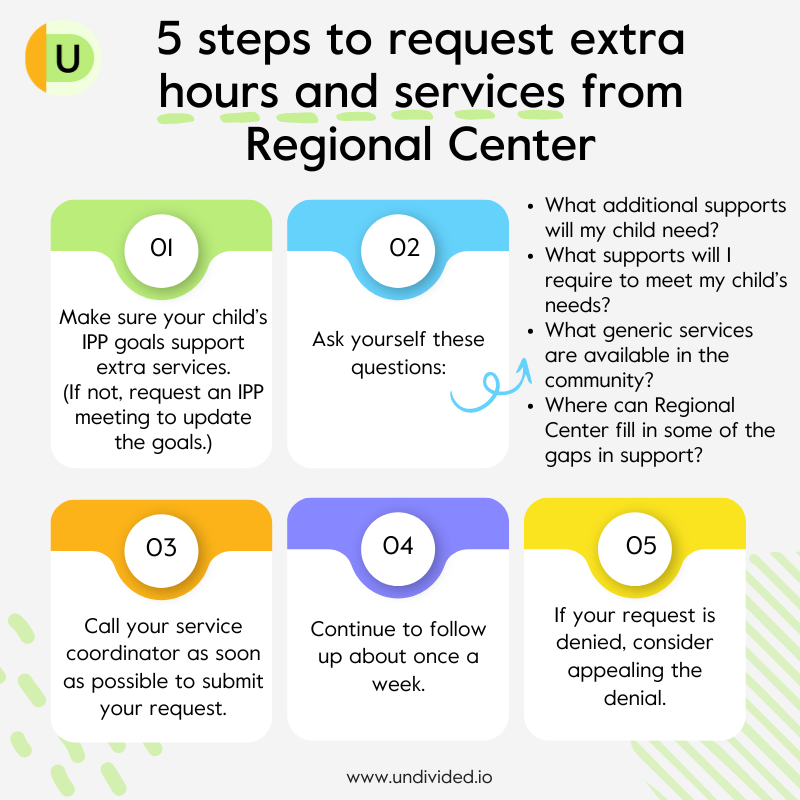
Check out Undivided's step-by-step guide for expert tips:
Request respite hours from Regional Center
Find a respite provider
Behavior respite
Per DDS, “Behavioral respite is intermittent or regularly scheduled non-medical care and/or supervision that is provided in-home for individuals with intellectual/developmental disabilities and behavioral needs. Staff teaches the individual self-help and daily living skills, and implements a pre-existing behavior plan to support behavioral needs.”
If your child has behavioral needs, check your Regional Center's purchase of service standards for specifics as to who qualifies for behavioral respite and under what circumstances. Generally, behavioral respite is provided by someone who has the training to address behavioral needs that a regular respite provider is not qualified to address, during a time when the child cannot be left alone with a regular respite provider due to those behaviors.
For those using the Self-Determination Program (SDP), request a Behavioral Technician Paraprofessional and follow the DDS description of standards. This may also mean that you need BCBA oversight, so you would need to request that for your budget as well.
Specialized Therapeutic Services (Nursing respite)
When traditional respite is not the safest option due to complex medical needs, Regional Centers can offer Specialized Therapeutic Services for access to a nurse as respite. There are no age restrictions for this request; the clinical team must deem it necessary.
Regional Centers may offer nursing outside of Specialized Therapeutic Services through direct nursing. The clinical team will also let you know the level of nursing care, such as LVN or RN. If you disagree, you can always appeal their decision and provide more documentation of your child’s needs.
Note: If you are directly hiring staff with SDP and are funded for LVN, consider requesting RN oversight as well unless you have RN or doctor oversight from other generic resources.
Crisis Team
Crisis Team can be another level of behavioral respite. Although some providers offer behavioral respite, they may not offer crisis support. Crisis services can be offered over the phone, in person, and/or out of home. Each situation includes an evaluation process and treatment plan, including caregiver training. Work with your Regional Center and their vendors to learn more about this option.
Out-of-home respite
More commonly used for adult children, out-of-home respite provides overnight to multi-night respite care in an acute facility or approved location. There is no age restriction, but approved locations for minors are harder to find. Out-of-home respite can include specialized care in behavioral or nursing-level facilities that are approved for people with developmental disabilities.
If you use the Self-Determination Program, ask your service coordinator what they require to request out-of-home respite.
Specialized Supervision
What is specialized supervision?
Regional Centers may be able to fund specialized child care services (also referred to as day care, child care, or specialized supervision) for parents who work full-time or are enrolled in full-time job training or education programs that will lead to employment and can only take place beyond the child’s school day. Typically, this service comes in the form of 1:1 child care that functions similarly to respite in terms of hiring and paying providers. Some Regional Centers may offer exceptions to rules regarding what kind of work or study a parent must be engaged in to receive day care services; limited or one-time exceptions may be made for parents who are working part-time, studying for a licensing exam, doing volunteer work that helps Regional Center families, etc.
Who qualifies?
In order to receive funding for day care services, the child’s care and supervision needs must exceed that of a non-disabled child of the same age, such that they cannot participate in regular childcare resources in the community (such as day care centers, after school programs, YMCA, and others). The care hours are usually awarded during periods when a child is not in school, e.g., after school or during school vacations.
Child care is generally funded only to the extent the cost exceeds that for a typically developing child; in other words, only the portion in excess of typical child care costs will be funded. Often, additional child care/specialized supervision/personal assistance funding or center-based day care may be available for teenagers and young adults, as their typically developing peers can be home alone and usually do not require 1:1 day care services.
Note: sometimes, parents want their child to participate in an after-school day care program for socialization purposes as opposed to child care purposes. In such cases, the parents should investigate social-recreational funding, which does not require that parents be working full time.
What if you need more specialized supervision?
Parents who are working full-time (whether in or out of the home) may be able to request additional specialized supervision hours if their child’s school is not in session and the child requires supervision so that parents may continue to work. These are often referred to as ESY hours. Additional exceptions/allowances may be made on a case-by-case basis.
Request specialized supervision/daycare from Regional Center
Other resources for caregiver relief
Here are additional sources of respite and assistance potentially funded by Regional Center and/or other organizations.
Personal Assistance
For parents who work at home or need help outside of respite for a child who needs assistance completing Activities of Daily Living (ADLs), another option may be Personal Assistance services from Regional Center. This option can look different based on each individual and their needs. It can be flexible, helping in the community or at home. It can be temporary or ongoing, depending on the individual’s needs documented in the IPP. According to DDS, "The service may include direct assistance (actually performing a task for the person) or supporting the individual to perform a task." Some Regional Centers have age restrictions in their POS guidelines, although you can always ask for an exception.
Camp
Camp can be used as a form of respite for caregivers, and Regional Centers can help facilitate it if it’s part of the IPP. There are no age restrictions for camp, and there are many options for all age groups.
Note: Regional Center cannot require that a family reduce, exchange, or forgo respite for access to camp. Per DDS, all services are reviewed individually; therefore, social recreation of camp and respite should not be treated as the same thing. Check out our article about social-rec funding for more information.
Independent Living Skills (ILS)
During the transition into adulthood, adult children should also consider Independent Living Skills (ILS), which is another opportunity to receive 1:1 care while also building skills. Make sure the IPP reflects that independence is something to work on, and request an ILS evaluation before your child turns 18 so you're ready to start the process.
ILS can happen at home or in the community and must include goals in the IPP. An example could be preparing a meal from start to finish, including looking up a recipe, going to the store, getting ingredients, preparing the meal, and cleaning.
Note: ILS should not replace respite. This additional service can help your adult child build skills toward independence, whatever that looks like for them. Also, be aware that ILS has limits; the maximum is 80 hours a month, with averages closer to 20-40 a month. Whether your child is about to move out soon or in the more distant future may also affect how many hours are recommended.
Respite from CalAIM
Some Medi-Cal members can access the CalAIM program through their managed care plan if they meet high-risk or clinical “population of focus” criteria. This may be an option for those who are not Regional Center clients, or who need more services than the Regional Center has assessed.
Steps to apply:
- Find your health plan - Which Medi-Cal managed care plan do you have?
- Contact Member Services - Call the number on the ID card for the Medi-Cal managed care plan and ask for a “Community Supports” assessment for caregiver respite care.
- Authorization Approved - Once you are approved, you will use the directory for the Medi-Cal managed plan and find an agency, unless they have directly connected you to the agency.
Note: If you are a Regional Center client, let your coordinator know if your child is approved for CalAIM Respite, Enhanced Care Management (ECM), or any community support services to avoid duplicating services.
Respite from private health insurance
Although it is rarer, some private medical insurance programs do offer respite services, depending on the situation. For example, many private insurance companies offer respite exceptions for those in hospice care. Veterans benefits also offer a limited amount of respite care.
If you have long-term care policies or specialized disability insurance, reach out to learn what options are available, and feel confident seeing it in writing, not just relying on someone's interpretation.
Explore Regional Center services


Unlock more with Undivided
Turn knowledge into action that benefits your child
Get Membership


Author