

How to Choose a Medi-Cal Managed Care Plan

If you are enrolling your child in Medi-Cal, whether as primary or secondary coverage, part of the process will include choosing a managed care plan. Available plans vary depending on your county.
There are some great online resources to help you choose the right managed care plan as your child’s sole insurance coverage. You can use the California Department of Health Care Services (DHCS) to:
- Compare up to three health care or dental plans.
- Find information on standard benefits, pharmacies, urgent care centers, and more.
- Search for a specific provider or hospital to see if they accept a Medi-Cal managed care plan.
- Get contact information for each provider.
Managed care plans can be used as secondary insurance if families enroll in the same Medi-Cal HMO as their primary insurance (if it is available in their county). In these cases, Medi-Cal typically covers what the primary insurance doesn’t.
Are managed care plans required?
CalAIM is an initiative by the Department of Health Care Services (DHCS) focused on whole-person care, with added supports such as housing, food assistance, and respite, to help members stay healthy through access to Enhanced Care Management (ECM), nonclinical community supports, and more. On January 1, 2022, CalAIM went into effect to streamline the delivery of Medi-Cal services in the community, including a requirement that most recipients enroll in a plan even if they were exempt previously. For those with other health coverage who are enrolled via Medi-Cal Home and Community-Based Services (HCBS) waiver — including the institutional deeming waiver — and for those who are dually eligible for Medi-Cal and Medicare, this change took effect January 1, 2023. Only a small number of recipients remain under fee-for-service Medi-Cal.
Working with providers who accept your Medi-Cal managed care plan
Your child should receive an annual packet from Medi-Cal Health Care Options advising you of your county’s Medi-Cal managed care plan options.
Note: Many parents have reported that their packet still includes language from previous years stating, “You or a member of your family cannot choose a health plan if you are a member of a commercial health plan through private insurance.” This is an error! If you have received this packet, you must choose a plan. You are also free to switch your plan if you decide it is not a proper fit. Changes typically happen the 1st day of the next month after being processed.
If you use Medi-Cal as secondary coverage, start by asking your providers whether they accept a Medi-Cal managed care plan. Don’t forget to check not just with your child’s treating physicians but also with service providers for OT, PT, speech therapy, ABA, home health (e.g., private duty nursing), and any other health care services you utilize on a regular basis. Knowing which providers will accept both your primary health insurance and a Medi-Cal plan can help you choose the most appropriate plan for your child.
Hear tips for going about the process in this clip from Public Benefits Specialist Lisa Concoff Kronbeck:
It’s important to know that if you fail to select a plan by the due date, the county will automatically choose a plan for you. You should check your packet to confirm when you need to choose a plan.
To make your selection, or to choose a different plan if you were automatically enrolled, you can call Medi-Cal Health Care Options at (800) 430-4263.
How to request a Continuity of Care agreement
Children who are in active treatment for a medical condition can request Continuity of Care for up to 12 months if their fee-for-service Medi-Cal provider is not contracted with any county plan but is willing to enter into a single case agreement with the selected managed care plan, and they can agree on a rate. Note that a Continuity of Care agreement cannot be requested until after the managed care plan is active. We have been advised that if a child is not in active care (for example, in remission or being monitored long-term), they will be transitioned to a provider of the same specialty within the managed care plan. If the managed care plan does not have the appropriate specialist, they need to contract with one; you can request that they enter into an ongoing single-case agreement with your child’s current provider.
The DHCS Continuity of Care FAQ lays out what must happen for a successful Continuity of Care request:
The managed care plan is able to determine that the child has an ongoing relationship with the provider. “Ongoing relationship” means the child has seen the provider at least once in the previous 12 months before enrolling in the managed care plan.
The provider is willing to accept the managed care plan’s contract rates or Medi-Cal fee-for-service rates, whichever is higher.
The provider meets the managed care plan’s applicable professional standards and has no disqualifying quality-of-care issues.
Note: The Continuity of Care request process is specifically for prior fee-for-service Medi-Cal providers, not all out-of-network providers. You will not be able to use this process to get a Medi-Cal managed care plan to cover out-of-pocket expenses billed by a provider who does not accept fee-for-service Medi-Cal.
Keep in mind that a continuity of care agreement is for the short term: up to 12 months. You will be expected to switch to a new provider who is in-network with your plan. Health plan advocate Leslie Lobel explains how this is different from requesting an exception on a long-term basis, which is rare:
Tips for switching to a Medi-Cal managed care plan
Below are some issues that may arise during and after the transition and how to approach them proactively:
You will need to choose a primary doctor, or one will be chosen for you. For those with Medi-Cal as a secondary coverage, if you choose to stay with your primary doctor and they do not accept Medi-Cal as a secondary, you will need to pay for any out-of-pocket expenses.
A lot of families have asked whether they will be able to continue to see their child’s specialists once they enroll in a managed care plan. Because Medi-Cal is acting as secondary insurance, Health Care Options reports that children should not require a referral from an in-network primary care doctor to see a specialist as long as the specialist accepts both the primary insurance and the Medi-Cal plan. This means you can choose to stay with a doctor that does not, but Medi-Cal will not help with the out-of-pocket expenses.
Children in a Medi-Cal managed care plan are covered for medically necessary ABA services regardless of diagnosis. Once your child is enrolled in a plan, you will need to use a provider who is contracted with that plan. Now is the time to ask your provider if they intend to contract with a Medi-Cal managed care plan, and if so, which one.
- Tip: You can request a Continuity of Care agreement if your ABA agency doesn’t participate in a managed care plan and switching to the managed care plan’s contracted ABA agency would result in a significant lapse in care — for example, if the new company has a long wait list.
Children receiving home nursing services will have a reassessment by the managed care plan to ensure that they are receiving the right number of hours. It is the managed care plan’s responsibility to make sure the hours are staffed. With the national LVN shortage, this is a great example of a situation where a Continuity of Care agreement can help prevent disruption in care. While a Continuity of Care agreement cannot be requested until after the managed care plan is active, it can still be helpful to do your homework and find out whether the nursing agency will participate in a plan or would be willing to enter into a Continuity of Care agreement.
Durable medical equipment (DME) should be purchased from a supplier who accepts both the private insurance and the managed care plan. After the private primary plan pays its part, the managed care plan should pay the out-of-pocket portion up to the Medi-Cal rate, even if the prescription came from a provider outside of the managed care plan. As with other Medi-Cal services, you should not be billed for any unpaid balance after the primary insurance and the managed care plan have paid their portion. You should work with your plan’s enhanced care management coordinator if you have concerns about funding DME.
Always check to see if testing will be covered by Medi-Cal. In many cases, it will only be covered if administered at certain facilities or under certain requirements, such as inpatient compared to at-home testing. Always make sure to ask for prior authorization.
You should also know that even after your child enrolls in managed care, they will access pharmacy benefits and incontinence supplies via Medi-Cal RX, the same pharmacy network that serves fee-for-service recipients. This is a statewide policy change that affects all Medi-Cal recipients and gives patients access to a more expansive network of pharmacies.
- Tip: Your prescriber needs to ensure the diagnosis code is included on the prescription so that the pharmacy can properly bill Medi-Cal. Another possible issue is that the pharmacy may have outdated Other Health Coverage, and you may need to update the card on file due to possible changes in plan.
Takeaways
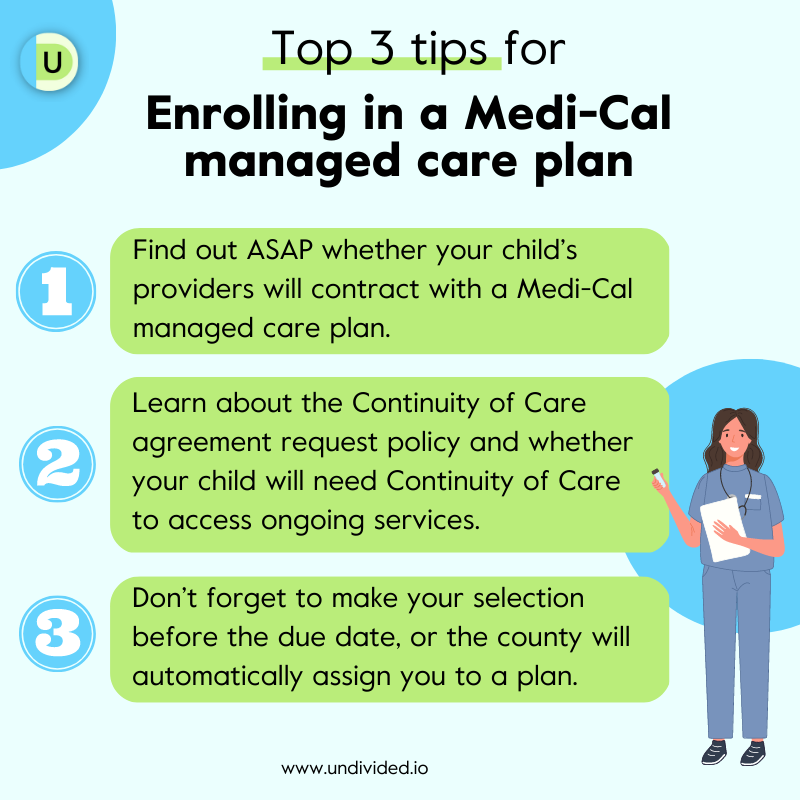
- Find out ASAP whether your child’s providers will contract with a Medi-Cal managed care plan.
- Familiarize yourself with Continuity of Care policies and criteria. Continuity of Care requests may be critical in ensuring that your child has access to ongoing treatment and services during the transition.
- Don’t forget to make your selection before the due date, or the county will automatically assign you to a plan, and it may not be the one you prefer. You can always switch to a different plan, but it’s easier to be proactive than to fix an unexpected enrollment. If you make any plan changes, it should be active by the following month.


Unlock more with Undivided
Turn knowledge into action that benefits your child
Get Membership


Author