

Updates to the California State Budget for 2026-2027

Update: June 30
On June 29, 2026, Governor Newsom signed the final budget bills that emerged from the previous week’s floor debate and a busy weekend of negotiations. The 2026-27 California state budget now includes a package of bills in addition to the already passed AB109 Budget Act of 2026. The State Senate and the Assembly approved the package, and Newsom signed it shortly after. Here's what's confirmed for families.
2026-27 state budget in brief
Regional Center governance
Regional Center Boards will now be required to have 17 members with professional experience, and their boards will have training on board responsibilities. DDS proposed ending the requirement that Regional Center boards consist of 50% parents of persons with developmental disabilities and 25% individuals eligible for Regional Center services, but this proposal was dropped.
The advisory group of people with lived experience will be required, and it will designate two of its members — plus one family member — to serve directly on the governing board. At least one of those representatives must also sit on the board’s recruitment and screening committee, giving families a formal role in helping decide who joins the board.
All board members must complete annual training on governance, ethics, Regional Center contract requirements, open meeting law, equity, and the Lanterman Act. Training materials must be in plain language, and individualized supports and accommodations must be provided to board members with disabilities. An anti-retaliation policy protecting board members and Regional Center employees is also required.
Each Regional Center must retain an attorney with at least five years of nonprofit or public entity experience by July 1, 2027. That attorney must be present at all board and executive committee meetings and advises on governance, conflicts of interest, open meeting requirements, and executive director contract compliance.
IHSS cuts rejected
Newsom had proposed cuts that would lead to many families losing their IHSS, but this was rejected by lawmakers. The Backup Provider program also survives.
Medi-Cal asset limit compromise
The governor’s proposal to reinstate the $2,000/$3,000 Medi-Cal asset limit was rejected. The current limit of $130,000 is maintained until July 1, 2027, and then it drops to $21,000 for individuals or $31,000 for couples starting July 1, 2027. This is still a problem for adults with disabilities who need to offload $10,000 to get married to each other, and it doesn’t come close to the savings someone would need to become a homeowner.
Self-Determination Program (SDP) Local Volunteer Advisory Committees
The Self-Determination Program has a pool of federal participation funding that DDS has historically used to fund Local Volunteer Advisory Committees (LVACs) to support independent facilitators, help build individual budgets, fund outreach to underserved communities, and cover Regional Center operations costs related to SDP. In 2026-27, it is funded using $4.3 million in old, unspent funds that were already allocated in a prior budget year for LVAC support. This means DDS has funds to support LVACs at roughly $1 million per year from 2026-27 through 2029-30, with up to $1 million a year after that.
DDS will use the flexible funding pool for standardized statewide SDP training, and local funds will be used for local community resource fairs providing information about the program. After June 30, 2030, continued funding depends on the legislature appropriating at least $1 million for these purposes. While DDS is pulling back the funding pool that used to support local SDP committees and outreach, this reappropriation is a lifeline that keeps LVACs activities specifically funded for several more years.
Historical investment in special education funding (AB 126) confirmed
The final package includes a $2.4 billion special education funding increase (43%), bringing SELPA equalization to $1,340 per ADA. This means that public schools will receive more state funding that can only be spent on IEP services, supports, and administration.
Given that about 15% of students have IEPs, it means around $8,933 per student with an IEP. That's because the district gets $1,340 for every student enrolled (general ed included), but this money exists to fund special education costs; when you divide the total pot by just the kids it's meant to serve, you get roughly $8,933 per student with disabilities. The actual money lands at the SELPA level and gets redistributed locally based on each SELPA's own formula, so individual districts' real per-student allocation varies, and none of this money is tied to the severity or cost of an individual child's IEP.
More key education investments in the final budget
AB 2526 (Muratsuchi) is a separate bill that expands California’s low-incidence special education funding. Currently, this funding is available for students with IEP eligibility categories of Visual Impairment, Deafness, and DeafBlindness. The new bill would add a new funding category for students who participate in the California Alternate Assessment. However, some advocates are worried that this new funding category could incentivize schools to move more students than necessary to the alternate assessment.
The final budget also includes:
- $60 million for the Extraordinary Costs Pool that school districts can access for high-needs students
- $16.2 million IDEA funds for special ed teacher training and the Golden State Teachers Grant to address the teacher shortage
- $1.2 million for monitoring out-of-state nonpublic schools
- At least $1.9 million for the Supporting Inclusive Practices project extended to June 30, 2027 to provide technical support for inclusive practices
- $25 million to support inclusive college programs for students with intellectual disabilities
- $10 million for the Sacramento County Office of Education to develop resources and provide technical assistance to support the implementation of alternative pathways and means to a high school diploma
In addition, the budget contains some big investments in education funding generally:
- $4.7 billion in Expanded Learning Opportunities (ELOP) is designated for after-school and summer school opportunities for high-needs kids
- The LCFF base is raised considerably with a 4.31% cost of living adjustment (COLA).
- Literacy coaches and reading specialists funding is extended to 2031.
- Teachers will be offered 14 weeks of maternity leave.
What happened to Prop 98 funding?
Proposition 98 is a rule that sets aside about 40% of California’s general fund revenue for schools and community colleges. Education advocates raised concerns about a $3.9 billion deferral of Prop 98 funds “until revenue materializes," as Governor Newsom described, a proposal strongly opposed by ACSA, CSBA, CTA, CFT, and California State PTA.
The legislators brokered compromise and now have a concrete repayment mechanism: the final deal appropriates 33% of any higher revenues collected between now and next May, after first covering increased Prop 98 and rainy day fund requirements, toward paying down all or part of the estimated $3.9 billion unpaid obligation to schools and community colleges for 2025-26. Any portion not retired through this mechanism would be addressed during the June 2027 budget process, and state law already requires payment in subsequent years once the 2025-26 guarantee is "certified" next summer.
What this means is that schools will get this funding (later) but only if the economy continues to flourish.
Who will oversee our schools?
California schools
AB 181 changes who oversees California’s public education system. Beginning January 15, 2027, the next governor will appoint a Senate-confirmed Director of Education to lead the California Department of Education (CDE), while the elected State Superintendent of Public Instruction will shift to an independent evaluation role. This change is likely to face legal challenges.
What parents need to know: for families navigating IEPs and special ed compliance, the CDE is an enforcement backstop. A shift to a governor-appointed director changes the political accountability structure, so the new director answers to the governor, not to voters. Special education monitoring, complaint resolution through the State Complaint Office, and implementation of the CAA and LRE policies all run through CDE. An appointed manager might run the department better because they aren't beholden to stakeholder support, but it's too early to know how this plays out. Families should be aware that the governance landscape is changing.
Early Start
Oversight of Part C early intervention school programs will be transferred from CDE to DDS. While Early Start services might not look different on the ground, it is an administrative change worth noting. New IDEA Part C to Part B transition requirements such as points of contact, family information, and preschool referrals are confirmed. Regional Centers will receive $15 million for the early intervention center-based rate model update.
The Department of Health Care Services budget includes $349 million to provide 22,770 new childcare slots to low-income families that may expand inclusive opportunities for early intervention.
Major changes coming to California Regional Centers
Regional Center funding is not cut, and there is additional funding:
- $3.5 million for HCBS Access Rule compliance — confirmed
- $1.5 million to clear the HCBA waiver waitlist — confirmed
In addition to the professionalization of their boards, a number of important reforms are introduced to change the way Regional Centers are run. Regional Center participants are now “individuals,” not “consumers” (AB 1575).
LOIS as the single unified statewide data system
The budget confirmed statutory language and $14.6 million for LOIS project continuation. AB 163 codifies LOIS as a formal enterprise system under state law. Beginning July 1, 2026, Regional Centers must notify DDS of any plans to connect third-party applications to participant, provider, financial, or operational data, and they cannot migrate their existing case management systems to any new platform without prior written DDS approval. DDS must submit quarterly written updates to legislative budget and policy committees, and to the LAO, covering cost estimates, planning expenditures, federal funding status, and governance plans.
Section 4731 complaint process
The trailer bill sets up a new grievance process that replaces Section 4731 for citizen complaints based on the Federal Access Rule, delayed to February 2027. The old Section 4731 complaint process will become inoperative on February 1, 2027, and is repealed January 1, 2028. Any 4731 complaint filed before February 1, 2027, continues under the old process. The new grievance system is now fully codified in Chapter 16 of the Welfare and Institutions Code (Sections 4890–4894). Note that this covers only Section 4731 complaints and not fair hearing appeals.
Key differences from the old process:
- Grievances are now filed with DDS first — not the Regional Center. DDS screens the submission within five days and routes it to the Regional Center. Submissions indicating serious harm get expedited referral.
- The Regional Center must assign a reviewer who was not involved in the original decision. The grievant receives a copy of their full case file within three business days, at no cost. The Regional Center has 60 days to produce a written resolution plan (extendable 14 days for documented good cause). If unsatisfied, the grievant has 15 days to request DDS review, and DDS has 21 days to respond. DDS may affirm the plan, send it back to the Regional Center with instructions, or require corrective action.
- DDS must annually review a sample of resolution plans from each Regional Center and post deidentified results publicly. Retaliation against grievants, witnesses, or anyone assisting in the process is explicitly prohibited.
- The new grievance process covers HCBS settings rule compliance issues and violations of rights under Welfare and Institutions Code Sections 4502, 4502.1, and 4503. It does not replace the fair hearing process for IPP and service disputes — those still go through the existing appeals procedure.
Standardization for Regional Centers
DDS is responsible for a standardized intake/needs assessment tool. AB 163 doesn't create a new assessment requirement — that was already required by law since January 2025. The trailer bill formally integrates the standardized intake process into the new LOIS case management system, with quarterly reporting on intake volume, outcomes, and timeliness now codified.
In addition, SDP will have standardized policies across Regional Centers by March 1, 2027.
There is a rate reform extension; the rulemaking deadline moved to December 2030.
Tailored day services and supported employment
Final AB 163 language allows supported employment services to be provided to individuals on the same day as tailored day services. It’s a small but meaningful change for transition-age youth and families pursuing employment alongside day programs.
Family Teaching Model distinct from Family Home Agencies
This gets its own service code. The Family Teaching Model (FTM) is a residential housing option for adults with developmental disabilities — it's not a teaching or educational program despite the name. FTM homes are small community residences (up to three people) where individuals with IDD live with shift-based paid staff who support their daily needs. The homes are owned by a housing developer organization, not by the care provider themselves. This distinguishes FTM from the better-known Family Home Agency (FHA) model, where a family essentially takes someone into their own home and lives with them.
FTM originated during the closures of developmental centers (like Fairview and Porterville) to house people transitioning out of institutional settings. It's been operating quietly under the Family Home Agency service code, which has caused data and billing confusion since the two models are quite different in structure and cost. The Trailer bill language gives FTM its own separate service code and rate, so Regional Centers can track it distinctly from FHA and pay providers more transparently. It also explicitly allows FTM homes to use Accessory Dwelling Units (ADUs), which is a practical expansion of housing options.
Supported living services overtime pay
AB 163 includes a new worker protection not mentioned in earlier budget summaries. Hourly workers providing supported living services to Regional Center participants are now entitled to overtime pay at 1.5 times their regular rate for all hours worked over 40 per workweek. This applies notwithstanding any federal Fair Labor Standards Act exemptions that might otherwise apply. This is a meaningful cost and capacity factor for families who use supported living services and for the providers who deliver them.
Remote delivery of services authorized
AB 163 authorizes remote delivery of certain Regional Center services through December 31, 2028, if the individual chooses it and the provider offers it. Services that may be delivered remotely include day programs, independent living programs, and behavioral therapy services. Remote administration of clinical assessments is prohibited when in-person administration is required for validity or reliability. The individual's choice to receive services remotely must be documented in the IPP.
DDS must report to the Legislature by February 1, 2028, on participant satisfaction, outcomes, social isolation risks, and fidelity of remote services. Beginning March 2027, DDS must provide quarterly updates to the Legislature on remote service utilization, broken down by Regional Center, service type, age, and rural versus urban settings.
Remote services are intended to expand options, not replace in-person services. The law explicitly states that authorization of remote services shall not result in reduction of access to in-person services or become a default choice.
Vendor physical location requirement eliminated
Effective January 1, 2027, Regional Center service providers are no longer required to maintain a physical location within a Regional Center's service area, unless the nature of the service requires it — such as licensed residential facilities. A provider must maintain a validated USPS business address within the geographic area of the Regional Center that initially approved them. This change removes a significant barrier for providers serving participants across multiple Regional Center catchment areas.
CARF accreditation replaced
AB 163 eliminates CARF accreditation as a requirement for work activity programs and supported employment programs vendored by Regional Centers. DDS must establish new state-developed service standards by September 1, 2027, in consultation with Regional Centers, providers, and stakeholders. From September 2026 through September 2027, DDS must provide quarterly legislative updates on progress toward establishing these standards.
Families and advocates will have an opportunity to shape these standards during the stakeholder process — watch for public comment opportunities in 2026 and 2027.
DDS and the Department of Rehabilitation (DOR) working together
The interagency agreement between DDS and the Department of Rehabilitation is now required by statute, due August 1, 2027. The goal is an integrated employment system by March 1, 2029, with community input including consultation with the Lived Experience Advisory Group, individuals and families, Regional Centers, SCDD, the State Rehabilitation Council, and legislative staff. DDS must post semiannual progress reports on its website beginning December 1, 2026.
DOR brought in more federal funding than expected due to rising demand for vocational rehabilitation services — more people are qualifying for and using DOR's job-placement, training, and employment-support services than the prior budget anticipated, so DOR needs permission to spend more of the federal vocational rehab dollars it receives.
Potential Medicaid cuts
Federal reconciliation bill shadow HR 1 Medicaid cuts are not in this state budget, but they loom over everything. The HCBA waiver, supported living, Regional Center services, and IHSS are all partially Medicaid-funded.
Sources:
Update: June 15
The short version: California legislators faced with today's deadline to pass a balanced budget voted for a package that avoids many of the disability community’s concerns. While the legislators approved Governor Newsom’s mechanism to defer payment for $3.9 billion for schools, they rejected many of the proposals that the disability community was worried about — the Medi-Cal asset limit reduction, IHSS cuts, and changes to the Regional Center process and governance. They also approved a historic investment in special education. Now, we watch to see if the governor will sign it.
Here are more details about the 2026-27 budget update.
Prop 98 shortfall: You will likely have heard from your school or other education advocacy organizations that the governor's May Revise Budget shortchanged our schools by $3.9 billion. The package passed by the legislature, AB 109, provides $2.7 billion more for schools and community colleges across 2025-26 and 2026-27 than the May Revision and sets out a schedule to pay districts the $3.9 billion omitted from the May Revision. The budget doesn't meet the constitutional Prop 98 guarantee, but it does make sure the payback is timely.
There is still a lot of money for special education — more than ever before!
- $2.4 billion for special education funding, which is a 43 percent increase above levels appropriated in the 2025 Budget Act.
- $60 million for the special education extraordinary costs pool, which districts can use for extreme expenses.
- $1.2 million federal Individuals with Disabilities Education Act (IDEA) funds and three positions to support increased state monitoring of out-of-state nonpublic schools.
- $16.2 million in federal IDEA funds on an ongoing basis to support special education teachers and $1.6 million in federal IDEA funds to support grants through the Golden State Teachers Grant Program, administered by the California Student Aid Commission to train more teachers to fill the chronic shortage.
- $4 million General Fund one-time for deferred maintenance projects at the State Special Schools.
There is also $4.7 billion for the Expanded Learning Opportunities Program (ELOP), guaranteeing a base rate of at least $1,800 for Tier 2 local educational agencies—possibly expanding opportunities for districts to develop inclusive ESY.
Overall, the education budget includes $438 million to provide a 4.31 percent cost of living adjustment (COLA) to apportionments. This is inclusive of the statutorily required 2.87 percent COLA ($292 million) as well as an additional 1.44 percent discretionary COLA ($146 million). What this means is that the base rate that funds all public schools is raised by 4.31% — all schools in California will receive an increase in general education funding in addition to the increased special education funds.
The Prop 98 shortfall allows the legislators to meet the balanced budget requirement today but, at the same time, reject many of the governor’s proposals that would have a significant impact on the non-education side of the budget.
The budget deal proposed by the legislature:
Rejected the Medi-Cal asset limit reduction to $2,000 — although the proposal includes a less drastic reduction. It maintains the current Medi-Cal asset limit test of $130,000 for a person ($195,000 for a couple) until July 1, 2027. It proposes to update the Medi-Cal asset limit test to $21,000 for a person ($31,000 for a couple) beginning July 1, 2027.
Rejected the IHSS cuts proposed by the governor.
It also includes:
- Reappropriation of unspent funds from prior years to support Local Volunteer Advisory Committees in the DDS Self-Determination Program (SDP) to allow approximately $4.3 million to support continued LVAC funding of $1 million per year for 2026-27 through 2029-30 and allow up to $1 million each year for LVACs thereafter.
- Increased federal fund authority for the Department of Rehabilitation (DOR) to meet increased demand for vocational rehabilitation services.
- $15 million ($12.4 million General Fund) for DDS to update the rate model for center-based early intervention services.
- $1.5 million General Fund to enable the Department of Health Care Services (DHCS) to clear the waitlist for the Home and Community-Based Alternatives (HCBA) Waiver.
- $25 million for the CDSS Housing and Disability Advocacy Program.
- $3.5 million ($3 million General Fund) to support the Department of Developmental Services (DDS) and Regional Centers to comply with new federal Home and Community-Based Services Access Rule requirements.
- $14.6 million ($5.7 million General Fund) for DDS to continue the Life Outcomes Improvement System project.
What happens next?
Now that the legislators passed their version of the budget, there will be serious negotiations to iron out the differences before the governor signs the budget before July 1, 2026.
Disability advocates are also closely watching the budget trailer bills, which are passed as part of a budget package and often contain small but important changes to the law.
For example, AB 1575, introduced by Assembly Member Arambula, changes the language in the Lanterman Act to reflect that participants in Regional Center Services do not have a commercial relationship with the Regional Centers. Instead of consumers, individuals will now be known as persons eligible for Regional Center services. In its original form, the bill clarified that respite services may be provided in and around the home and local community, but this was amended out of the final version, which is still waiting for a final vote.
Proposals from the budget trailer bills that would alter the makeup of Regional Center Boards do not appear in any of the trailer bills so far.
Update: May 28
IHSS cuts denied by California senators
On May 28, 2026, the Senate Budget and Fiscal Review Subcommittee No. 3 voted on the governor’s budget proposals. The committee rejected the proposal to reduce the Medi-Cal asset limit and rejected the cuts to IHSS in the proposed budget.
The Department of Health Care Services proposed to restore the asset limit of $2,000 for an individual ($3,000 for a couple) for seniors and persons with disabilities to qualify for Medi-Cal.
- The 2021 Budget Act increased the asset limit to $130,000 in January 2022 and eliminated the limit entirely in January 2024.
- The 2025 Budget Act restored the asset limit to $130,000 in January 2026.
- The proposed cut was estimated to save $278.3 million in 2026- 27 and $495.6 million annually thereafter.
California legislators announced on May 11 , 2026 that they would reject the proposed $323 million cuts in IHSS funding.
- The governor’s 2026-27 budget proposed shifting the state’s share of IHSS hours-per-case growth entirely to struggling counties, which would encourage counties to deny increased services. The cut would save $234 million starting in 2027-28, growing to $805 million in 2029-30.
- The governor also proposed aligning IHSS Residual with Medi-Cal termination timing, which would result in $86 million cut because many people failing to complete Medi-Cal determination every six months would then also lose IHSS.
- The budget also proposed defunding the IHSS Residual and Backup Provider System programs that provide continuity of care in case of lapse of Medi-Cal coverage or a regular caregiver becoming unavailable, which is proposed to save $3.5 million.
The legislators, lead by Assemblymember Dr. LaShae Sharp-Collins (District 79) in San Diego and Assemblymember Patrick Ahrens (District 26) in Silicon Valley, reminded the governor that IHSS services save money compared to institutionalized care. Watch their press conference online here.
The budget plans released by the majority party include the Road Map to a Responsible and Compassionate Budget in the Assembly and Foundation for the Future in the Senate rejecting the proposed IHSS cuts.
The Senate Budget and Fiscal Review Subcommittee No. 3 rejected all the cuts except for the alignment between IHSS and Medi-Cal, for which they are waiting on the trailer bill language to be updated.
Both houses must vote on all the budget items by June 15, 2026.
May 14: What's in the revised 2026-27 budget?
On May 14, 2026, Governor Newsom announced the May revisions to his proposed state budget from January, many of which impact children with disabilities. In this update, there is a lot of good news, but there are still some areas of concern.
Currently, the Assembly and Senate are reviewing these proposals and developing trailer bills to be passed containing the legal language that goes with the main budget bill in order to reform some government systems.
Note that these are proposals only; there is still time to contact your state Assemblymember or Senator and explain why your family might be affected by these changes — even the good ones! It is refreshing for them to hear words of thanks from our community.
The good news is that the state has a lot more money than expected. The May Revise includes $16.5 billion more than projected in January. But volatility is still an issue — California’s revenues still depend largely on taxes tied to the stock market and tech stocks, which could shift at any time and impact future revenue forecasts.
Good news to note: funding increases for schools, special education, and Regional Centers
The biggest good news is the budget for education. More money coming in means a substantial increase in the education funding guarantee in our state constitution, known as Prop 98. The state will distribute more money than ever before to public schools, community colleges, and CSU/UC universities. Newsom noted that per-student funding has increased by 66% during his eight years in office, reading $28,282 per student. But that money isn't distributed evenly, so we have to take a closer look at the details.
The revised Prop 98 Guarantee for TK-14 schools is now calculated to be $124.9 billion in 2024-25, $125.1 billion in 2025-26, and $127.1 billion in 2026-27, which increases the money for schools by $28 billion over the three-year period relative to the 2025 Budget Act, and approximately $6.4 billion more than the governor's January budget proposal. This money includes a hefty one-time increase in the base rate for state special education funding.
Since January’s proposal, there has been friction between the governor, who wants to defer a substantial amount of Prop 98 money, and the publicly funded schools and organizations that represent them, which argue that the money belongs rightfully to the schools and is needed now. That tension has been diffused as the new guaranteed level provides far more, and the Prop 98 mechanism itself requires substantial investment in the Prop 98 Rainy Day Fund. However, the May revision still withholds $3.9 billion that would otherwise go toward the Prop 98 Guarantee.
Within that debate, there were also many who were citing the increasing cost of special education. The May Revise contains a huge investment in special education funding, increasing the state’s dedicated special education funding by 43%! But how will the proposal actually impact children with disabilities and the services offered in your child’s IEP?
Kristin Wright, former California Director of Special Education, and Executive Director of Inclusive Practices at the Sacramento County Office of Education, told us:
“This budget reflects a growing recognition that inclusive education and strong supports for students with disabilities are essential investments in California’s future. As both a parent and a special education leader, I’m encouraged to see historic increases in special education funding alongside efforts to strengthen inclusion, early intervention, and educator preparation across the state. Bravo California!”
There is also good news for Regional Center participants — no cuts and a small increase in funding to cover the expected rise in eligible participants. While many families were concerned about possible cuts to Regional Center funding, we find ourselves celebrating the continued underfunding of the Lanterman Promise to support individuals with developmental disabilities in their community. The May Revision estimates that over 527,000 people in 2026-27 will receive services from the Regional Center under the Lanterman Act, and it includes a small increase for the Department of Developmental Services to $21.6 billion for 2026-27 ($13.5 billion in the General Fund).
Beyond funding, the budget also comes with “trailer bill language” that proposes changes to systems of accountability and distribution. We took a look at the proposed changes in the budget trailer bills as they are developing and some of the reactions from the disability community.
Top takeaways for parents:
- The education budget equalizes SELPA base funding for the first time since 1998 and increases special education funding by 43%. But it likely won’t lead to an increase in your child’s services.
- There are significant increases to public schools and funding for training and retaining teachers.
- Counties will bear the cost of any increases in IHSS, and since they determine eligibility and hours, they will have an incentive to keep costs from growing.
- The Regional Center budget is increased in line with the expected increase in participants.
- The Self-Determination Program budget is cut, but this doesn't mean your individual budget has to be cut.
- DDS is working on standardized policies and procedures for SDP across Regional Centers.
- Proposed changes to Regional Center governance disempower families and block them from Regional Center boards.
- Regional Center provider rate reform continues, but it will take longer.
- LOIS is a new statewide data system for Regional Center participants.
- There is a proposal for a new process for Section 4731 complaints when Regional Center clients’ rights are not upheld.
- There is major improvement in the transition from IDEA Part C, mainly provided by Regional Centers, to Part B, which is provided by the school district at age 3.

Proposed changes to Medi-Cal
The Medi-Cal budget is a challenge for California because of the ongoing cuts in federal Medicaid contributions and increasing federal restrictions on how the funds are used. The revised budget proposal includes $194.4 billion ($48.6 billion from the state General Fund) in 2025-26 and $216.7 billion ($44.9 billion from the General Fund) in 2026-27. Medi-Cal is projected to cover approximately 14.4 million Californians in 2025-26 and 13.9 million in 2026-27, more than one-third of the state’s population. There are two concerning proposals.
First, the governor is proposing to bring back the $2,000 ($3,000 for a couple) Medi-Cal asset test limits, effective July 1, 2027. This would effectively prevent adults with disabilities from saving money and could also discourage them from marrying due to stricter financial limits together. The state expects this proposal would save $278.3 million in 2026-27 and $495.6 million ongoing from Medi-Cal and IHSS because many individuals would no longer qualify.
Families may remember that the 2025 Budget Act also proposed this asset limit reinstatement, and many families contacted their legislators and successfully pushed for a more generous version instead. It looks like we have to fight this one again!
Second, to ensure Covered California health coverage for adults with unsatisfactory immigration status (aged 19–59), which often includes families who are in California lawfully working on an H1B visa, the monthly premium will increase from $30 to $50. The state estimates this change would save approximately $427.3 million in 2027-28, though it doesn't kick in until July 1, 2027.
Regional Center proposed changes
The budget now proposes an increase of $2.9 billion over 2025 levels for the Department of Developmental Services (DDS), which provides funding for Regional Center services. That is approximately $500 million more than proposed in January. However, this increase must also support a growing projected caseload, rising from 489,254 participants to 526,848 — that's 39,000 more individuals. DDS will save $8.1 million by shutting down the last State Developmental Center at Fairview. They also believe that they can save $22.5 million through changes to the Self-Determination Program.
The May Revision also proposes a $15 million increase to enable DDS to update the current rate model for early intervention services delivered outside the home. DDS is also tasked with developing a standardized intake process and statewide clinical needs assessment tool for use across Regional Centers, with a goal of promoting consistency and improving equity regardless of where an individual lives, with direct funding allocated to these reforms.
There is also a proposed $1.1 million increase to address increased workload at Regional Centers associated with the implementing the federal Home and Community-Based Services (HBCS) requirements. This funding would be used to update the Federal Access Rule's new grievance process, which will be implemented in February 2027. We take a closer look at this new process below.
There are also some concerning proposals in the trailer bills associated with this year’s budget that change the way that Regional Centers are run. We took a closer look at these proposals to identify ways that children and young adults with disabilities might be impacted.
Regional Center participants are now “individuals.”
The trailer bill language strikes out the word “consumer” in the Welfare Code that governs Regional Center and replaces it with "individual" throughout. It is a technical change and is seen as a person-first language cleanup. Previously, 1992 amendments to the Lanterman Act changed participants in the Regional Center system from “clients” to “consumers.”
Self-Determination Program funding cut
The 2025 Budget Bill contained a reduction in planned funding for the Self-Determination Program funding by $45 million. This is equivalent to a cut of 12% in each participant’s current budget, according to Disability Voices United. However, the budget and the trailer bills do not explain the plan to cut SDP costs, other than the expected growth in new participants is not manifesting itself. There are no current proposals that change the way that your individual budget should be determined or what SDP can cover.
What parents need to know: Regional Centers have not been asked to cut everyone’s individual SDP budget. As your child grows, their needs change, and the budget should change with them. However, expect the possibility for Regional Centers to cut any unused budget, review large cost items, and seek to lower costs by looking for generic services (services from other providers such as health insurance, the school district, or non-profits).
The matching trailer bill language doesn’t give us a lot of clues about where the cuts might come from. The SDP framework stays largely intact.
Change to federal financial participation funds
The only substantial change to the SDP budget is in how the federal financial participation (FFP) funds generated by SDP participants are used. Currently, they first go to offset DDS's administrative costs such as criminal background checks. The remaining funds go into a pool that DDS uses flexibly to support independent facilitators, help build individual budgets, fund outreach to underserved communities, and cover Regional Center operations costs related to SDP. If this trailer bill passes, all the FFP funds would only be used to cover DDS's administrative costs. There will be no funding allocated to the local SDP committees. Whatever is left over stays with the state.
What parents need to know: Eliminating the flexible funding pool is a quiet but meaningful cut. It won‘t necessarily end spending on independent facilitators for initial planning meetings, local SDP committees, and outreach to communities that are underrepresented in SDP enrollment, but those programs will depend on the Regional Center making funding decisions.
DDS standardization in 2026-27
DDS is required to establish standardized statewide processes and procedures by March 1, 2027, covering enrollment, individual budgets, spending plans, financial management services, and access to transition supports. The goal is to address a longstanding challenge with SDP implementation: access and processes can vary significantly from one Regional Center to another, meaning families in some areas face more barriers than others.
Many advocates have pushed for greater consistency across the state, arguing that services and supports should not depend on where a person lives. Standardized procedures could help reduce regional disparities and create clearer expectations for families navigating the program. At the same time, some advocates caution that consistency alone does not guarantee equity. They note that the impact of standardization will depend largely on how the standards are developed and who is involved in shaping them. Without inclusive assessment and eligibility practices that reflect the diverse ways disabilities present and are experienced, there is concern that statewide consistency could reinforce existing barriers rather than eliminate them. There is also concern that any standardization will make the system less individualized.
Watch for the DDS stakeholder process on those standards opening in 2026, when there will be a 45-day public comment period before anything is finalized.
Also, note that the SCDD has already taken over providing SDP orientation for all new families statewide.
Regional Center oversight and board governance
Trailer bill language proposes significant changes to how Regional Center boards are structured and governed, with a push toward “professionalized” boards. Disability Rights California warns that this could undermine the inclusion of people with developmental disabilities or their family members in decision-making, a core value at the heart of the original Lanterman Act. The language proposed no longer requires that 50% of board members be individuals served by the Regional Center or their families, and it proposes credential requirements that could exclude self-advocates and families from historically underserved communities.
What parents need to know: The new language no longer requires any representation from Regional Center participants or their families and instead requires that they have expertise in the practice of law, management, board governance (beyond being in the Regional Center board), financial and developmental disability programs, and at least three years of service or program administration beyond personal or family lived experience with a developmental disability. This will privilege individuals who serve participants rather than those with lived experience.
Provider rate reform
DDS sets rates that Regional Centers are allowed to reimburse service providers — companies or non-profits that provide job coaching, day programs, supported living, and personal care. For a long time, the rates were too low for providers to pay their workers decent wages, so good workers left, especially in areas of the state with a high cost of living. Additionally, in some cases, two providers doing the exact same job in the same city might get paid totally different amounts, and there was no connection between pay rates and performance. Often, no one asked participants if they liked their provider.
In 2016, after a tsunami of advocacy from many organisations, California agreed to fund a study aimed at identifying fixes for the broken system. The study, done in 2019, established what fair pay should look like. The fair pay proposal has been implemented gradually from 2022 until January 2025, but only at 90% — the remaining 10% was tied to quality measures to ensure that the services provided made participants’ lives better, but only if the provider was not already receiving the higher rate.
The quality improvement bonus measures outcomes such as:
- Are consumers happy with their services?
- Are outcomes equitable across different groups?
Is the quality actually improving?
The higher rate must go to increasing wages for the worker, not to administrative costs.
January 1, 2025, was the target date for full rate model implementation. The trailer bill language for 2026 contains two concrete alterations but does not change the rate structure itself:
The rulemaking deadline is extended from June 30, 2028 to December 31, 2030. That means the department can keep running the program through written directives and informal instructions for longer before having to go through the full formal rulemaking process.
Contracting exemptions are extended. Procurement contracts were exempt from normal state purchasing rules "operative through December 31, 2030." This exemption language is extended to cover Section 4519.11 and the biennial rate model review process going forward.
This proposal will give DDS more runway to operate informally before locking everything into permanent regulations, which gives DDS more flexibility.
What parents need to know: Families and advocates should keep watching for how quality measures get defined in practice rather than waiting for formal rulemaking to nail things down, in both traditional and SDP services. Regional Center coordinators may be looking for positive quality indicators in order to ensure bonus payments and fair pay are made.
LOIS: Data and case management systems
A major state technology project — the Life Outcomes Improvement System (LOIS) — is already underway. Right now, California's 21 Regional Centers each run their own case management and financial information technology systems. Some use SANDIS, some use Virtual Chart, SmartChart, KEA, Atlas, Atticus, or other platforms. This means the data infrastructure behind Regional Center services is fragmented — different systems, different data formats, inconsistent reporting, and significant cost in maintaining parallel systems across the state. LOIS is the state's effort to replace all of that with a single unified platform.
The proposed trailer bill language gives LOIS a legal foundation and sets the rules for the transition period. Starting July 1, 2026, Regional Centers must notify DDS of any plans to connect third-party applications to their data, cannot migrate their existing systems to any new platform other than LOIS without written state approval, and must prioritize data cleanup to prepare for the switch. Once LOIS is ready, Regional Centers must shut down all other systems and move fully to LOIS.
LOIS is designed so that individuals, families, and service providers can access and update their own information directly. That's a meaningful shift — currently, getting information out of RC case management systems is often opaque and cumbersome for families. A unified system also means your child's records should be consistent regardless of which Regional Center serves you, which matters enormously for families who move between catchment areas.
The more important long-term implication is data. A single statewide system means DDS will have real-time, consistent data on services, spending, and outcomes across all 21 Regional Centers — something that doesn't exist today. That has significant implications for oversight, for identifying disparate outcomes by race and ethnicity, and for policymaking. Advocates and legislators will have access to information that has historically been difficult to compile or compare.
What parents should know: Data is valuable and, once collected, can be misused. Families and advocates should watch the implementation closely, particularly around data privacy protections and what access rights individuals and families will actually have to their own records in the new system. LOIS is infrastructure; it doesn't change who is eligible for services or what services are available. But infrastructure shapes experience, and a well-implemented unified system could meaningfully improve consistency, transparency, and family access to information across the entire Regional Center network.
Federal access rule and grievance process reform
The trailer bill language proposes overhauling the Section 4731 complaint process for Regional Center clients to better align with the federal HCBS final rule for Medicaid-funded services. The new process would route grievances through DDS first, then to Regional Centers for local resolution. The budget proposes $2.4 million to DDS to enforce the ruling.
While the proposal will mainly impact adults, children with IDD who receive Regional Center-funded services — such as behavioral supports, respite care, day programs, or supported living — in community settings are covered by the HCBS Settings Rule if those services are funded by Medicaid. If those settings don’t meet the “home and community-based” standards (integrated, non-institutional, with autonomy and rights protections), families can file a complaint.
Currently, if a Regional Center client or their family believes a right was violated — a service was withheld, denied, or mishandled — they file a complaint directly with the Regional Center director, who has 20 working days to respond. If unsatisfied, the family escalates to the state, which has 45 days to issue a decision. This system has existed for decades.
This bill retires that process for any grievance filed on or after July 1, 2026, and replaces it with a new system under a brand-new Chapter 16 of the Welfare and Institutions Code.

What parents need to know: This grievance process is for rights violations and HCBS setting compliance issues — things like your child being denied rights under the Welfare Code WIC §4502-4503, or a provider operating in a setting that doesn't meet federal community-based requirements. It does NOT replace the fair hearing process for IPP disputes and disagreements over what services go in the plan. Those still go through the existing appeals procedure.
The most important shift is where you start. Under the old system, you went directly to the Regional Center. Under the new system, you go to the state first — the Department of Developmental Services receives your grievance and then routes it. This creates a paper trail at the state level from day one, which is a meaningful structural change.
Several new family protections are embedded in the bill:
- Priority review applies when there is a risk of serious harm to your child. That's a new escalation pathway that didn't exist in the old complaint system.
- You have the right to your child's full case file within three business days of filing — at no cost. This is significant because families often struggle to get documentation during disputes.
- The Regional Center must assign someone to review your grievance who was not involved in the original decision. That reviewer has to give you a genuine opportunity to present your case — face-to-face (including by video), or in writing. You're not just submitting a form and waiting.
- If you receive a resolution plan you're not satisfied with, you have seven days to request state-level review. The state then has 21 days to make a determination — faster than the old 45-day window.
- Retaliation is explicitly prohibited. The Regional Center cannot take any punitive or threatening action against you for filing.
New public dashboard
DDS will be required to publicly post annual data on grievance outcomes on a new public dashboard, including how many were filed, how long RCs took to respond, how many families requested state review, and what percentage were resolved in favor of the family vs. the RC. DDS has to review a sample of resolution plans annually, look for systemic problems at specific RCs, and fix them.
However, the bill allows DDS to move through written directives rather than full rulemaking, which is faster but also less public. Disability Rights California raises significant concerns that, as drafted, the proposal lacks teeth; it doesn’t clearly require meaningful remedies, make-whole relief when harm occurs, or strong DDS enforcement when Regional Centers fail to resolve complaints adequately.
Department of Rehabilitation (DOR) and DDS working together
DOR funds services to help individuals with disabilities find long-term employment, often termed vocational rehab. DOR and Regional Centers operate in parallel. An adult with a developmental disability often has to navigate both systems separately, with separate vendorization, separate funding streams, and handoffs between agencies that create gaps in service.
This trailer bill language requires DDS and DOR to develop a formal interagency agreement by August 2027, and then build an integrated employment services system by March 2029. The goals are explicit: uninterrupted services, fewer handoffs, and faster access to competitive integrated employment. The proposal is to create a “no wrong door” model for people with IDD seeking employment. Disability Rights California strongly supports this.
For a young adult transitioning out of school and into employment services, the current experience can look like this: Regional Center refers to DOR, DOR opens a case, there's a waiting period, funding questions arise, and the person falls through a gap or loses momentum. This bill is a direct attempt to fix that by requiring a unified path — one vendorization process for providers, clear funding obligations between the two agencies, and services that feel seamless regardless of which agency is technically paying.
What families need to know: The timeline is long — the full integrated system isn't due until 2029 — but the proposed law requires DDS to post public progress reports every six months starting December 2026, which creates some accountability.
Accreditation changes for supported employment
The same trailer bill language proposes an accreditation change that will impact job coaches and supported employment coaches. Right now, work activity programs and supported employment programs that serve Regional Center clients are required to be accredited by the Commission on Accreditation of Rehabilitation Facilities (CARF), a national independent standards body. This bill tasks DDS with creating state-developed service standards in consultation with Regional Centers, providers, and other stakeholders by September 1, 2027.
What families need to know: CARF compliance has been a barrier to vendorization for some programs, particularly smaller or newer ones, but their accreditation program is a national benchmark. Removing CARF as a requirement could lower the floor for what programs have to demonstrate. Whether the new DDS standards end up being stronger, weaker, or equivalent to CARF will depend entirely on what the department develops — and families and advocates will have an opportunity to weigh in during that stakeholder process.
IDEA early intervention transition (Part C to Part B)
Many children with disabilities qualify for IDEA under Part C for infants and toddlers. When a child turns 3 years old, there is a transition from early intervention services (Part C, birth to age 3, mostly administered through Regional Centers) to preschool special education services (Part B, administered through school districts). Coordination between Regional Centers and school districts is inconsistent, and families frequently fall through the gap as Regional Center services end, the school district isn't ready, and the child loses services right at a developmentally critical moment.
This transition is one of the most stressful and confusing for families of young children to face, and this trailer bill language is a direct attempt to make it less chaotic. It requires a formal interagency agreement between DDS and the Department of Education specifically focused on the Part C to Part B transition.
Regional Centers and local school districts (LEAs) are now each required to designate a named point of contact responsible for coordinating that transition. Regional Centers are given responsibility for assessing toddlers aging out of Part C who may be eligible for a California state preschool program and make a referral.
The bill also requires that families receive specific, standardized information:
- The difference between Part B and Part C services
- Local Part B programs available in their community
- Options after age 3
- The process and timeline for transition
DDS is authorized to issue directives to both Regional Centers and LEAs to implement these provisions while regulations are being developed, with a deadline of June 30, 2029 for final regulations.
What parents need to know: If your child is under age 3 and receiving Regional Center early intervention services, you should be provided this information and dedicated points of contact.
The new preschool referral requirement from Regional Centers is particularly significant; it creates a pathway to general education preschool settings that previously depended entirely on whether an individual service coordinator happened to raise it. It's not a new entitlement, and it doesn't change who is eligible for what.
In-Home Supportive Services (IHSS) costs and potential cuts
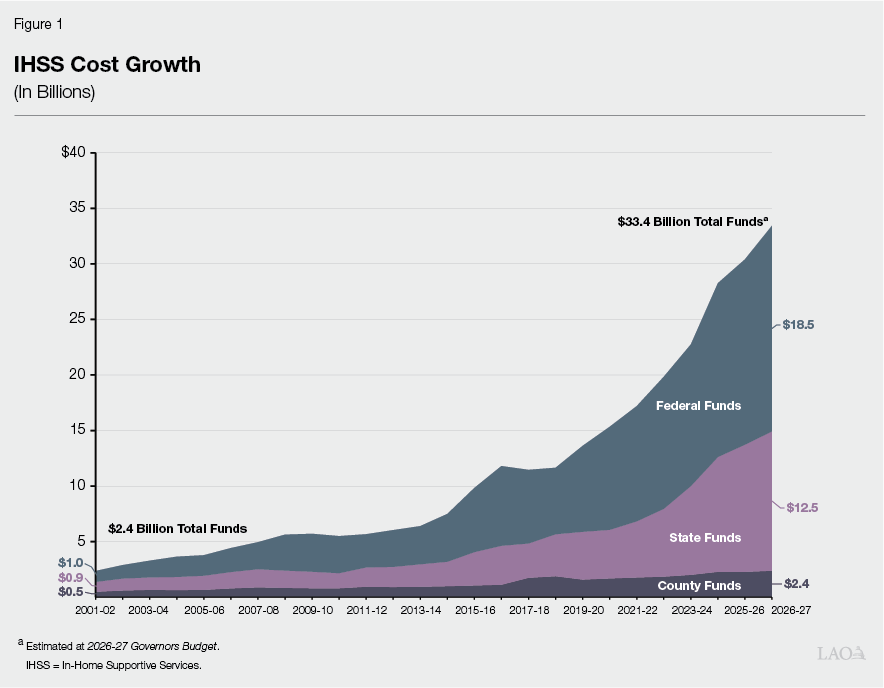
IHSS costs have been rising dramatically. The state is actively seeking to get the costs under control, although it is evident that IHSS is far cheaper than institutionalization. HR 1 removed some individuals from Medi-Cal and, therefore, from IHSS, but the changes aren’t all about federal funding. The state has seen a huge increase in IHSS costs over several years, and they are worried it’s going to keep going up.
The May Revision includes $33.7 billion ($12.7 billion from the state’s General Fund) for the IHSS program in 2026-27. There is an increase of $30.8 million in 2026-27 to adjust IHSS to the federal restrictions on how Medi-Cal is used.
The proposed reintroduction of the strict Medi-Cal asset test limits for seniors and disabled adults ($2,000 for an individual or $3,000 for a couple) will be effective on January 1, 2027, and is expected to save money for both Medi-Cal and IHSS by rendering some individuals ineligible. Note that individuals with disabilities can save money in an ABLE account that is not subject to the asset limit test.
Source: LAO
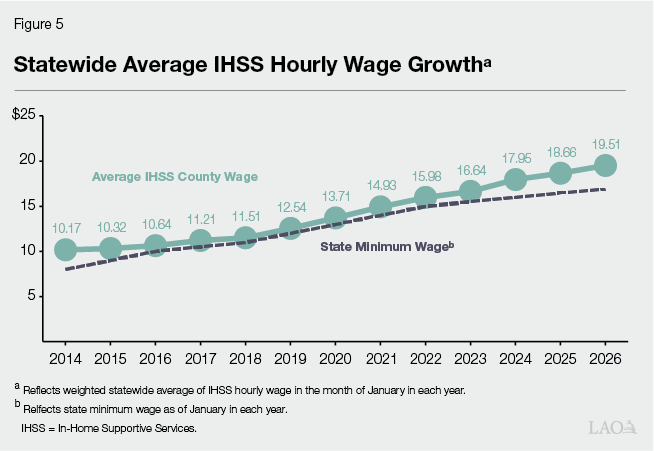
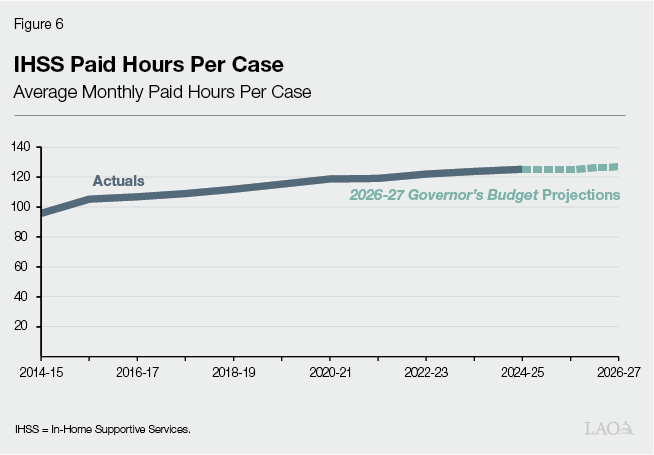
The Legislative Analyst’s Office (LAO) made a report showing three main drivers of the increased costs:
- The number of IHSS cases (caseload) is increasing; it’s been variable for many years, and it’s now at 10%.
- The cost of each hour of care has gone up steadily and in proportion to minimum wages in California.
- The number of hours that an average case gets has increased by around 2% annually.
Overall, the LAO calculated that roughly 50 percent of the growth is due to caseload growth, 40 percent is due to cost per hour growth, and 10 percent is due to hours per case growth.
 Source: LAO
Exacerbating the huge increase was a 2019 agreement between the state and the counties that administer IHSS: as the federal government was reducing costs, the state would provide the increased costs. However, the cost is not necessarily from federal cuts, and the balance between state and county is causing friction.
For this reason, the state proposal to lower the cost of IHSS falls principally on restoring the county’s responsibility to pay for IHSS and, therefore, to fund increased costs. The state is relying on the counties that make the assessments and determinations for IHSS to be incentivized to deny hours to families, thereby reducing costs or at least preventing them from accelerating.
The proposal also eliminates the Back Up Provider program that may affect some families.
What parents need to know: County IHSS offices could be looking for ways to deny eligible families. Make sure you prep for your assessment so that you can accurately convey your child's support needs.
Prepare for my child's annual In-Home Supportive Services (IHSS) home visit
California Department of Education proposed changes
Major changes are underway in the governance of public education, focusing on the role of the State Superintendent of Public Instruction. Over many decades, we have seen initiatives from the governor or the State Board of Education with weak implementation from the CDE. The proposal seeks to align and coordinate these two centers of policymaking for more effective reform. The May Revise includes $1.5 million of non-Proposition 98 money in 2026-27, growing to $3 million beginning in 2027-28, redirected from the Department of Education to the new Office of the Superintendent of Public Instruction.
Proposal to defer funding for K-14 schools
Prop 98, passed in 1988, requires the state government to allocate a percentage of its revenue each year to education spending based on a complex formula — around 40%. In January, the governor proposed withholding some of this money ($5.6 million) until another year. A large coalition of education advocacy organizations, including California Association of School Administrators (ACSA), California School Boards Association (CSBA), California Teachers Association (CTA), California Federation of Teachers (CFT), and California State PTA, spoke out against this proposal, saying that the schools need the money now.
The state of the economy is a big unknown, which means that the amount Prop 98 guarantees is always an estimate. The May Revision greatly increases the estimated total revenue, so even though the Governor still plans to hold back $3.9 billion, the schools are getting more money than they expected, and more than ever before. A major downturn could reduce revenues by tens of billions of dollars — reducing the guarantee by about 40 cents for each $1 of lower revenue. The state has to “settle up” if it gives schools too little but does not get the money back if it gives them too much.
The increased projected revenues determine an increase in funding, which must continue at 40% even if fewer kids are enrolled in our California public school system. The Local Cost Funding Formula (LCFF) determines how much each school district or charter school gets from the state. The state determines a base rate and then allocates funding based on average daily attendance, unless a district already gets more from its property taxes.
The increase in expected revenues allows the governor to propose several increases to the money schools receive through LCFF. First, there is a 2.87% cost-of-living adjustment (COLA), which is an increase in the base rate triggered by inflation and the rising cost of living. This means schools are getting an additional $1.3 billion in discretionary funds that they determine how to spend. The May Revision also includes $906.7 million for a discretionary investment, commonly referred to as a "super COLA," resulting in a total (statutory plus discretionary) COLA of 4.31%. This means that the budget this year will raise the base rate for schools, which will substantially support all public schools and also reflect in supplementary and concentration funding for schools with high needs students.
What parents need to know: Many schools are experiencing funding cuts because their main funding is based on kids attending, so falls in enrollment and attendance cost a lot of money. Some school districts that do not have a lot of high-needs students felt that the base rate funding left them with inadequate resources. Since roughly 60% of the money to pay for special education comes from the school district’s general fund, some schools are looking to cut the cost of special education just because money is so tight.
Within all this good news there is one concern: the May Revise reduces the cost-of-living adjustment for the California State Preschool Program from 2.41% proposed in January to 2.0%, in alignment with other childcare and development programs. The program provides state preschools that often allow students in the IDEA Part B age 3-5 program to utilize these programs for inclusive settings.
Proposal to equalize state funding for special education
Most importantly for our community, the May Revise proposes an ongoing special education base rate investment of $1.8 billion in addition to the $509 million special education funding proposed in January. It's a whopping 43% increase in special education funding, nearly a $2.4 billion increase in special education funding over the 2025 budget.
This will take the form of a base rate increase to AB602 funding. This funding is distributed to SELPA based on Average Daily Attendance (ADA), regardless of the number or type of IEPs. There are extra funds for low-incidence funding. This will take the funding from $999 per ADA to $1,340. Each SELPA’s local formula will then determine how this money is distributed locally. However, if you consider that only around 15% of students have an IEP, it works out to over $9,000 per student with an IEP.
Dr. Scott Turner, Co-Executive Director of the California Early Childhood Special Education Network (CalECSE), says:
“This proposal not only addresses longstanding funding inequities, but also provides critical relief to local educational agencies that continue to shoulder significant special education costs. By reducing pressure on local general funds, Local Education Agencies will have greater capacity to expand programs, supports, and inclusive practices that benefit all students, including students with disabilities. The May Revision reflects a strong commitment to educational equity, student success, and improved outcomes statewide.”
The May Revision includes a one-time increase of $25 million for the Inclusive College Technical Assistance Center.
That’s a substantial increase to special education funding, but you may not see increases to your child’s IEP or the money your district is spending. Currently, the difference is made up by your school district shifting funds from general to restricted funds. This funding may just reduce the need to do so, boosting discretionary funds for all students.
The state special education funding stream, which was created by law AB602 in 1997, does not come close to meeting the actual cost of special education; typically, it has met around 30-40% of the cost. Federal funding provides around 10%, while typically 50-60% is taken from local funding that is made up of local property taxes and state funding based on the LCFF formula. Notably, special education funding in California is allocated based on ADA without reference to the number or type of IEPs in the district. This additional funding will allow for full equalization of special education rates across the state, meaning that all LEAs will now receive the same rate per pupil for state special education funding.
When AB602 was implemented in 1998, each SELPA received money based on the number of special education classrooms or programs they had. To ease the new system in, the law set out different rates for each SELPA, which would gradually increase over time until they were equal. But for more than a decade, there were no increases. In 2020, a West Ed study found the base rate differed ranging from $550 to $980.
Governor Newsom started to increase the base rate each year so that in 2025-2026, all SELPAs received $918 per ADA (except one that received $999). Since 2018-19, the funding has increased by $4.5 billion, or 237%, and has included investments in more intervention-focused special education programs, including early intervention for pre-K and kindergarten students, to improve student outcomes.
To put this into perspective, the average expenditure in California per public school student in the 2024-25 school year was $21,214 per ADA. Of that, $2,981 per ADA was spent on special education instruction and far more on administration, so an increase to $1,340 per ADA is useful but will most likely just reduce the amount the district has to take out of the general fund to make up the difference.
There is also a bill being proposed, AB 2526 (Muratsuchi), that will apply additional funding to students who are eligible for the California Alternative Assessment. That might well be a useful way of giving districts a small incentive to pay attention to students with extensive support needs, but given that the state is required by federal law to limit the alternative assessment to 1% of students, there are concerns that this could lead to overuse of this assessment.
Funding for Supporting Innovative Practices project
The $15 million already appropriated to the Riverside County and El Dorado County Offices of Education for their Supporting Innovative Practices (SIP) project — which provides tiered technical assistance and grants to LEAs to increase inclusion of students with disabilities in general education — is extended from June 30, 2026 to June 30, 2027. There is also a bill, AB2468 (Patel), proposing changes to SIP, locating them within the California Collaborative for Educational Excellence rather than in the California Department of Education, in order to have greater system impact in the state system of support.
Notably, the May Revise notes that currently, family empowerment centers and SIP are supported with the IDEA funds, but these programs are being shifted to the ongoing Proposition 98 General Fund to allow the IDEA funds to be used for training special education teachers.
Training and retaining teachers
One of the biggest impacts on public education, and especially special education, is the shortage of trained teachers. We need to train more teachers, especially education specialists (special education teachers), and we need to keep them happier so they don’t keep leaving the profession. The May Revise contains several proposed ideas to make this happen:
- There is $5 billion for a Student Support and Professional Development Discretionary Block Grant. The funds can be used by local educational agencies for professional development for TK-3 teachers and elementary schools, especially on the English Language Arts/English Language Development (ELA/ELD) Framework and the Literacy Roadmap, with a focus on strategies to support literacy for English learners, and the Mathematics Framework.
- Teachers will now get 14 weeks of paid pregnancy leave, which has to be covered by the 1.4% LCFF COLA.
- There is $30 million in one-time Proposition 98 funding for the statewide teacher residency technical assistance center to support local educational agencies in implementing, expanding, and sustaining teacher residency programs; National Board for Professional Teaching Standards certification incentive programs; and other grow-your-own educator preparation programs through 2034.
- There are $16.2 million ongoing federal special education (IDEA) funds and $1.6 million one-time federal Title II funds allocated to continue the Golden State Teacher Grant Program (GSTG).
- A $15 million one-time Proposition 98 General Fund to expand and enhance offerings through the 21st Century California School Leadership Academy (21CSLA) program for school leaders — a no-cost, high-quality professional learning to support California’s education leaders and administrators in improving student outcomes and implementing initiatives like UTK.
- The May Revision includes a one-time increase of $428.8 million to extend funding for the Literacy Coaches and Reading Specialists Grant Program for all grantees until June 30, 2031. There is $11.2 million for the Literacy Coaches and Reading Specialists Educator Training Competitive Grant, which provides training and support to new and existing literacy coaches.
- For math, the 2025 Budget Act included $30 million for the Mathematics Professional Learning Partnership to support educator training and mathematics coaching across the state, with a prioritization for rural and high-need schools. The May Revision proposes an additional $60 million in one-time funds to extend its impact beyond its current expiration date of June 30, 2029.
There is $5 million in ongoing funding for the Multitudes Literacy Screener. The Sacramento County Office of Education, in partnership with the UC San Francisco Dyslexia Center, developed the Multitudes screener, which can be used statewide at no cost to schools. This funding will enable Multitudes to expand the number of languages supported by the screener.
Community schools
There is a one-time increase of $50 million in support for the state’s Multi-Tiered Systems of Support (MTSS) framework as part of the state’s community schools initiative. MTSS focuses on aligning initiatives and resources within an educational organization to address the needs of all students. Community schools take a whole-child approach by addressing non-academic barriers to learning. These are public schools that act as neighborhood hubs, partnering with families and local organizations to provide "wraparound" support for students, such as health care, food insecurity, and family instability.
Conclusion
There is a lot of good news here, but there are also indications of a move away from accountability and the inclusion of individuals with disabilities, and their parents, from the system. While there is a lot of new funding here, it might not be sustained in a down-trending economy, so we can’t ignore the details, especially where we find the erosion of participation and accountability hidden in the weeds.
Sources:


Unlock more with Undivided
Turn knowledge into action that benefits your child
Get Membership


Author