

Sensory Rooms and Spaces at School
If you've already read our article Tips for Creating a Sensory-Friendly Home, you know that building a sensory-supportive space is less about one dedicated room and more about the environment, intention, and people that surround a child every day. The same is true (perhaps, even more so) when we step outside the front door and head to school.
For many children with sensory sensitivities, the home is the one environment that parents have real control over. However, beyond that, places like school can sometimes feel like a different story. It's louder, less predictable, there’s unexpected fire drills, field trips, buzzing fluorescent lights, and all of it is governed by schedules, expectations, and institutions that weren't always designed with sensory-sensitive children in mind.
To help us navigate what a sensory-friendly space at school should look like, what to look out for, and other alternatives to sensory triggers, we spoke with Guy Stephens, founder and executive director of the Alliance Against Seclusion and Restraint and father of an autistic son, who has spent years working at the intersection of school policy, disability rights, and the neuroscience of behavior. And we'll be weaving in guidance from Kelli Smith, MOTR/L, founder and owner of Abundance Therapies, and Beatrice Tokayer, founder of a sensory-informed BRT Interior Design company and mom of three boys with ADHD, to find out.
How to use sensory-friendly spaces proactively
When a sensory space is used proactively, it becomes part of a child's regulation toolkit. This can look like them taking a voluntary break before a difficult transition, a few minutes of vestibular input before a task that requires sustained attention, or a quiet decompression window after lunch in a loud cafeteria. When it's used only reactively, Stephens notes that staff often describe it primarily as “where we take kids when they're having a hard time.” Which means that it's most likely functioning more as a crisis response than being supportive. And that distinction matters because a reactive space is rarely preventing dysregulation.
The same principle of sensory spaces being used proactively plays a major difference in a sensory space being used reactively. A proactive approach anticipates the need before dysregulation sets in by building movement breaks, vestibular input, and quiet decompression into the rhythm of the day rather than reaching for them only when a child is already struggling.
Smith builds sensory input directly into the daily schedule — even for children who resist it. A child who says “I'm good” and would rather skip the trampoline might still be guided through ten jumps, not as a punishment or a demand, but as a proactive reset. “You might, amazingly, just feel super energized after those ten jumps,” she explains. “We are giving that alert to your system to wake up.”
Stephens touches more on the proactive approach to sensory spaces in this video:
Sensory-friendly rooms at school
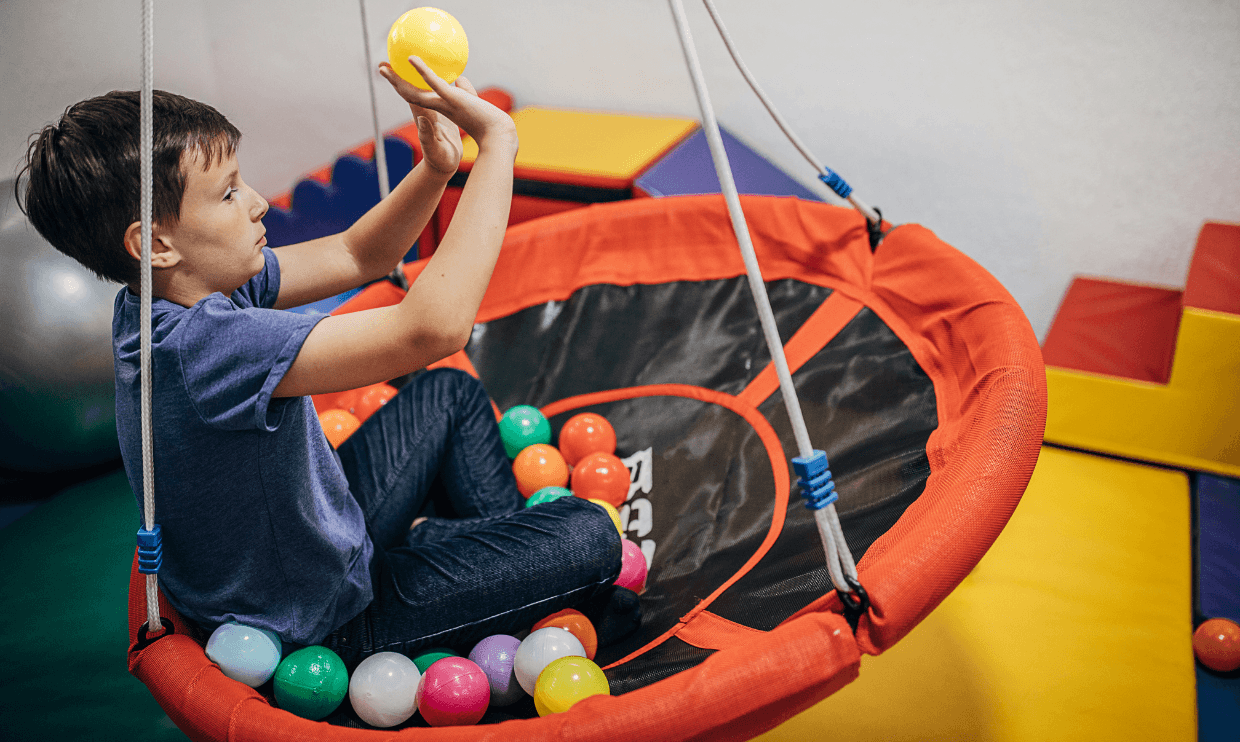
When you walk into a truly sensory-friendly school space, something shifts. It doesn't look like a timeout room. It doesn't look like an empty room with a bean bag shoved in the corner, a padded closet, or a cinder block room with nothing in it. It feels like an oasis — a genuine pause from the noise, movement, and demands of the school day for children whose nervous systems are working overtime just to keep up.
According to our experts, a well-designed sensory room should look intentional. It should look like someone thought carefully about who would be using it and what their nervous system needs. That means accounting for the full range of sensory profiles walking through the door: the child who needs to move, crash, and seek input, and the child who needs to decompress, dim the lights, and block out the noise. A space that only serves one of those needs is only doing half the job.
If you've read our Tips for Creating a Sensory-Friendly Home, some of this will feel familiar. The same foundational principles in making a space sensory-friendly apply in a school setting, and while there's no universal formula for every school, every budget, or every student population, Smith and Tokayer point to a few characteristics that show up in spaces that genuinely work:
Soft and adjustable lighting: harsh overhead fluorescent lighting — the kind found in most school buildings — is one of the most common and overlooked sources of sensory overload. A truly sensory-friendly space offers softer, warmer lighting or the ability to dim as needed.
A calm color palette: shared spaces should be muted and intentional as a baseline, with pops of color or visual stimulation added thoughtfully rather than defaulting to busy, stimulating environments.
A welcoming layout: the space should feel like a carefully considered retreat, not a repurposed supply closet that happens to have a swing in it. If it feels clinical or punitive, it's not doing its job.
Equipment that serves both sensory-seeking and sensory-avoiding needs: a space designed only for one type of sensory profile will leave students behind. Ideally, there are options for movement and input alongside options for quiet and calm.
Specialist(s) involvement in the design: one of the clearest markers of a genuinely therapeutic school sensory space is the involvement of specialists like occupational therapist, behavioral therapist, psychologist, and more as to how the room should be set up. Without that clinical foundation, even well-intentioned spaces can potentially miss the mark.
Smith dives into more ways to create a sensory-friendly space in this video:
Ultimately, every school sensory space will look a little different. What works beautifully in an elementary school may look nothing like what's possible in a high school. Budget, square footage, and staffing all shape what's achievable. And some schools might not have a dedicated sensory room at all, but that doesn't mean that there still can't still be sensory-friendly practices.
A well-designed school sensory space isn't defined by any single piece of equipment (or confined to one room). And like we said earlier, there is no universal checklist of items that automatically makes a space sensory-friendly. What defines a sensory-friendly space (like a classroom, cafeteria, playground, etc.) is intention, design, and the people supporting it.
What a sensory-friendly space is not
Unfortunately, Stephens is just one of many parents who has had to learn that just because a sensory room is called a sensory room doesn’t mean that it is. As there have been more than a few occasions where these rooms act more like seclusion rooms.
Stephens is direct about so-called “sensory-friendly spaces” that don't meet the bar.
“If what you're seeing as a sensory space is a small padded closet, that is not a sensory room,”he says. “If what you're seeing is a cinder block room with nothing in it, that is not a sensory room.” The visual test, he says, is one of the first and most reliable indicators of whether a space was designed with genuine therapeutic intent.
The visual test is useful, but it's not the only one. Stephens also encourages parents to listen carefully to the language used around a space. If staff describe it primarily in reactive terms — “we take kids there when they're having a hard time” — that's a signal. A true sensory space is a proactive support, not an emergency measure. “It should not be held up as a reward,” Stephens says. “It is a support. It should be planned.”
When a “sensory room” is a cover for seclusion and restraint
Seclusion is the forced isolation of a child in a room or area from which they are prevented from leaving. This is not sensory support. It is not a calming strategy. And it is not the same thing as a child choosing to take a break in a quiet space.
“There are dozens of names that are sometimes used for these spaces,” Stephens explains. “The name is not what makes something seclusion, it is how it is used, so if you have a small room where a child can choose to take a self-directed break, they're not forced in that area, they're not prevented from leaving, it would not be seclusion. If you have a true sensory room that's been set up to help a child as a proactive measure if they're becoming dysregulated, that is not at all a seclusion room. Seclusion is really about forced isolation.”
Stephens touches more on seclusion rooms in this video:
The names used for these spaces vary widely (quiet rooms, cool rooms, blue rooms) and some have been rebranded in more therapeutic-sounding language. Stephens recalls hearing a seclusion room referred to as a “co-regulation room.” He says, “There's nothing co-regulating about being put into a room by yourself while somebody holds the door shut. It devalues the actual practice of sensory rooms — and it's very misleading to families.”
There is currently no federal law banning seclusion in schools, and state laws vary widely. The Keeping All Students Safe Act, reintroduced in December 2025, would ban seclusion and prone, chemical, and mechanical restraint in schools nationwide, but it has not yet passed. In the meantime, Stephens encourages parents to ask questions, request to see any space their child is sent to, and trust their instincts. “If you go see that space and something doesn't feel right,” he urges, “listen to that.”
Signs of seclusion
If your child's school mentions a sensory room, Stephens has simple advice: ask to see it. “If you ask to see that space and there's hesitation,” he says, “that can speak volumes.”
Stephens shares more potential signs of seclusion and restraint in this video:
For parents of non-speaking children navigating school environments, Stephens adds an important caution: pay close attention to behavioral signals that something may be wrong in spaces your child can't report on verbally. Sudden school refusal, unexplained marks, or new aversions — like a child who previously loved car rides suddenly resisting seatbelt straps — can all be signs worth investigating.
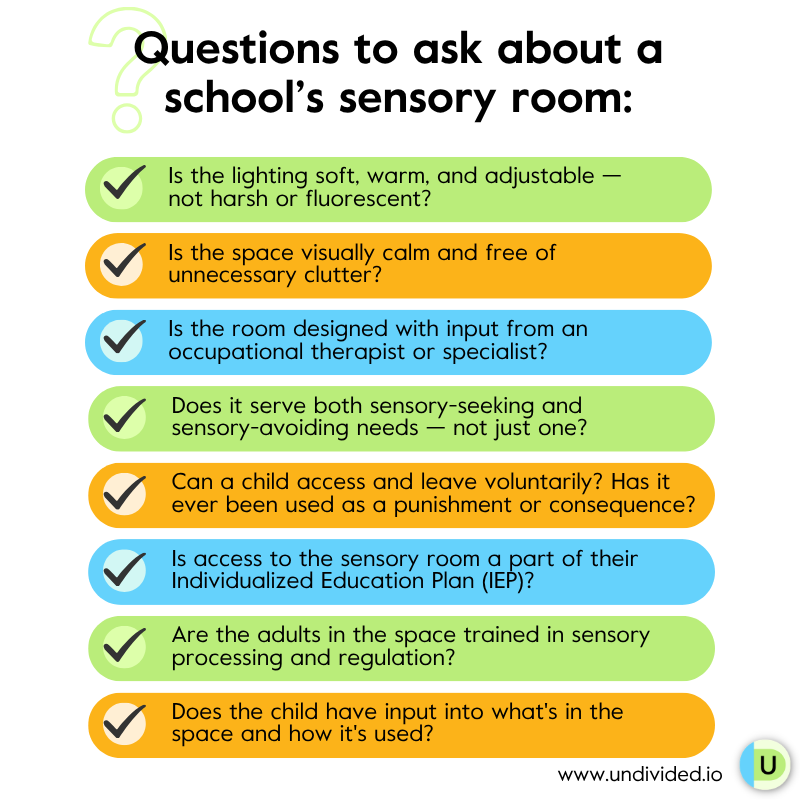
Here’s a checklist of things to look out for/ask if concerned:
- Is the lighting soft, warm, and adjustable — not harsh or fluorescent?
- Is the space visually calm and free of unnecessary clutter?
- Is the room designed with input from an occupational therapist or specialist?
- Does it serve both sensory-seeking and sensory-avoiding needs — not just one?
- Can a child access and leave the room voluntarily?
- Has it ever been used as a punishment or consequence?
- Is access to the sensory room a part of their Individualized Education Plan (IEP)?
- Are the adults in the space trained in sensory processing and regulation?
- Does the child have input into what's in the space and how it's used?
The clearest signs that a space is being used appropriately? Your child is never sent there against their will and would willingly go back. Also, there should be experts like occupational therapists, behavioral specialists, psychologists, and more who are there to help properly form and create a sensory-friendly space.
Stephens shares more on how to advocate if you think something is off about a school’s “sensory room” in this video:
Rethinking defiance: how schools can learn to recognize sensory needs
Stephens argues that true sensory-friendly spaces don't come from one room or one accommodation. It comes from every adult in the building learning to see behavior through the lens of the nervous system rather than the lens of compliance.
As Stephens explains, this is harder than it sounds. The way behavior has been understood in schools for over a century is still largely rooted in the dated idea that most behavior is intentional. Meaning, if a child is doing something you don't want them to do, the traditional response is to offer a reward or a consequence. Comply, and the child gets something good. Don't comply, and something gets taken away. It's a system built on the assumption that children are making rational and conscious choices — and that the right incentive will change those choices.
Stephen explains more on reframing behavior in this video:
But as Stephens points out, that framework doesn't hold up when you look at what neuroscience actually tells us about behavior.
“We've learned more about human behavior in the past several decades than we've known in all time before now,” he says. “Not all behavior is intentional, yet we often treat it that way.”
For example, a child who is struggling may appear to be “melting down” in the cafeteria because the noise level has pushed their nervous system past its threshold. In this instance, they're having a stress response. Responding to a stress response with a consequence doesn't regulate the nervous system but adds to the stress, which is why it’s important for school staff to understand that what looks like a behavioral problem on the surface can often be a sensory or regulatory one underneath.
That said, sensory needs and behavioral challenges aren't always mutually exclusive, and not every difficult moment in the classroom has a sensory root. This is exactly why having a qualified specialist involved is so important. A behavioral specialist, working alongside an occupational therapist and the rest of a child's support team, can help identify what's actually driving what is happening. This way, the response fits the students' needs. For more on understanding behavior in children with disabilities, see our article Supporting Our Children’s Behavior at School.
Overall, when adults stop reading dysregulation as defiance and start reading it as a stress response, everything changes. “When we can begin to get all adults seeing and responding to behavior differently,” Stephens says, “it can make a tremendous difference in the outcome, not only for the children, but for the teachers and staff as well.”
Sensory-friendly school culture
We’ve talked a lot about sensory-friendly rooms and spaces, but the best schools don’t just stop with one room. The best schools create a sensory-friendly culture and environment in classrooms, hallways, and mindset that understands and respects every student's nervous system.
When Smith worked in schools, she made a point of teaching sensory regulation strategies to the whole class, not just to the students on her caseload.
“The best teachers I've ever met are the ones that implement those breaks not for one individual, but for their whole class. I promise you everybody needs that movement break.”
When sensory supports are available to everyone, no one is getting singled out. The student who needs noise-canceling headphones doesn't have to ask for them in front of the class — they're just on the shelf, available to anyone. The movement break isn't something one child gets pulled out for; rather, it's something the whole class does together. That shift from accommodation to culture is the difference between a school that tolerates sensory needs and one that genuinely understands them.
Case study: what a truly sensory-friendly school event can look like
For Schmidlkofer and Krelkamp, this was not an option that they were ready to accept. That’s why they created an event specifically for students with disabilities in mind. This event included a petting zoo, wheelchair basketball, a bouncy castle, and a courtyard full of sensory stations contributed by 25 community organizations. There were also student volunteers who made superhero-themed shirts for every student and staff member and helped run the grounds in full costume.
Schmidlkofer and Krelkamp accounted for every sensory modality: visual, auditory, kinesthetic, and vestibular. And when the stimulation became too much for some students, teachers were able to pull them aside for a moment, or students were able to move away on their own. Students who were stimming (using repetitive movements or sounds to self-regulate) didn't get a second look. No one had to explain themselves or sit out. The event was built so that every way of participating was a valid (and respected) way of participating.
That's what sensory-friendly school culture looks like in action. Not just accommodations, but a community where difference is expected and welcomed, and nobody needs to justify how their nervous system works.
Examples of sensory-friendly school culture
The same principles that made the Shadle Park field day work apply to any school event — they just might require advance planning rather than last-minute problem-solving. Here are some ways schools and families can build sensory-friendly culture into everyday school life (from the classroom to the broader school community):
In the classroom
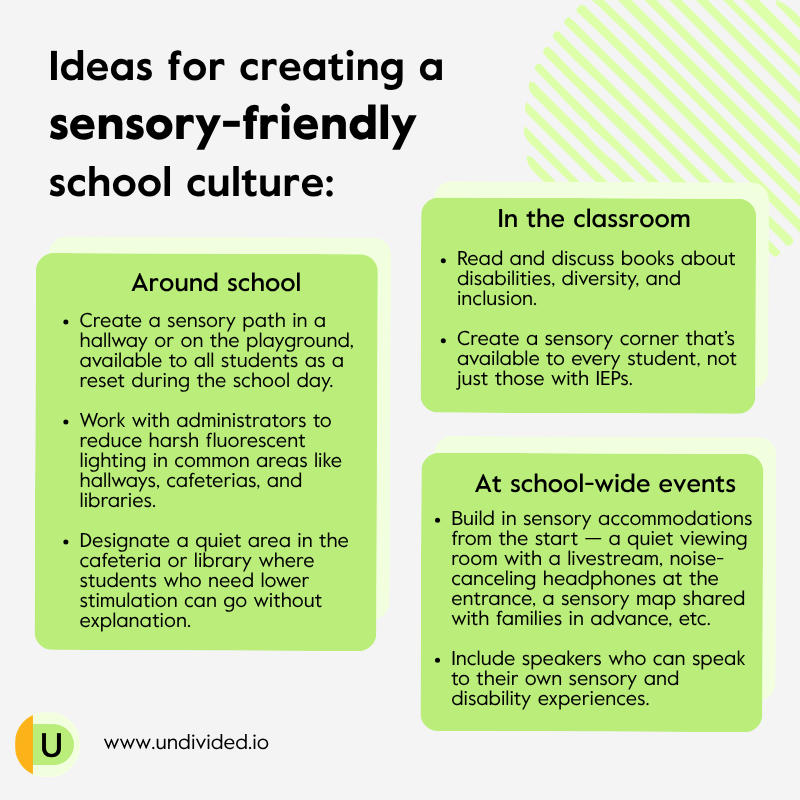
- Read books in the classroom about disabilities, diversity, and inclusion. Lead a discussion after.
- Host a classroom activity where the kids create short books about themselves, focusing on shared interests instead of challenges. Kids already notice the differences and challenges, but what will create more of a sense of inclusive community is pointing out the ways your child is the same as others (loves pizza, likes playing board games, etc.).
- Ask the librarian to read and share disability-themed books throughout the month.
- Create a sensory corner or calming corner in the back of the classroom with a therapy ball, a visual timer, and a few fidget tools — available to every student, not just those with IEPs.
Feature videos made by or giving voice to individuals with disabilities to discuss or share virtually. Here is one example. Find more examples here.
Around the school
- Post disability facts and quote flyers around the school.
- Create a “kindness” wall where students post positive messages about inclusion and acceptance.
- Create a sensory path in a hallway or on the playground, available to all students as a built-in reset during the school day — not just those with IEPs.
- Work with administrators to reduce harsh fluorescent lighting in common areas like hallways, cafeterias, and libraries where possible.
- Designate a quiet area in the cafeteria or library where students who need lower stimulation during lunch or study periods can go without explanation.
- Share ways that non-disabled students and community members can be allies — e.g., sharing information about inclusion and why it’s important.
- Put together resources on disability history, disability culture, disability language, and inclusion.
Put posters of notable people with disabilities around the school (not just posters of people who are notable for having a disability).
School-wide events and programming
- Encourage your district to recognize Disability Awareness Month.
- Start a special education PTA committee at your school to support families that have kids with disabilities and help raise disability awareness.
- For school events like assemblies, field days, and performances, build in sensory accommodations from the start — a quiet viewing room with a livestream, noise-canceling headphones at the entrance, a sensory map shared with families in advance — rather than retrofitting them after the fact.
- For school dances, consider creating a quieter area with lower lighting, a preview of the music playlist so families can prepare their child, and student leadership that's been genuinely briefed on what inclusion looks like in practice.
- Host disability-led assemblies or career days that include speakers who can speak to their own sensory experiences, centering lived experience rather than outside perspectives.
Write and share articles about disability in parent newsletters.
Smith, Tokayer, and Stephens all come back to the same point throughout this article: regulation isn't a disability issue. It's a human issue. On any given day, any child's nervous system might need a reset — like the kid who didn't sleep well, the one who had a stressful morning, or the one dealing with a sudden loss. A school that has already built sensory-friendly practices into its culture doesn't have to figure out how to support those kids at the moment. It already knows. That's why it’s so important for schools to stop treating sensory needs as just a disability accommodation and start treating them as a basic part of human life.
The through-line in all of it is proactive planning. Not “let's see how they do.” When a school sets the tone for sensory-friendly culture, the ripple effect goes further than most people expect. For more ways to create an inclusive school, check out Nurturing Disability Acceptance in Your Child’s School.
Sensory supports in the IEP
The best way to make sure your child is getting the sensory support they need to thrive in school is through the Individualized Education Plan (IEP). For children who receive special education services, access to a sensory space can be written directly into an IEP as an accommodation or support. This isn't a favor the school can offer when it feels like it but a legal obligation under the Individuals with Disabilities Education Act (IDEA).
“If a child needs a certain type of sensory input, that can be written directly into their IEP,” Stephens says. He recommends working with your IEP team to specify not just the space itself but also the conditions under which your child can access it — whether that's on a schedule, when the child self-requests, or both. The more specific the language, the less room for interpretation or inconsistency from year to year or teacher to teacher. And the child should be part of that conversation wherever possible. “The child should know they have access to this,” Stephens says, “and how to ask for it.”
Parents also have the right to request an occupational therapy (OT) evaluation as part of the IEP process. If your child's school doesn't currently have an OT involved in their team, that's an issue worth raising directly — an OT's assessment of your child's sensory profile can be one of the most useful pieces of information in designing supports that actually work.
Stephens knows firsthand how daunting the IEP process can feel for parents.
“You may find yourself sitting in a room with a lot of other individuals who have many advanced credentials behind their names, telling you things about your child that are difficult to hear — that are different from the things that you see at home, that don't really square with what you know about your own child.“
In those moments, he says, the most important thing a parent can do is hold their ground. “It's really important that you continue to believe in your child, even when others seem not to.” For help navigating this process, be sure to check out our IEP decoder, which features IEP meeting prep, IEP goal writing tips, related services, what to do after the IEP, and so much more.
Behavior plans and sensory diets
Beyond the IEP, sensory supports can also be incorporated into a behavior intervention plan (BIP), particularly when sensory dysregulation is connected to behaviors that have been flagged at school after a Functional Behavior Assessments (FBA) has been completed. Feel free to check our article Functional Behavior Assessments (FBA) to learn more about the process and how to advocate for one.
In this context, a sensory break or access to a sensory space can be written as a proactive strategy to help soothe a student’s sensory needs.
For children working with an occupational therapist, sensory supports are often organized into what's called a sensory diet. A sensory diet is a set of compensatory strategies and activities created by an occupational therapist to help a child better cope with sensory processing difficulties. This can look like a movement break between subjects, a compression cushion during circle time, a fidget tool during independent work, or a few minutes in the sensory room before transitioning to a different class/subject. It’s important to note that a sensory diet can be written into the IEP (or a behavior intervention plan) as long as it is written by a qualified OT.
Including your child’s voice in their support plan
Whether it’s an IEP or a BIP, including your child’s voice into the process is key to making sure they understand what’s available to them, and that they can then advocate for themselves. “I think it's really important that children are involved in that process,” Stephens says, “that they know what they can ask for, and that that's respected.”
To learn more about incorporating your child’s voice when creating the support plan, Stephens walks us through it deeper in this video:
For non-speaking children, this may look like parents and educators having to pick up on behavioral cues: what a child gravitates toward, what they consistently avoid, what their body does when they're approaching their threshold. That information belongs in the support plan just as much as any formal assessment.
As Smith puts it, the goal is always the same — to give every child, regardless of how they communicate, a way to say what their nervous system needs are and how to ask for it.
How might schools fund a sensory room?
One of the most common justifications schools give for not having a sensory-space or environment is lack of funding. However, there are funding pathways that exist, and many schools and families have found creative ways to build meaningful sensory spaces.
Here's where to start:
1. Federal funding through IDEA
Schools can receive funding under the Individuals with Disabilities Education Act (IDEA) Part B and C to support children with disabilities, and this funding can sometimes be used to purchase sensory equipment for educational settings. If your school has an OT on staff or on contract, they can often help make the case for sensory equipment as a necessary educational support — which is exactly the framing IDEA requires. Parents who have sensory supports written into their child's IEP can also use that document as leverage when advocating for a school to fund the necessary equipment.
2. Title IV-A (Student Support and Academic Enrichment grants)
- Title IV-A federal funds are specifically designated for creating well-rounded educational opportunities, safe and healthy students, and effective use of technology (all of which sensory spaces can fall under). Schools and districts receive these funds annually and can allocate them toward sensory room equipment, OT consultations, and professional development for staff around sensory needs. Note: If your school isn't using Title IV-A funds for sensory supports, it's worth asking your principal or district special education coordinator whether that's an option.
3. Grants
- There are several grant programs specifically designed to fund sensory equipment and spaces in schools.
- Costco offers local grants for organizations focused on supporting children, education, and physical activity.
- The Philanthropic Ventures Foundation offers Special Education Resource Grants of up to $500 for public school teachers and therapists serving special education students, with sensory integration resources listed as an eligible expense.
- Action for Healthy Kids provides grants to schools to support student wellness goals, which sensory spaces fall directly under.
- McCarthey Dressman Education Foundation is an academic Enrichment Grants designed to develop in-class and extracurricular programs that improve student learning
4. Community funding
- Sometimes, the most powerful funding doesn't come from a grant application or a federal program but from the community. In 2025, Girl Scout Kaitlyn Kropp created and maintained a sensory room for students through community fundraising events. By doing so, she showed schools around the country that creating a sensory space is possible through community fundraising.
- School clubs are another great way to activate the community to help fund a sensory space. Plus, it helps to make the whole student body aware of creating a culture that respects sensory spaces and the people that use them.
- A PTA or PTO with a focused fundraising goal can also help raise money for a school sensory space, especially when the community understands what the space is for and who it serves.
Key takeaways
At the end of the day, we know how hard you are working to forge a world where kids can experience it in the ways they need and deserve. And we hope that this article has given you a good jump start in advocating for a sensory-friendly school, culture, environment and beyond! Here are a few things we hope stay with you long after you close this article:
Know the difference between a sensory room and a seclusion room. A sensory room is a proactive support your child can access voluntarily and leave whenever they choose. A seclusion room is forced isolation, regardless of what it's called. If something doesn't feel right about the space your child is being sent to, trust that instinct and ask to see it.
What looks like a behavioral problem is often a nervous system asking for help. The faster we learn to read that signal (and respond with support rather than consequences) the better the outcomes for every child, in every setting.
Your child's sensory needs are valid and, in many cases, legally protectable. If your child has an IEP, sensory supports can be written in as binding accommodations. If they don't have one yet, that conversation is worth starting sooner rather than later.
Sensory-friendly is more than just one room — it's a culture. The most effective sensory-friendly environments aren't contained in one space. They bleed into how every adult understands behavior, how every event is planned, and how every child is made to feel supported about the way their nervous system works.
The world is getting more sensory-friendly. With every accommodation you request, every question you ask a venue, and every time you advocate visibly for your child's needs, you make it a little easier for the family behind you.
The last thing we want to drive home is that you don't have to figure this out alone. Whether you're navigating a school IEP, looking for sensory-friendly community spaces, or simply trying to understand your child's nervous system better — there are experts, advocates, and communities ready to help. And if you're here, it's safe to say you're already doing everything you can to set your child up for success.
If you haven't yet read our companion article: Tips for Creating a Sensory-Friendly Home For Kids, be sure to check it out. Because the sensory-friendly world we're building — in schools, in communities, and in the spaces in between — is only as strong as the foundation children come home to.


Unlock more with Undivided
Turn knowledge into action that benefits your child
Get Membership


Author