

Tips for Creating a Sensory-Friendly Home For Kids
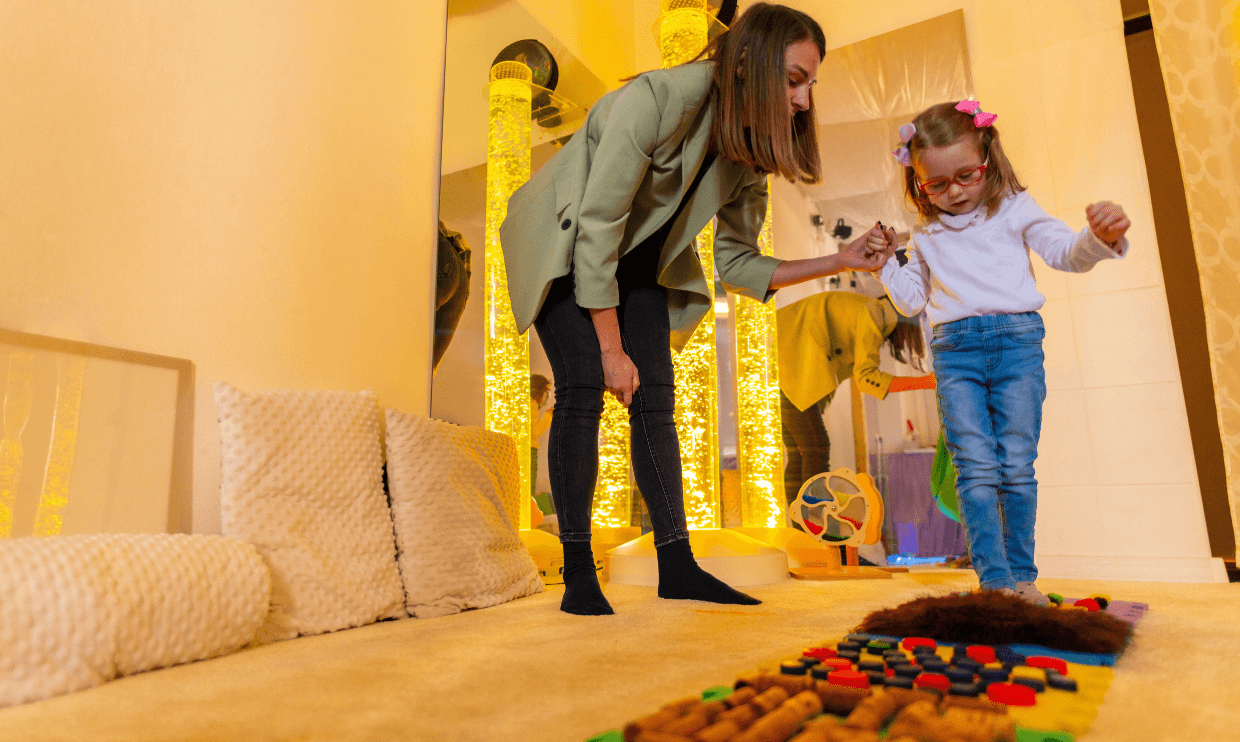
Your child walks into a crowded birthday party or a busy restaurant and, within seconds, they are hit with a wall of sound, a blur of movement, the scratch of their shirt collar, the smell of food, and the glare of fluorescent lights overhead. For many children, these settings can often overwhelm their senses.
And beyond home, the world is bustling with crowded waiting rooms, unpredictable public spaces, and quiet theaters where sitting still and being silent are the price of admission. So how can we help create a home that better supports children with sensory sensitivities and sets them up for all the spaces outside the home? We spoke with Kelli Smith, MOTR/L, founder and owner of Abundance Therapies, and Beatrice Tokayer, founder of a sensory-informed BRT Interior Design company and mom of three boys with ADHD, to find out. They'll guide us through what sensory-friendly really means, what it looks like done well, and how to incorporate sensory-friendly practices at home (and beyond).
What does a truly sensory-friendly space look like?
When you hear “sensory-friendly space,” maybe you picture a single dedicated area. Maybe a room with a swing, some soft lighting, and a bean bag chair with a cozy rug. And while that image isn't entirely wrong, it's incomplete. According to Tokayer, a sensory-informed interior designer who has spent years creating supportive environments for children with disabilities, the goal is much bigger than one room.
“I don't believe in sensory rooms,” Tokayer says. ”I believe in a sensory environment.”
Tokayer explains more: “Let's say you're really stressed in life, so, you go get a massage, and in those ninety minutes you feel amazing. But then an hour later, the stress comes back. Getting the massage was great, but really you need to change your stressful life and modify that. That's how I look at the house.” A single sensory room, in other words, can offer temporary relief, but if a child returns to an environment that dysregulates them, the relief won't last. Meaning: the environment itself has to be modified for an overall change to be felt long-term.
This philosophy applies whether we're talking about a home, a classroom, a school event, or a community space. Sensory-friendly isn't a room you build and check off a list. It's a standard to be applied everywhere.
The eight senses
Most of us grew up learning about the five senses — sight, hearing, smell, taste, and touch. But researchers and healthcare professionals now recognize three more senses that are equally as important to how we all experience and navigate the world: proprioception, vestibular, and interoception.
Smith breaks them down here:
Proprioception is the feedback we get from our muscles and joints. It tells us where our body is in space, from our shoulder joint all the way down to our fingertips. “If our arm is up or down, if somebody is touching us, if we're putting our hands or our heels into a firm surface,” Smith explains, that's proprioception at work. It's the sense that helps us feel grounded, contained, and physically present in our own bodies.
The vestibular system tells us whether we're moving forward or backward, right side up or upside down, and plays a central role in our balance and coordination. It's also deeply connected to the vagus nerve — a key player in how our nervous system self-regulates. Vision and balance are closely tied to vestibular processing, which is why children who struggle with it may appear clumsy, fearful of movement, or in constant pursuit of it.
Interoception is our internal world. It's the sense that tells us whether we're hungry or full, hot or cold, or whether we need to use the restroom. “Those are our insides,” Smith says. “Our internal world is interoception — and they have a huge impact on how regulated we are.”
When any of these senses are overwhelmed, the behavior that follows can be confusing — a child uncontrollably squealing or laughing, seeming not to hear a word you say, or melting down and covering their ears or eyes because something is too bright or loud. Smith notes that sensory processing differences are typically linked to emotional dysregulation in children with autism, ADHD, sensory process disorder, and other developmental disabilities. You can read more about sensory sensitivities in our article Sensory Processing Disorder and Sensory Diets.
Is your child (and family) sensory-seeking or avoiding?
Before any design decisions are made, Tokayer says the most important starting point is understanding how your child experiences the world. Specifically, whether they are sensory-seeking or sensory-avoiding.
Sensory-seeking children crave input. They're the ones who can't stop moving, touch everything in reach, make noise, or seem to thrive in chaos. Sensory-avoidant children are the opposite. They are easily overwhelmed by too much stimulation, prone to shutting down in busy or loud environments. Although some children, Tokayer notes, are both seeking in some areas and avoidant in others. The distinction between the two matters because the same space that soothes one child can overwhelm another.
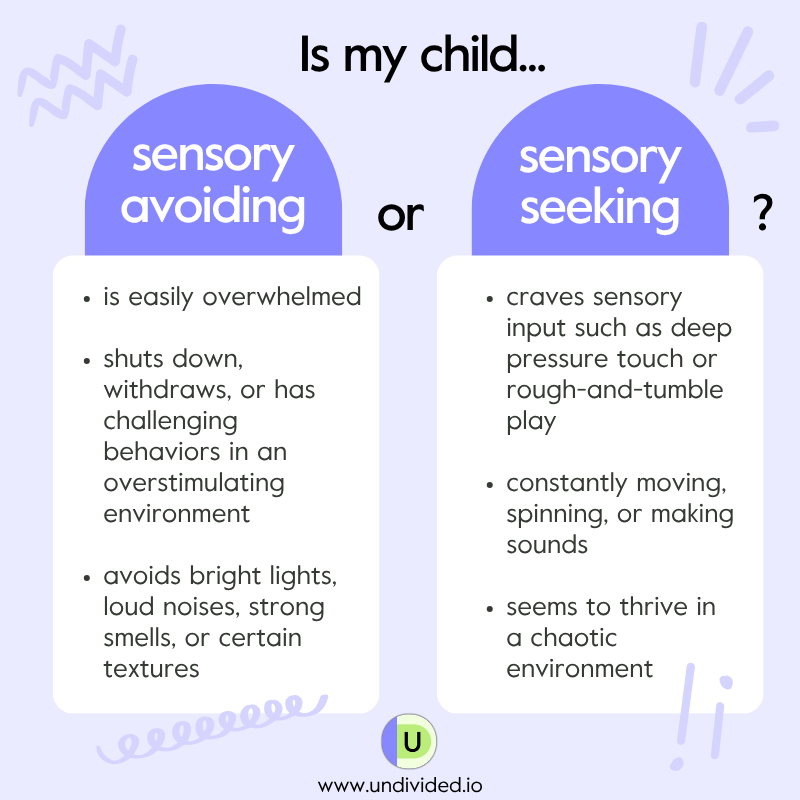
Smith also shares that the line between seeking and avoiding is often blurrier than may seem, and that parents shouldn't mistake a quiet, disengaged child for one who simply doesn't need sensory input.
“I think that sensory seeker versus avoidant is just like the really sleepy body versus the really wired body,” she says. A child who seems checked out, sluggish, or resistant to movement may actually benefit enormously from vestibular input — they just don't have the internal drive to seek it on their own. In her work with older children and young adults, Smith often encounters this directly. “A lot of my kids will often be like, ‘Oh, I'm good, I'm good,’” she says — and then she’ll encourage them to jump ten times anyway to “wake their bodies up” and feel more energized.
That said, Smith is equally attentive to the other end of the spectrum. Sensory-seeking children will want more, more, more — and part of her job is knowing when to redirect. “If they're seeking, they're going to want more, and we might have to cut them off and say, ‘Okay, let's come over and do five math problems now, and then you can go back to the swing,’” she explains. The goal in both cases is the same: finding the “just right” level of input for that child's nervous system on that particular day — not too much, not too little.
Smith touches more on sensory-seeking vs. sensory-avoidant in this video:
The best way to figure out where your child falls? Watch them. Tokayer shares that a lot of what informs her designs comes directly from parent observation — noticing what a child gravitates toward, what sets them off, and what they seem to be asking for through their behavior.
“You can tell a lot from speaking to the parents,” she says. “A lot of it comes from the family dynamic, and the way that the child is acting out or asking for certain things — you know that's sensory seeking.”
A child who is constantly jumping on the couch and turning furniture into a jungle gym is telling you something. So is a child who retreats to a corner with their headphones and weighted blanket when people come over. Both are communicating a sensory need — just in different ways.
Your dysregulation can cause a domino effect
Tokayer is careful to point out that a sensory-friendly environment isn't just designed around one person's needs, but the whole family's.
“Recently, I'm noticing that it's not just the child, but if the parent is overstimulated, their energy is transferring to the child,” Tokayer expresses. “If you don't feel comfortable in your home, you're going to snap at your kids more, you're going to be in a bad mood, there's going to be tension.”
Smith also adds to this saying, “You have to put on your oxygen mask first, and then you can actually better care for the ones you're going to try to help.”
She describes her own experience coming home after a full day of clinical work to a daughter who immediately needs her full attention, and the conscious effort it takes to transition. “I always try to cleanse off all the things and the interactions I've had in a day, and then come in with fresh eyes and be a mom,” she explains. Even five minutes — a snack, a breath, a moment to close off the workday — can shift the entire interaction that follows.
A regulated adult communicates safety to the nervous system of the child near them. A dysregulated adult communicates the opposite — and that signal travels fast.
“If everyone is coming under stress,” Smith says, “their stress raises the stress of everybody else around them.”
It becomes a cycle that no amount of sensory equipment can fix if the adults in the home are running on empty.
Smith touches more on the importance of centering yourself first in this video:
Tokayer makes the same point. “If the parent is overstimulated, their energy is transferred to the child,” she says. A parent who doesn't feel comfortable or calm in their own home will have less patience, less capacity to observe what their child needs, and less ability to respond. “When the parents are happy, they can give more to their kids.”
In other words, a sensory-friendly environment supports everyone in it — not just the child with the diagnosis. That means creating a sensory-friendly home isn't only about what you do for your child. It's also about asking honestly: what does my own nervous system need? What environments drain me, and which ones restore me? Because a parent who has never thought about their own sensory thresholds may be less equipped to recognize and respond to their child's.
That's why before you start redesigning anything, start by paying attention — to yourself, your child, and your family as a whole. Ask yourself and your family these questions to get a clearer picture of where a sensory shift might be needed.
About your home:
- Are there rooms in my home where I feel calm, and rooms where I feel on edge, and do I know why?
- Does my home feel like it's getting smaller because there's so much stuff?
- Is the lighting in my home something I've ever thought about, or do I just live with whatever's there?
- Do I find myself constantly turning lights off, closing blinds, or retreating to a quieter part of the house?
Are there smells, sounds, or textures in my home that bother me more than they seem to bother others? Or, alternatively, what smells, sounds, or textures do I seem to gravitate towards?
About your child:
- Are there rooms or areas my child consistently avoids or refuses to enter?
- Does my child's behavior change noticeably depending on which room they're in?
- Is my child constantly moving, climbing, or seeking physical input — and is there a space in our home that supports that?
- Does my child seem more regulated outdoors than indoors, and what does that tell us?
Does my child create clutter or chaos in their room, and could that be their way of seeking sensory input?
Tokayer shares more on the common patterns she sees in families who come to her seeking sensory support, and how to recognize them in your own home in this video.
Start with the basics
One of the most common mistakes families make, Tokayer says, is jumping straight to equipment and accessories without addressing what she calls “the bones” of a space first after establishing what kind of sensory-support everyone needs. “You have to look at the bones — the layout, how the furniture is placed, whether the furniture is matching in tones,” she explains. “You can't start with the details.”
That means looking at three things first:
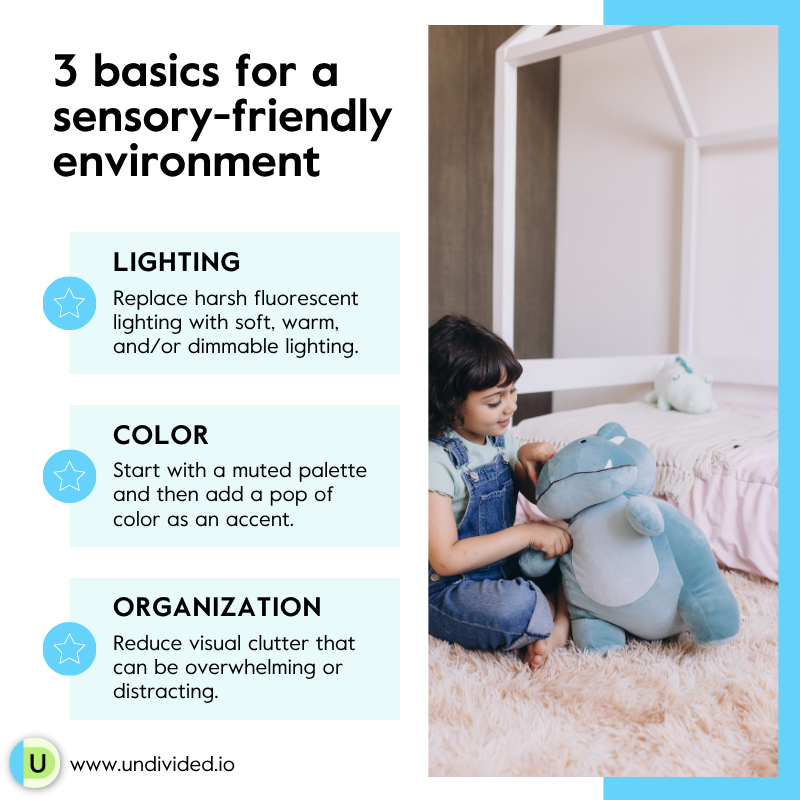
Lighting. Harsh overhead fluorescent lighting — the kind found in most schools, hospitals, and stores — is one of the most common and overlooked sources of sensory overload. Softer, warmer lighting or the ability to dim a space makes an immediate difference.
Color. Tokayer recommends avoiding mixing more than four colors in a shared space, and keeping the overall palette muted as a baseline — especially in common areas used by multiple people with different sensory needs. More isn’t always better! For a child who is sensory-seeking and craves more visual stimulation, the solution isn't a chaotic room, but one vibrant accent wall. “Give them a wall that has more vibrant colors — orange, bright blue, yellow — but just one wall, not the entire room.”
Visual chaos. That pile of clutter we’ve all been meaning to get to can cause visual overwhelm. “If there's too much clutter, too much visual chaos — piles in the corner, a project you never finished, things on the floor — the energy gets heavy and it's draining,” Tokayer says. “The space feels gloomy.” Interestingly, she notes that sensory-seeking children often create clutter themselves, not out of messiness but because they're unconsciously trying to generate the stimulation their nervous system is craving. The solution isn't to clear everything away, but to organize the clutter. After that, then you can give them intentional sources of stimulation (more on this in a bit) so they don't have to make their own.
The key is designing shared spaces to be calm enough for sensory-avoiding individuals, while creating specific zones or personal spaces where sensory-seeking children can get the input they need. “The common spaces need to be more muted, with pops of color to keep it balanced so that everyone feels comfortable,” Tokayer explains. “But there's always going to be someone who needs more stimulation — and that's where you create a specific space for them.”
Tokayer shares more on how to get there in the following video.
Start with the bones: affordable ways to build a sensory-friendly home
Creating a sensory-friendly home doesn't have to look like a major renovation or a room full of expensive equipment. Even small, intentional changes can make a meaningful difference. As Tokayer reminded us, the biggest sensory shifts often come from the simplest changes — softer lighting, less visual chaos, and calmer shared spaces.
Here are some changes you can make in your house, before buying more sensory-focused items:
Lighting
Warm LED bulb swaps ($8+ for a pack) to replace harsh overhead fluorescents
Or, color changing LED bulbs ($8+) that you can connect to your phone or a smart device to change a specific part of the room to a more soothing or stimulating color
Salt lamps for soft, warm ambient light ($15+)
Shatterproof string lights, fairy lights, or glow in the dark stars for a calming glow ($9-$25)
Blackout curtains for sensory avoiders who are light-sensitive ($9+)
Calming canopy for sensory avoiders who require a darker space to relax (25+)
Clutter and chaos reduction
Fabric storage bins ($14 for a pack of six) to get things off surfaces and behind closed doors
Labeled bins also can help to reduce the mental load of clutter for the whole family
Over-the-door organizers to reclaim floor space ($9+)
Drawer dividers ($9+) and organizers ($18+) to reduce visual chaos inside cabinets
A dedicated coat and shoe rack ($37+) by the door so backpacks, shoes, and jackets don't pile up
Alternatively, a big basket ($9) or designated space could work as well
Color and walls
Peel-and-stick wallpaper ($9+) for a single accent wall, gives sensory seekers visual or tactical stimulation without overwhelming the whole room
Removable wall decals ($9+)
Painting one wall a deeper, moodier tone to create a cozy area
Neutral removable contact paper ($10+) to tone down a visually busy surface
Sound
A white noise machine ($15+) or a fan ($14) to drown out background noise for sensory avoiders
A small Bluetooth speaker ($18+) for playing calming music or nature sounds in a child's space
Thick rugs ($12+) to absorb sound and reduce echo in hard-floored rooms
Texture and comfort
A doorway tension rod ($9+) with a curtain to create a semi-enclosed nook without permanent installation
Floor cushions ($35+) or a few pillows from Five below or Dollar Tree as flexible seating options that also provide grounding input
A small trampoline ($50+), spinner seat ($40), and a wobble board ($20+) as a relatively low-cost vestibular tool
Sensory tools and equipment
Once the bones of a space are addressed, sensory tools and equipment can be added and tailored to the specific needs of the child and your budget. There's no universal formula here. What works for one child may do nothing for another, and what a child needs at age five may look very different at age ten. Oftentimes, it is recommended to consult a specialist (like an occupational therapist (OT)) before purchasing some of these bigger items to make sure that it will be the proper support tool for your child.
In a home, an Tokayer and Smith recommend the following:
Vestibular input (the sense of balance and movement)
Disc, sensory, compression swings ($23-$100+)
Therapy swing frames (freestanding, no ceiling mount required)
Zip-lines ($59+)
Rocking chairs ($64+)
Exercise balls ($13+)
Can also be used as alternative seating or for rolling and bouncing)
Scooter boards ($39+)
Climbing structures ($69+) and rock climbing walls ($180)
Proprioceptive input (the sense of where the body is a space)
Weighted blankets ($20+)
Crash pads ($109+)
Sensory liquid floor mats ($55)
Sensory pod or cocoon chair ($49)
A suspended or floor-based enclosed seating option that provides gentle compression
Gymnastic wedge or foam incline mat ($76+)
Resistance tunnel ($37)
Inflatable sensory cushion ($40) or wobble cushion ($18-$20+)
Body sock ($22)
Visual and tactile input
Bubble tubes ($10)
Sensory tube ($10)
Water stations ($39+)
Pop tubes ($6)
Magnetic tiles ($20)
DIY sensory tools/equipment
Some of the best sensory tools are the ones your child helps build. Not only does DIY cost a fraction of purchased equipment, but it gives children ownership over their own regulation toolkit, which makes them far more likely to reach for it when they need it.
Below is a list of few DIY tools that you can make at home:
Rice bins are sensory wonderlands that cost less than a family dinner out. Fill a large plastic container with rice, add scoops, small toys to hunt for, or textured objects to discover. This is great for tactile input whenever your child needs to reset. (Worried about the mess? Check out these tips for easy sensory bin cleanup.)
Kitchen straws are secret oral motor powerhouses. They can be used as a regulation tool for kids who need to chew, blow, or suck to focus. Cut them into different lengths, use them for bubble-blowing exercises, or create breathing games that turn regulation into play.
Heavy blankets and couch cushions create instant deep pressure magic. Build blanket burritos, create cushion sandwiches, or set up caves under the coffee table. These provide kinesthetic input that helps scattered nervous systems organize and calm down.
Texture boards are great for our sensory seekers who love texture. Just grab some cardboard and raid your craft supplies. Glue on sandpaper for rough input, bubble wrap or pop especially used on phone covers for satisfying pops, fake fur for soft touches, or corrugated cardboard for ridged sensations.
One practical note: variety and novelty matter. Tokayer recommends rotating equipment rather than leaving everything out all the time. “Kids get bored — ADHD and sensory-seeking kids get bored super quickly,” she says. Swapping tools in and out, or introducing something new when engagement drops, keeps the space feeling fresh and effective.
That said, know your child. Some kids need predictability and may find changes to their environment deeply unsettling. “Some kids want things exactly where you left them, because it's predictable and they have control over it,” she says. “Sometimes you might have to actually talk to them and say, can I move this? Can I switch this up for you?”
There's no single right answer here, and that's exactly the point! The best sensory environment for your child is one that grows and adapts alongside them, built on observation, collaboration, and a willingness to keep asking what's working. Whether you get there with the help of an OT, a sensory-informed designer, or simply by paying closer attention to what your child's body is telling you, you're already doing the most important part: supporting them.
When to bring in a professional
Creating a sensory-friendly home is something many families can start on their own, and the tools and strategies in this article are a great place to begin. But there are times when professional guidance makes all the difference, and knowing when to ask for help is just as important as knowing where to start (or when to stop).
For instance, if you've made changes to your home environment and aren't seeing meaningful improvement in your child's regulation, or if your child's sensory needs feel complex or difficult to identify, an occupational therapist (OT) is a great resource to turn to as they are experts in sensory and motor processing. An OT can help evaluate your child's specific sensory profile, identify which senses are most dysregulated, and recommend targeted tools and strategies that are tailored to your child. Plus, they can also help your family save money on any equipment that doesn't match your child's actual sensory profile.
You can learn more about what an occupational therapist is and how they can support your child and your family in this article: What Is Occupational Therapy for Kids?
How to pay for it all
We know that sensory tools and equipment can add up quickly, and for many families, the cost is a real barrier. And while we’ve provided some budget-friendly ways to create sensory-friendly spaces, we know that sometimes our kids' needs exceed what some can afford. The good news is that there are more funding pathways available than most parents realize.
Here's a quick breakdown of where to start:
Your child's school (if they have an IEP): if your child receives special education services, certain sensory tools and accommodations can be written directly into their Individualized Education Program (IEP), which means the school district is responsible for providing them at no cost to your family. In some cases, equipment recommended by a school-based OT may be provided for home use as well, as long as it's determined to be necessary for your child's educational goals.
- Insurance: some sensory equipment (particularly items prescribed by your child’s OT or another health professional) may be covered under your child's health insurance. The key is getting the recommendation in writing from the health professional where it highlights the equipment as a medically necessary intervention rather than a lifestyle purchase. Coverage varies significantly by plan and provider, so it's worth calling your insurance company directly and asking specifically about durable medical equipment (DME) coverage.
Regional Centers (California): for families in California whose child qualifies for Regional Center services, certain sensory tools and equipment may be funded as part of an Individual Program Plan (IPP). However, it’s important to note that Regional Center funding is needs-based and can vary by center, so be sure to check with your service coordinator even if you're not sure your child qualifies.
Medicaid: for families who qualify, Medicaid (called Medi-Cal in California) may cover certain sensory equipment when prescribed by a physician or OT as part of a treatment plan.
Nonprofit funding: there are several nonprofit organizations that offer sensory equipment and therapy tools for children with disabilities. Organizations like the Kids Wish Network The Sensory Processing Disorder Foundation, Be An Angel, Got DME, Ability Found, and local disability-focused community foundations are worth researching.
Flexible spending accounts (FSA) and health savings accounts (HSA): if your family has an FSA or HSA through an employer, many sensory tools (particularly those recommended by a health professional) qualify as eligible medical expenses. This won't reduce the overall cost, but it does allow you to pay with pre-tax dollars, which can help to reduce what you spend.
Secondhand and community resources: Facebook Marketplace, local Buy Nothing groups, and disability-focused online communities are often excellent sources for gently used sensory equipment at a fraction of the retail price. Weighted blankets, therapy swings, crash mats, and trampolines all appear regularly in secondhand markets. Some communities also have sensory equipment lending libraries!
For more information about how to navigate all these funding pathways, check out our [How Do We Pay For It All? Undivided’s Guide to Funding Resources in California article.
Helping your child build self-awareness via the “the feedback loop”
The goal isn't a perfectly regulated child in a perfectly designed space. It's a child (and a family) who knows how to find their way back to center, wherever they are. And while a sensory-friendly environment and the right tools are a powerful foundation, Smith says there's one more piece that makes it all stick: what she calls “the feedback loop” — the practice of helping a child build awareness of their own sensory needs.
The idea is that when you notice a sensory behavior, name it back to the child without judgment. For younger children, this can look like modeling and narrating by pointing out what you notice, offering simple choices, and following their cues. Phrases like, “I notice the lights are bothering you. Are you good with lights on or lights off?” or, “I see you are covering your ears. Do you want music on or off?” can help to subtly point out a sense that is being overwhelmed, in hopes that the child will then begin to understand what their potential triggers are.
That way by the time they are older, it looks like them saying “I need five minutes on the trampoline before I can do my homework,” rather than waiting for you (or an adult) to notice and intervene.
Smith explains more about “the feedback loop” in this video here:
“The most important thing we can do from birth to death,” Smith says, “is feeling what actually makes us feel comfortable in our space and in our body.”
Smith has seen this pay off across decades of working with the same children from early childhood into young adulthood. The young adults who do best, she says, are the ones who learned early to recognize what their nervous system needs and ask for it. Smith calls this “neuro-resilience:” the capacity to understand your own sensory and regulatory needs well enough to meet them, wherever you are. It's not about eliminating sensitivity or powering through discomfort. It's about building self-awareness and tools to find your way back to feeling regulated, on any given day, in any given environment.
Watch Smith explain more about neuro-resilience here:
How your sensory-friendly home prepares your child for the world
One of the most powerful things a sensory-friendly home can do for a child isn't just what happens inside it, but what makes it possible outside of it. When a child has a home environment that genuinely meets their sensory needs, they build something that no amount of equipment can manufacture on its own: a felt sense of safety. And from that foundation, the world becomes a little more navigable.
Tokayer touches more on the importance of sensory integration in this video:
But navigating the world doesn't happen all at once. For sensory-sensitive children, the goal isn't to avoid overwhelming environments forever, but to approach them gradually, intentionally, and always with the child's cues leading the way.
Tokayer learned this firsthand with her own son. Rather than avoiding going to New York City altogether because of how overwhelming it was for him in the past, she found a middle path. “We went on a boat ride by Seaport,” she explains, “which is not super populated, but it's still the city. And he was like, ‘I feel okay here.’” Starting slow — finding a version of the overwhelming thing that feels manageable — is the foundation of gradual exposure done well.
What gradual exposure looks like in practice
Instead of diving head first into the most intense version of an environment, our experts urge us to start our children with the least overwhelming version and build from there. For instance, a child who struggles with crowded, noisy spaces doesn't need to conquer an amusement park on day one. They need a series of smaller, successful experiences that teach their nervous system that the world can be managed — one step at a time.
In practice, that might look like:
- Visiting a restaurant during off-hours
- Attending a movie screening during off-hours
- Exploring a museum during a designated quiet hour before a regular visit
Attending a rehearsal or sound check at a performance venue before the actual show
The key in all of these is pacing. Always lead with leaving before your child reaches the point of overwhelm rather than waiting until they're already dysregulated. “When they get uncomfortable, remove them,” Tokayer says. “Just being attuned — not just to their regular needs, but to that stuff — because that could really affect behavior.”
Preparing your child in advance
Gradual exposure isn't just about the experience itself — it's also about what happens before you leave the house. Preparing a child for what they're about to encounter reduces the element of surprise, which is one of the most common sensory triggers.
Some ways to help prepare your child can look like:
- Showing photos or a video of the venue ahead of time
- Visiting the venue's website (or going in person during off-hours) to look at the layout together
- Calling ahead to ask about sensory accommodations, noise levels, or quiet spaces available
- Practicing a simple signal your child can use to tell you when they've had enough (a hand sign, a card, or a specific word)
- Identifying an exit strategy before you arrive so both you and your child know the plan if things get overwhelming
Portable tools for outings
Part of what makes gradual exposure successful is having the right tools on hand when you leave the house. A small sensory kit that travels with your child can make the difference between a successful outing and one that ends early.
Some sensory items worth considering:
Sunglasses or tinted lenses for light sensitivity
A weighted lap pad that folds flat for travel ($16)
A small fidget tool or chewable jewelry ($9)
A comfort item from home (a familiar texture or scent)
Snacks (because who doesn’t become more on edge when hungry)
Building confidence over time
What Tokayer describes in her son's New York City example isn't just a one-time accommodation — it's a long game. Each successful experience in a manageable version of an overwhelming environment builds the nervous system's tolerance and the child's confidence. Over time, what felt impossible becomes possible — not because the environment changed, but because the child's nervous system learned it could cope.
“Once you do that,” Tokayer says, “their body just becomes more comfortable with the world. And then slowly they're able to open up to other areas. Whereas if they're uncomfortable, they're going to be guarded — because being out in the world makes them too anxious.”
This is the real payoff of a sensory-friendly home. It's not just a place where a child can retreat, it's the launching pad from which they learn to engage with the world on their own terms.
Importantly, Smith notes that sensory processing isn't static. Our sensory needs shift across the lifespan — from infancy through adolescence, into hormonal changes as teenagers and adults, and all the way into older age. A child's sensory profile today may look different in five years, which is why building confidence, awareness, and flexibility into the environment matters so much.
Sensory-friendly places in the community
Everything we've talked about in this article is part of a larger movement toward a more inclusive world. And that movement doesn't stop at home (or school). Communities, venues, and organizations across the country are starting to understand that sensory-friendly access isn't a niche request. It's something a significant portion of the population genuinely needs.
Here's what's out there — and how to find it near you.
Playgrounds
- Look for playgrounds designated as “universally accessible” or “all-abilities” in your area — these are specifically designed with sensory-friendly features like quiet retreats, tactile and musical elements, and equipment for a range of abilities
- InclusionMatters.org maintains a searchable database of accessible playgrounds across the United States and beyond
Trails and nature
- AllTrails has an accessibility filter that allows families to search for ADA-accessible trails by location nationwide
- Look for flat, paved, or wide natural surface trails with low foot traffic — early morning on weekdays tends to mean fewer crowds and less noise
- Botanical gardens, arboretums, and nature centers are often quieter, more visually calm, and more sensory-friendly than busy amusement parks or crowded attractions
- Check venue websites for accessibility information, sensory bag loans, and quiet hour programs before visiting
Movies and live theater
- AMC Sensory Friendly Films has screenings on the second and fourth Saturdays of each month at participating locations nationwide; lights up, sound down, movement and noise welcomed
- Regal also offers sensory-friendly screenings on select Saturdays at participating locations
- Cinemark offers sensory‑sensitive screenings in select theaters
- Pro tip: don’t be afraid to call and ask to see what your local movie theater can offer (you might be surprised).
Live theater
- Check the accessibility page of any performing arts venue near you — many regional theater companies now offer relaxed or sensory-friendly performances that aren't always widely advertised.
- Children's Theatre Company (located in Minnesota) offers dedicated sensory-friendly performances with adjusted lighting and sound, relaxed audience policy, quiet spaces, and social stories sent to families in advance
- Segerstrom Center for the Arts, Santa Ana provides reduced sound and lighting, freedom to move and talk during performances, pre-visit guides provided, and designated break spaces available
- A Noise Within, Pasadena offers “relaxed performances” open to all audience members, intentionally modified for those with sensory sensitivities, autism, anxiety, and other needs
Museums
- The Guggenheim provides a comprehensive sensory-friendly toolkit for families, including guidance on quieter visiting times, what to expect from different galleries, and how to prepare your child for the visit
- Van Abbemuseum is a leading international example of multi-sensory exhibit design for people with disabilities, offering a model for what truly inclusive museum experiences can look like
- Many museums now offer sensory bags available for checkout at the entrance (typically containing noise-canceling headphones, fidget tools, and a visual guide to the space)
- Keep an eye out for museums that offer dedicated quiet hours or early access mornings
- Before any museum visit, check the venue's accessibility page and ask specifically whether a sensory map is available — knowing which areas are loud, bright, or crowded in advance makes a significant difference for sensory-sensitive children
- Smithsonian Institution has shared research that highlights how sensory maps can reduce anxiety for visitors with sensory sensitivities (many Smithsonian museums offer these as a free resource before or during your visit)
Haircuts
- Calling ahead to find a stylist who has experience with sensory-sensitive children
- Bringing noise-canceling headphones
- Practicing at home with a comb before the appointment k
- Keeping the first few visits short and low-stakes.
- For more practical strategies, visit our full guide: 10 Tips for - Making Haircuts Easier for Kids with Sensory Processing Issues.
- Calling ahead to find a stylist who has experience with sensory-sensitive children
Dentist visits
- Requesting the first appointment of the day when the waiting room is quieter
- Asking for a pre-visit tour of the office
- Bringing a comfort item from home
- Letting the dentist know in advance about your child's sensory sensitivities.
- For more tips, visit our full guide: 10 Tips for Making a Dentist Visit Easier for Kids with Disabilities.
The most important ingredient: the child's voice
No matter how thoughtfully a space is designed, it won't work if the child it's built for wasn't part of building it. Both of our experts are emphatic on this point.
“The child's voice is the most important voice when creating these spaces,” Tokayer says simply.
Tokayer's process reflects this as she gathers detailed information from parents and the child about their favorite colors, characters, or themes where possible, and shows children the design for their approval before anything is finalized.
For non-speaking children, this process can often look slightly different. In these specific cases, Tokayer and Smith often work primarily through parent observation by listening carefully or sometimes observing what behaviors the child is displaying and what those behaviors are communicating. Tokayer recalls designing a playroom for a non-speaking child that included a zip line leading directly into a bouncy house — a design born entirely from watching what the child's body was asking for.
Not every environment your child navigates will be sensory-friendly — and that's the reality most families live with every day. Doctor's offices, grocery stores, haircut chairs, and crowded hallways aren't going away. But a child who comes from a home that genuinely supports their nervous system doesn't meet those moments empty. It's the foundation from which your child learns to move through the world on their own terms, at their own pace, with the confidence that comes from knowing their needs are real, valid, and worth meeting.
And a sensory-friendly home isn't just about the right equipment, the right lighting, or the right layout. It starts with you, too, because a well-regulated adult is one of the most powerful sensory tools your home can have. When you feel calm and supported in your space, that regulation is contagious.
For ways to navigate sensory-friendly environments in school and the community, check out Sensory Rooms and Spaces at School.


Unlock more with Undivided
Turn knowledge into action that benefits your child
Get Membership


Author