

How to Support Your Neurodivergent Child Through Dating

From deciding whether to swipe left or right, to working up the courage to meet someone new, dating can feel like an emotional roller coaster. In truth, dating is complicated for most people. Opening yourself up to someone else requires vulnerability — and vulnerability can feel uncomfortable, exciting, and a little scary all at once.
Now add in being neurodivergent (having autism, ADHD, dyslexia, etc.), and it can feel even more layered. Navigating social cues, sensory needs, communication differences, rejection sensitivity, and societal stigma — all while trying to “put yourself out there” — can make the process feel, well, impossible.
But complicated doesn’t mean it's not worthwhile. And as parents raising children who are neurodivergent, we need to remember that being different doesn’t mean that our children are romantically doomed — that they should just cut themselves off from any possibility of a connection and start adopting pets to fill the void. Dating is possible if you are neurodivergent! It just might look a little different — and that’s okay.
To help us navigate dating while neurodivergent we spoke with Katherine Gyolai, founder and CEO of Find Love Safely, an organization that helps adults with intellectual and developmental disabilities build friendship, confidence, and love — with thoughtful matchmaking and supportive guidance. We also spoke with Ilana Hamburgh, director of education for the Social Life 360 Program, and Jeremy Hamburgh, founder of the Social Life 360 Program that focuses on teaching step-by-step strategies to help individuals who are neurodivergent make friends, find community, start dating more successfully, and build a social life that sparks joy.
Addressing common misconceptions
For many parents or guardians, the idea of your child with a disability dating can feel incredibly scary — maybe even totally out of the question. It might feel like the world is already stacked against your child simply because they have a disability. And when you add a romantic relationship into the mix, it’s easy for our minds to spiral toward every worst-case scenario imaginable. So, in order to dispel some anxiety and myths, we’ve compiled four of the most common misconceptions that prevent people with disabilities from dating.
Misconception # 1: people with disabilities are not interested in dating
“I think the most common misperception is that people with disabilities aren’t interested in relationships,” Gyolai shares. “Or they’re not capable of having a relationship.”
This is false! Relationships — specifically, romantic relationships — are an integral part of the human experience. Most people don’t ever truly want to be alone (or have just their parent/caregiver as company) all the time.
Gyolai emphasizes, “People with disabilities’ desire for connection is a very basic human need. We are not meant to be alone. We’re not meant to live alone. And so that desire for love and connection and companionship is universal.”
A disability, a diagnosis, or an extra chromosome doesn’t take away that desire to love and be loved. Dating while having a disability is possible, and there are ways to do it safely (we’ll touch more on this later).
Misconception #2: people with disabilities only want to date people with the same disability
“A misconception I want to dispel is that people will only want to date people with the same disability that they have,” Gyolai says. “We’re finding that’s not true at all, that many people are open to connection across disability experiences, and that shared disability is not the only factor that drives compatibility.”
Just as people don’t choose partners based on one shared characteristic alone, individuals with disabilities often want to branch out beyond their own experiences to form connections with a wide range of people. There are many people willing to date someone with a different disability — or no disability at all.
Misconception #3: if a person without a disability wants to date someone with a disability, they must be in it for the wrong reason.
The misconception that a person without a disability could not genuinely want to date a disabled person is rooted in ableism — the belief that disabled people are somehow lesser than people without a disability.
There are a couple of important things to keep in mind. First, not all disabilities are visible, meaning someone may not appear to have a disability but still identify as having a disability. Second, attraction and connection are not limited by disability status.
People with and without disabilities can (and do) find romantic connections together. This type of relationship is often referred to as an interabled relationship. One person may have a physical, intellectual, or emotional disability, while the other person does not.
Hannah and Shane Burcaw are a well-known interabled couple. They are outspoken advocates for disability awareness and inclusion. Shane has spinal muscular atrophy that requires him to use a wheelchair. Together, they run a successful YouTube account, Squirmy and Grubs, where they share their daily lives, give insight into their relationship, and answer frequently asked questions about what it’s like to be in an interabled relationship.
The biggest takeaway from Hannah and Shane’s relationship is that — like in all relationships — what matters most is that both adults share a mutual level of respect, clear communication, and consent. When both individuals are able to express their wants and needs, understand one another, and feel safe and respected, these relationships can thrive and be just as healthy and meaningful as any other.
It’s important to note that understanding consent is a skill that can and should be taught (don’t worry, we’ll dive more into how to teach consent later). Some individuals with intellectual disabilities may need more explicit, ongoing support to fully understand consent — in a romantic and non-romantic sense. This does not mean that they are incapable of understanding consent or of having meaningful relationships.
As Gyolai emphasizes,“The goal is not to restrict these opportunities, regardless of whether it’s an interabled relationship, a relationship between two people with disabilities, or between two people without disabilities. It’s really about building confidence in decision-making skills so that both people are participating in a relationship that feels comfortable and safe.”
With the right education, guidance, and reinforcement, many individuals can learn to understand their boundaries and communicate what they do and don’t want.
At the same time, parents and caregivers may need to play an active role in helping reinforce these concepts and ensuring their loved ones safety. This balance — supporting autonomy while also providing appropriate safeguards — is key.
Misconception #4: it’s not safe for individuals with disabilities to date
“Another common misconception is that individuals with disabilities are somehow eternal children who should be protected from romantic experiences because it’s too unsafe, and the potential for lack of safety is too great,” Gyolai says.
For many parents, the idea of their child dating can be scary. Maybe it’s a concern that they won’t be able to recognize when someone has bad intentions, or, as Gyolai has heard, there’s a real fear of pregnancy. The reasons can feel endless (and they’re completely valid) — this world can be scary!
However, dating can be potentially unsafe for everyone (regardless of having a disability). As our sources share, their programs — Find Love Safely and Social Life 360 — have shown, there is a way for neurodivergent people to date in a safe and loving way.
“Safety is, of course, important, but denying people opportunities to learn relationship skills can actually leave them much more vulnerable,” Gyolai conveys. “Instead of preparing people for dating, we often focus on preventing it — and that’s not working well. When we don’t prepare people for dating and instead try to prevent it, that desire for human connection is so powerful that people will seek it somewhere. If we don’t provide healthy options for how to seek it, they’re going to fill that need with unhealthy ones.”
When we begin preparing our children (and honestly, preparing ourselves, too) as they approach dating age for how to navigate all types of relationships — not just romantic ones — we’re giving them the tools to access connection and socialization in mature, confident, and safe ways.
Start with friendship, not dating
If your child has brought up dating or they aren’t of age yet to date, and you’re not sure where to start, start with teaching friendship skills as early as you can. As Gyolai explains, “Preparation for dating actually begins long before dating happens. The most helpful thing that families can do is teach friendship skills first.”
In this video, Jeremy Hamburgh shares more on friendship being the foundation for a romantic relationship:
Focusing on friendship takes some of the pressure off. These are skills that can be practiced at any age — learning how to connect, communicate, and build trust with others. “Friendship is the basis of a romantic situation,” Gyolai explains. “So really, it’s about teaching friendship skills first.” And over time, those same skills naturally can evolve into romantic relationships skills when your child is ready.
Gyolai recommends teaching these three components of friendship:
Equal effort: both people are reaching out to make plans, taking turns choosing what to do, or checking in on each other. It’s not just one person doing all the work to keep the relationship going.
Common interest: this doesn’t have to mean liking all the same things as someone else, but having something in common — whether it’s a favorite show, hobby, or activity — gives people a natural way to connect and spend time together.
Mutual respect: this can look like listening to each other, honoring boundaries, and treating one another with kindness (even if you don’t always agree). It also means recognizing when someone isn’t treating you with that same level of respect.
These three components can help create a great start to a beautiful friendship. When our children are able to set standards for themselves and others, we are giving them the tools and the opportunity to flex their independence and create potentially meaningful conversations.
Find your people
Those still in school can find their people through classes, clubs, sports, and fun events. For those who are out of school, you might have to be more creative. When sitting in on a community call led by Jeremy Hamburgh, clients shared that they went to bingo night, trivia, comic cons, and more to try to make new friends or connect to their people. You don’t need to rush dating — focus on connection first.
Your child’s group of friends should include people who share Gyolai’s three components: equal effort, common interest, and mutual respect.
As Ilana Hamburgh explains, “You have this massive community of people who are really trying their best, but they don’t understand the elements of what makes people attracted to each other, what they need to do to build attraction, or how to spark that connection. A lot of that is just unclear to them.”
By starting with friendship, individuals who are neurodivergent have the chance to work on their social skills and connect with like-minded individuals. Of course, a big part of friendship (and life) is also learning how to read social cues, start conversations, and respect people’s boundaries.
“A lot of neurodivergent adults, when they jump into the dating scene, feel like, ‘Okay, if I show up or put up a profile, I’m good,’” Jeremy Hamburgh explains. “But then they start to realize that’s not enough. Many begin to feel like they’re guessing at invisible social rules — and getting it wrong.”
There’s a lot that is and isn’t said in the way people communicate — and that’s where things can feel tricky. Social cues such as tone of voice, facial expressions, eye contact, and body language often carry meaning that isn’t always obvious. As Hamburgh mentions, “Social cues are a set of skills. They can be learned, they can be practiced, they can be honed. And once you understand that, that structure behind connection, everything else, can start to make a whole lot more sense.”
Here’s a list of social cues that our experts recommend practicing:
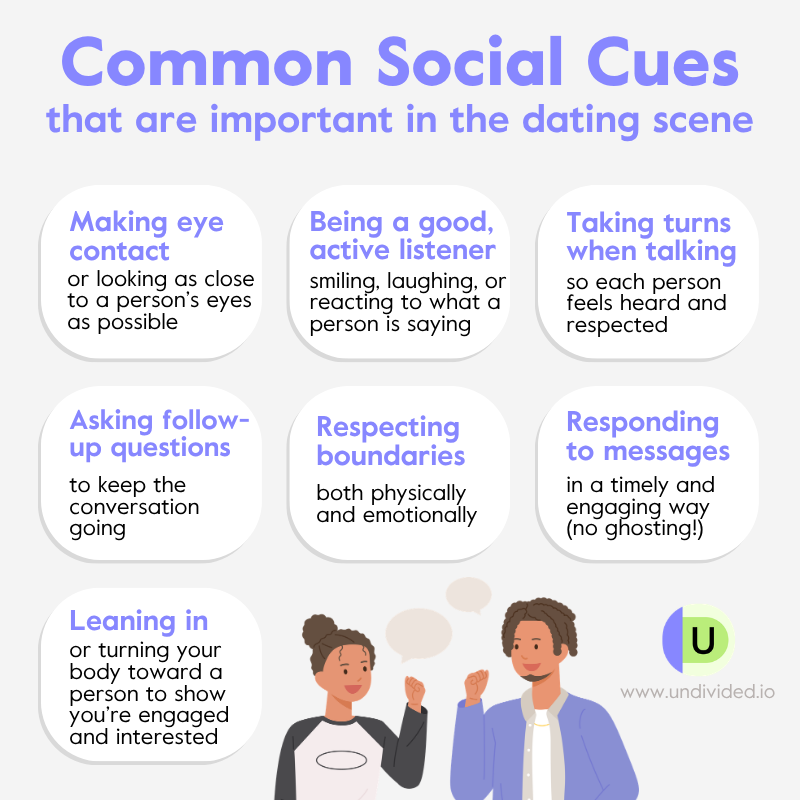
For parents, we encourage you to create opportunities for your child to practice — whether that’s with you, a sibling, a friend, or even a potential date when the time feels right. These small skills aren’t just helpful for making friends or navigating dating; they’re an integral part of everyday life. They’re what helps turn a conversation into a connection, and a connection into a platonic or romantic relationship.
Conversation skills
For many of our children, the hardest part of dating isn’t just finding someone — it’s knowing what to say once they are there. Ilana Hamburgh shares that the best way to ‘spark that connection’ is through purposeful conversations.
The good news is that conversing is a skill, and like social cues, it can be practiced! Hamburgh recommends starting by encouraging your child to build a “mental library” of questions, stories, and topics to go into social situations feeling more prepared. With a few go-to ideas in mind, the pressure is off in the moment and prevents that feeling of being stuck or unsure.
For those who might feel especially anxious, Hamburgh also suggests a simple but effective strategy: write down a few conversation starters or questions on a small note and keep it in your pocket. That way, if things feel overwhelming, they can step away for a moment, take a breath, and take a quick peek.
In this video, Hamburgh shares more on why practicing conversations makes dating easier:
Just as important as knowing what to ask is knowing how to respond. This is where practicing comes in handy again. Having a conversation isn’t just about having the “right” thing to say. It’s about actively listening — nodding while someone is speaking, making eye contact, asking follow-up questions, and showing genuine curiosity when talking with another person.
Here’s a list of a few questions to keep in mind when conversation lags:
- What’s your favorite restaurant or go-to food?
- Have you watched any good shows or movies lately?
- What kind of music do you like?
- Do you have a favorite place you’ve traveled to—or somewhere you want to go?
- What do you like to do in your free time?
- Are you more of a morning person or a night person?
- Do you have any hobbies?
- What’s something you’re really looking forward to right now?
- Do you have any pets? Do you like animals?
- What’s your favorite way to spend a weekend?
Remember, this is a process. Your child doesn’t have to master these skills all at once. In fact, try practicing each skill one at a time. As Ilana Hamburgh explains, “Neurodivergent individuals really benefit from structure and clarity, and so when you break dating down into understandable patterns, like how conversations flow, how attraction builds, it just becomes that much more manageable.”
Texting skills
Communicating in person can look very different compared to communicating over text. And, as Gyolai points out, “There’s not going to be a time in the near future where tech or texting isn’t a huge part of our lives. We can’t put our heads in the sand and pretend it doesn’t exist—we have to meet it and address it head-on.”
It’s important to acknowledge that a lot can get lost in translation when it comes to texting. Unlike face-to-face conversations, your child isn’t going to be able to read into subtle social/facial cues on their phone. Therefore, those who already struggle with picking up on those cues, may find difficulty in communicating over text (but, like everything, it can be taught).
That’s why teaching texting etiquette and safety is important. Below are a few tips to share with your loved one when it comes to texting:
Avoid over texting. Sending multiple messages in a row doesn’t allow for the other person to respond, and can feel overwhelming.
Respond in a reasonable amount of time. You don’t need to reply immediately, but responding within a few minutes helps to show respect and keeps the communication clear. If you’re busy, a simple message like “Hey, I’ll get back to you later!” can go a long way.
Don’t ghost. Instead of disappearing from the conversation without a reason, send a short, respectful message like, “I enjoyed talking, but I don’t feel a connection.” Ghosting can be confusing and hurtful to the other person, that is why clear communication helps both people move forward with understanding and respect.
Keep texting simple. Kind and clear communication goes a long way. A lot can get lost in translation over text (especially tone) so it helps to keep messages straightforward and easy to understand.
- For deeper conversations, phone calls, FaceTime, or in-person conversations can help people feel more connected and reduce misunderstandings.
Respect boundaries. Just like in person, if someone says they’re busy, that they don’t like something you said (or did), or they’re not interested, it’s important to respect that.
Check in with yourself. If a conversation feels confusing, stressful, or uncomfortable, it’s okay to step away or ask a guardian for support.
These tips may seem straight forward to some of us, but they’re an important part of communicating (especially, in this technological world). Texting is a great form of building connection, but can not replace in-person communication entirely.
Gyolai walks us through some more texting etiquette in this video.
Masking and dating
As our loved ones begin dating, it’s natural for them to want to be accepted and liked. Part of that may also include feeling the need to mask — suppressing behaviors/characteristics in social situations — which is something we all do to some extent. “Masking itself isn’t harmful. “Gyolai expresses. “It can be a helpful tool.”
And it can! Masking is often used to move through the world more confidently. However, when it comes to dating, it’s important that we’re teaching our adult children not to confuse masking with hiding who they really are.
As Gyolai shares, “Masking itself isn’t harmful. But when you show up as someone who is very different from who you truly are, it can negatively impact your relationships and your ability to genuinely connect. It can look like trying to be what you think the other person wants, rather than showing who you really are.”
When our children suppress who they really are they are more at risk of experiencing mental fatigue, anxiety, depression, and a loss of identity. So how do we help our loved ones find a balance between masking and showing up as their authentic selves, rather than a facade? Well, Gyolai walks us through some top ways to support that balance:
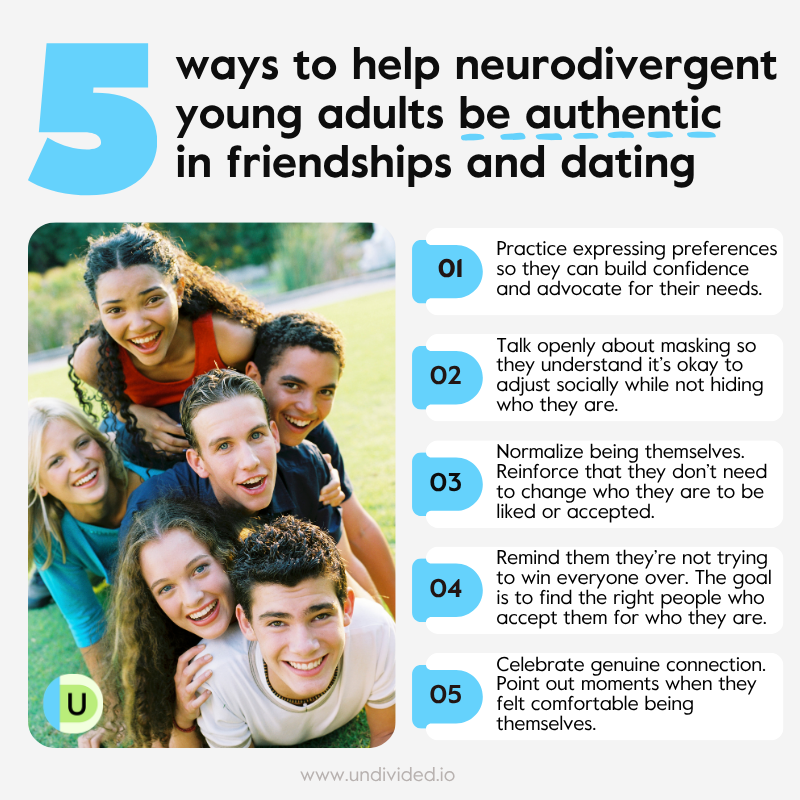
With time and practice, our loved ones can learn to show up more authentically in their relationships. And when they do, they’re more likely to build connections that feel safe, comfortable, and real. Which is something that extends far beyond building romantic relationships, but into every relationship in life.
Gyolai dives deeper into practicing authenticity in this video:
Communicating sensory sensitivities
Around 90% of people with autism have sensory sensitivities and about 1 to 3 out of every 20 people in the general U.S. population have sensory processing disorder. This can look like having a physical and/or emotional response to bright lights, loud noises, unexpected movement, and more.
That’s why it’s important to teach our children how to communicate their sensory needs — especially before going on a date. As we mentioned earlier, we don’t want them to feel like they have to pretend or “mask” their needs, because that can quickly lead to exhaustion.
Gyolai expands more on normalizing communicating sensory needs in this video:
We know that communicating sensory needs is often easier said than done for our children — but it’s a key part of helping them learn how to show up as their authentic selves. And, they don’t have to share everything all at once! If it’s easier, Gyolai encourages them to start by sharing bite-size pieces of information about their sensory needs before a date.
For instance, if their date suggests a concert that would be too overstimulating, we can encourage (or have our loved one practice) saying something like, “That concert would be too loud for me. Could we choose a different kind of place?” It can also look like asking the other person, “How would you feel about having a picnic at the park instead?” and giving them space to respond honestly.
Just as importantly, also about modeling that it’s okay to say, “That might be uncomfortable for me — could we find somewhere quieter?” When we normalize this kind of communication, we help our children understand that their needs are valid, and that healthy relationships make space for them.
Sensory-friendly dating suggestions
Finding a sensory-friendly space for a date is another key component to finding a space where our loved ones can feel comfortable to be themselves on a date.
A few sensory-friendly dates ideas look like:
- A quiet coffee shop
- A trip to the park
- An outdoor walk
- A casual or less crowded restaurant
- Going to places when it’s not peak times (like a bowling alley at 11 am on a Tuesday)
Places with less stimuli can help prevent any sensory triggers. Which goes in tandem with planning ahead. If your child is going to a new restaurant, have them check out the menu online. Likewise, if it’s a new location, have them look at google maps, or check-out the place beforehand in person to get them familiar with it. Going in prepared is the best way to reduce any anxiety.
Preparing also means having an exit or adjustment plan. As Gyolai explains, it’s important to encourage our adult children to say things like, “I need a break,” “Could we step outside?” or “This table is a bit loud for me, could we move somewhere quieter?”
Building in that kind of flexibility can help reduce any sensory dysregulation and help your child feel more in control of the situation.
Reframing rejection
It’s easy to say “just be yourself,” but that can be harder in practice. Rejection is something everyone experiences as they grow and build relationships. For children who are neurodivergent, those experiences can sometimes happen more often (or feel more intense), especially since research shows they are more likely to experience bullying than their peers are.
So, just as it’s important for your child to practice social cues and conversation skills, our experts encourage parents to also teach their children how to handle any possible rejection.
As Gyolai explains, “Parents often ask me how to stop their child from being rejected — and my answer is, I don’t. Rejection is a part of life. It happens in friendships, in work, and in relationships. As much as we want to protect our kids from that pain, it’s not realistic, and it shouldn’t be the goal.”
Rejection is a part of life. And as much as we wish we could shield our children from being rejected, we can’t always. That’s why it’s so important to show them how to handle rejection by building the confidence and resilience to move through it. Our experts emphasize preparing your child to navigate rejection using these five steps.
Take a deep breath. It’s normal to feel upset or sad, but know that rejection is not a representation of your worth.
Understand that everyone experiences rejection — it’s part of life.
A no does not mean that you are not a great person; it just means that this wasn’t the right match.
Respect the other person’s decision, even if it’s disappointing.
Take time for yourself and do things that help you recharge — go for a walk, spend time on a hobby, or connect with people who make you feel supported.
These are just a few ways to help work through rejection. Gyolai dives deeper into other coping strategies in this video:
Dating with rejection sensitivity dysphoria
Rejection sensitivity dysphoria (RSD) is a condition that causes an intense emotional response to perceived or real rejection, criticism, or social failures. RSD is a common co-occurring diagnosis in people who have ADHD or autism where they experience overwhelming feelings such as deep sadness, anger, or anxiety when they feel that they have been rejected or misunderstood.
When supporting your loved ones with RSD, it’s important that their feelings are validated while also helping them build perspective. As Gyolai expresses, we want to try and avoid reinforcing the idea that rejection is catastrophic or permanent. This can look like teaching your child how to separate rejection from their sense of self-worth.
This can sound like: “This situation does not define you at all. It’s not who you are — it’s just one experience you had.”
After acknowledging their emotions, it’s important to give them space to process. Then, once things feel calmer, you can gently reflect together by asking things like: What felt good about that interaction? What didn’t feel right? What might they want to do differently next time?
Rejection can feel especially intimidating at first, and no one enjoys it. But over time, with support and practice, your child can begin to recognize that they can move through it.
As Gyolai notes, “It’s scary to think about that first rejection. And I don’t mean to imply that being rejected repeatedly is a good thing, it’s not. It feels terrible. But like anything, once you have experience navigating it, surviving it, and feeling those emotions pass, you begin to rebuild your confidence. You start to realize, ‘I can get through this. I can survive it.’ And over time, each experience may feel a little less painful to navigate.”
Finding confidence after facing rejection
During a Social Life 360 Community Call, a young man shared that his date canceled on him. Instead of feeling discouraged, he chose to reframe his experience, seeing it as a positive rather than as a setback. In his words, it meant his time wasn’t wasted and made space for someone who would genuinely show up for him. This is a great example of someone who has developed the inner confidence to recognize that rejection isn’t a reflection of their self-worth.
In this video, Jeremy Hamburgh shares more on how to build confidence, one step at a time:
When friendship becomes something more
As we’ve established, building strong friendships is an important first step, but when those relationships begin to shift into something more, it can bring new emotions and questions to the surface. As Gyolai says, “We talked about the three components of friendship — equal effort, common interests, and mutual respect. In romantic relationships, those same three remain, with the addition of physical attraction and intimate touch.”
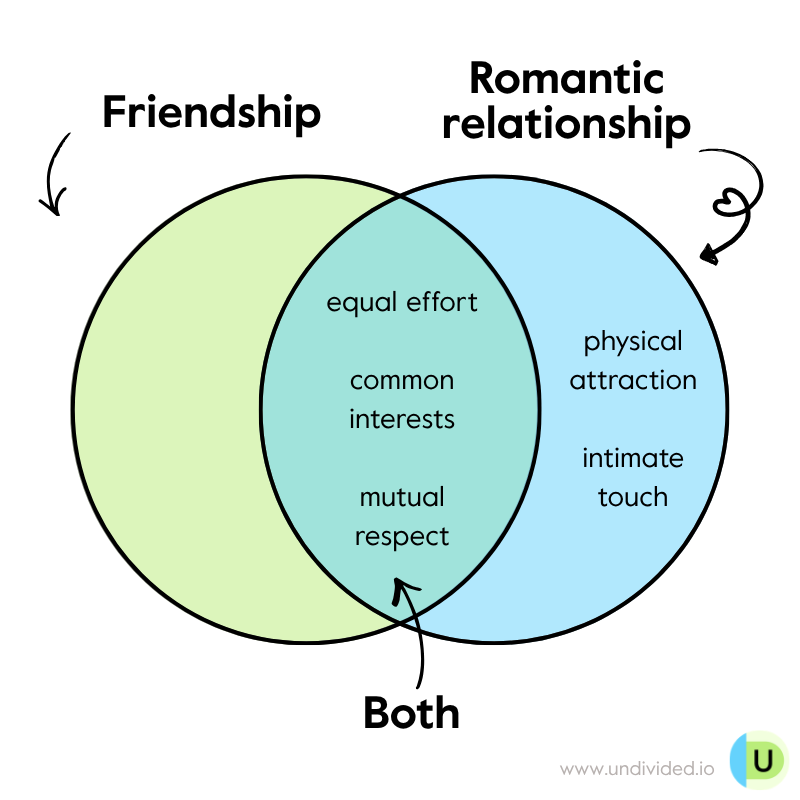
When attraction or romance blossoms, this can be a pivotal moment for parents to continue and deepen conversations that may have already started around consent, boundaries, and learning what red flags to look out for when dating.
Consent
The sad truth is that kids and adults with disabilities face shockingly higher rates of abuse than people without disabilities, and that risk does not diminish as they age. That’s why it is so important for our kids to learn (as early as they can) that they have a right to consent in all interactions, not only to protect them from perpetrators, but also because knowing that they have this right can help them lead more self-determined and fulfilling lives.
Consent isn’t just about physically intimate relationships. As Gyolai divulges, there’s often a societal fear that talking about consent will lead to raising a promiscuous adult — but she encourages families to approach it in ways that are separate from sexuality, at first.
At its core, consent is about teaching our children that they have the right to make choices about their own body, their space, and their level of comfort in any interaction.
According to Gyolai, “We should talk about consent as, ‘Wait a minute, you just took my phone. You didn’t ask to take my phone,’ or, ‘You just took something of mine without permission.’ That’s a consent issue right there.”
Teaching consent at a young age, can help lay a good foundation for when you can introduce more physically intimate forms of consent later on. This can also look like creating a list of trusted adults with them, and/or discussing appropriate vs. inappropriate touch (like hugging a relative, but not a stranger).
If you need a bit more guidance on teaching consent, here are a few tools that can help:
Specialized teaching and resources: while many children have great sex education classes in school, it is important for children with disabilities to have access to specialized classes that are designed with them in mind. You can talk to your 504 or IEP team to have curriculum materials that include modifications for students with disabilities, such as Positive Prevention Plus. In California, many Regional Centers offer a class for children on bodies and boundaries.
Social Stories: a Social Story™ is commonly used to help children understand events taking place in their lives as well as social norms and how to interact with the world around them — situations such as learning about safety and boundaries. You can use our Social Story template to write a Social Story about consensual touch, for example.
Books: there are books about consent and boundaries for children of every age. Check out many of the books here.
We know that it can feel hard to know how to talk about consent, but it's really important that we start having those conversations early so people can understand their choices.
Boundaries
Another great way to teach consent is to walk your child through firm boundaries. Boundaries can be physical — such as where it is and isn’t okay to touch or be touched — or they can be social, such as understanding the differences between professional, platonic, romantic, and sexual relationships.
Gyolai shares that a key part of teaching boundaries is helping our children understand that “everyone’s boundaries are different”. Meaning, what feels safe for one person may not feel safe for another, and each individual gets to define their own “rules” for comfort and safety.
So, how can we encourage our children to communicate their boundaries? Well, you might ask, “What helps you feel safe?” If they’re unsure, that’s okay — you can model it by sharing your own: “Here are some things that help me feel safe…” This helps them begin to recognize that they have a say in what their boundaries are.
Boundaries are best learned through practicing them in everyday situations, not just talking about them in theoretical ways. Giving concrete examples and rehearsing what to say can make it much easier to apply boundaries in real life.
Simple, clear phrases like:
- “I don’t like that” / “I love that”
- “I’m not ready for that” / “I am ready for that"
- “I’d like to take things slower”
- “No, thank you” / “Yes, please”
It’s important that we emphasize clear and concise phrases, because anything less — like saying, “Um. . . sure”, or, “I guess that’s okay” — can make boundaries and consent unclear.
A great way to practice boundaries and consent is a game that Gyolai calls “Rose, Bud, Thorn.” In this game, you share one good thing about your day, one exciting thing you’re looking forward to, and one thing you didn’t like.
This creates an opportunity to open up conversations and explore experiences more deeply. If your child shares something that felt uncomfortable or upsetting, you can gently ask questions like, “What about that felt disrespectful?” or “Tell me more about that.” Moments like these help build awareness and give your child the language to understand and express their boundaries over time.
Fostering a consensual romantic relationships
All of these tools can help our children learn how to say no when they feel unsafe, when a boundary is being crossed, or when they’re feeling uncomfortable. But, we can also encourage them to recognize when they are with someone who makes them feel safe, comfortable, ready to say yes.
Gyolai points out that a healthy, consensual relationship is built on mutual respect, clear communication, and shared consent.
These three pillars are the foundation of any healthy relationship:
- Mutual respect means both individuals value each other’s boundaries, feelings, and autonomy. This can look like a relationship where no one feels pressured, dismissed, or controlled.
- Clear communication can look like feeling safe to express what they want, don’t want, and need — without fear of judgment.
- Shared consent means both people actively agreeing to what’s happening. And, respecting if someone changes their mind.
“Consensual intimacy means that both people want it,” Gyolai explains, “both people feel comfortable and that there's no pressure, fear or confusion, and if someone feels unsure, it's a sign to pause. Anything other than a resounding yes is a no.”
Consent is an ongoing conversation. It shows up in everyday moments, like asking before borrowing something or checking in about plans, just as much as it does in more intimate situations.
Gyolai dives deeper into fostering a respectful and consensual relationship in this video:
Intimacy
As a society, our minds automatically associate intimacy with sex, but intimacy can be more than just sex. As Gyolai explains, “When we talk about sex, we have to recognize that it doesn’t necessarily mean intercourse. For some couples, it may look like hugging, kissing, or other forms of physical closeness — that may be their definition of sex.”
Families can help broaden this understanding of intimacy by talking about it as a spectrum, not a single act, and talking about where and when it's appropriate to be intimate.
Specifically, establishing what is appropriate in a friendship versus a romantic relationship — and when/where to be intimate. These distinctions can help your loved one better understand social expectations and boundaries.
You can support this by having open, judgment-free conversations like:
- What does intimacy look like in a friendship vs. a romantic relationship?
- What kinds of touch feel comfortable or uncomfortable?
When and where is certain behavior appropriate?
Again, we know these conversations can be hard! But the last thing we want is to deprive our adult children of a full and positive experience of intimacy (however that looks for them). And hopefully, if we’re starting conversations about consent early on, discussions around intimacy will feel like a natural progression — not something completely out-of-the-blue.
Sexuality
Sexuality, as defined by the American Psychological Association, is the capacity to derive pleasure from various forms of sexual activity and behavior, particularly from sexual intercourse. It can also include all aspects of sexual behavior, including gender identity, orientation, attitudes, and activity. For many neurodivergent individuals, sexuality and identity can be more fluid or explored in different ways.
Research shows that autistic individuals, for example, are more likely to identify as LGBTQ+. This makes it especially important to create space for open, affirming conversations — not just about dating, but about who your child is, who they’re attracted to, and how they define relationships for themselves. As parents, this can look like leading conversations with curiosity, not assumptions. Your child may not have all the language yet to describe how they feel (and that’s okay).
What matters most is that they know they are supported, respected, and safe to explore their identity at their own pace. Here are a few websites that can help you teach your child about their sexuality and relationships:
- National Sex Education Standards
- FLASH curriculum for special education
- How to teach sexuality education for individuals who are Deaf-Blind or significantly developmentally delayed
- How to teach sexuality to a person with ASD
Common issues with physical disabilities and sexuality
This is why ongoing conversations matter. When children understand that consent, boundaries, intimacy, and sexuality can look different for everyone, they’re better able to identify and advocate for what feels right for them.
Supervision and safety
For some neurodivergent individuals, little to no support may be needed when it comes to forming romantic connections. Others, especially individuals with developmental disabilities, may require additional support. As Gyolai notes, this can be a bit of a balancing act between offering support and ensuring safety (without becoming overbearing).
So what does this look like? According to Gyolai, it can mean supporting your child in attending structured social environments — places where expectations are clear — where people are there with a shared purpose. This might include hobby-based clubs, community programs, peer social groups, volunteer opportunities, relationship workshops, or speed-dating events.
Check to see whether there are any dating while neurodivergent events in your area. Some events, such as the Find Love Safely speed dating event, encourage parents/caregivers to come along to help support their loved one, depending on their needs.
Gyolai shares her own experience with navigating and supervising her son, Nicolas, who has Down syndrome, when dating, saying, “I’m not trying to keep him in a bubble. I’m trying to keep him safe, so matches can come to me and I’ll go, ‘I’ll work with him.’ I’m the human firewall. I want him to start navigating this on his own, but he needs to copy me in on what is being said.”
Again, not every person who is neurodivergent may need support, but some, like Nicolas, may require more. At the end of the day, this level of support and supervision is customizable to your child’s wants and needs.
Gyolai says it best, “We want our children to grow in independence and autonomy, but not at the expense of their safety.”
How to meet people
A great way to help your child connect with people is by getting them out into the community. This will help our children to feel (hopefully) more at ease when seeking a potential friendship or romantic interest, especially if they have a shared common interest.
Here are a few ideas:
- Book clubs
- Hobby-based clubs or classes
- Community events like the Red Carpet Ball or A Night to Shine
- EPKTO dances and proms
Speed dating events nearby (like Find Love Safely Speed Dating)
For some individuals, online platforms can be a helpful way to connect, especially if in-person interactions feel overwhelming at first. However, some may need additional support to navigate these spaces safely (we’ll cover this in more in a bit).
Some dating apps designed with neurodivergent individuals in mind include:
Online dating (and red flags to watch out for)
In 2021, nearly 70,000 people reported a romance scam, with losses reaching $1.3 billion. While there isn’t specific data on the correlation between people with disabilities (specifically those with developmental disabilities) and online dating scams, we do know from research and our experts that individuals with developmental disabilities are at a higher risk of being targeted by scammers.
Again, as Gyolai reminds us, the goal isn’t to prevent our children from dating, but to prepare them. And that extends to online dating, too. As parents, you may not be able to fully stop your child from going on dating apps or social media, even with supervision, so it’s important to have open conversations about what to look out for.
According to the Federal Trade Commission - Consumer Advice, romance scammers will often create fake profiles on dating sites and apps or contact people through popular social media sites, such as Instagram or Facebook. These scammers will often, 1) strike up a relationship to build trust, 2) send fake pictures of themselves to gain trust, 3) chat with a person several times a day. This is done all in the hopes of capitalizing on a person’s feelings or getting a person to send money or share their account information.
Here are a few red flags to be aware of when online dating:
- The person has only one or no profile photos. A profile with only one photo isn’t necessarily a red flag, but it can be a warning sign. Scammers often rely on a single image that looks overly polished or generic, since it may be pulled from stock photography or someone else’s social media profile.
- The person claims to be a celebrity or model. These are almost always fake.
- The person sends strange links right after matching. Most scammers will send a link to what is supposedly their social media account but is really a link to a virus that will infect your phone.
The person is unwilling or unable to meet in person. Or, the person makes plans to meet but something always comes up. Someone interested in forming a genuine relationship will be excited and want to meet in person.
Conversely, if someone wants to meet too quickly (for instance, within the first day) that can be a red flag too.
- The person pushes for sexual photos. Some scammers try to move the conversation in a sexual direction so that if a person sends them explicit photos, the scammer can use the photos for blackmail later, threatening to send them to a person’s contacts unless they pay.
- The person has an investment opportunity they want your child to be part of. This is almost always a scam in hopes that the person will send them money.
- The person asks to move the conversation to a separate app. This might be WhatsApp, Telegram, or any encrypted platform where the messaging can’t be traced back to them.
- The person asks for your child’s financial information. This is an obvious red flag — but it might not be so obvious to your child.

Our experts also share that dating apps, in general, can come with added levels of difficulty (on top of trying not to become a victim to scamming). As Jeremy Hamburgh notes, "Online dating creates twice as many skills that you need to master. The pictures are almost always not the representation that you want of yourself, and the way that you write about yourself is almost always not a representation of what the reader wants to be reading. And then our clients oftentimes struggle with, who do I reach out to? What do I say to them? How do I respond? And there are all these hidden rules to online dating that only get you to a date, and now you have to rely on the in-person skills that maybe you were neglecting.”
This isn’t to say that online dating can’t be a good way for your child to meet people, but it might not be the best for those who still are working on the social skills related to dating.
How you can support a child who is dating
If there’s one thing to carry forward, it’s this: early preparation matters. Here’s a list of further things you can do to support your child on their dating journey
Practice conversations
Confidence doesn’t come all at once; it’s something that is built over time. Practice everyday conversations with your child. Walk them through how to start a conversation, how to actively listen, and how to respond. These small moments can help them feel more prepared when real-life situations arise.
Role-play different scenarios
Role-playing can be a powerful way to prepare for dating. You can walk your child through situations such as asking someone out, setting a boundary, or responding to rejection. This gives your child a chance to build skills in a safe, low-pressure environment.
Talk openly about dating
Create space for ongoing, judgment-free conversations about relationships, attraction, and experiences. The more open these conversations are, the more likely your child will feel comfortable coming to you with questions or concerns.
Support autonomy and consent
It’s important to give your child the freedom to make choices and explore relationships in their own way. Independence is part of the process, but it doesn’t mean removing support altogether. Remember, this is all a balancing act!
Provide resources
Books like Kiss and Repeat or Let's Meet can be a great way to introduce your child to dating in a digestible way.
Be a safe place to come back to
Let your child know they can always come to you — whether something went well or didn’t. You being a consistent, supportive presence helps them process experiences and build confidence over time. Being a sounding board or a safe space to talk about dating is an integral part of keeping our children safe, while also allowing them to live their lives to the fullest.
Support without overstepping
These are just some of the many ways to help your neurodivergent child navigate dating. We also know how much of a balancing act it can be as a parent. You want to support them when they need it, while also knowing when to step back and “let them fly” on their own.
Gyolai shares her personal experience with finding the balance between support and independence in the following video:
Key takeaways
When you prep your child with the skills, guidance, and confidence to navigate relationships, you’re not limiting them, but opening doors. You are giving your child the tools they need to participate fully, safely, and confidently. Which all helps to make sure that your child is fully included in every aspect of their life.
Gyolai reminds us, “Inclusion means access with support, not access without safeguards. I believe true inclusion means honoring autonomy while also providing structure, guidance, and protection. When it comes to dating, people with disabilities want the same things that all of us do. They want friendship. They want connection. They want love, and they want to belong. They want their tribe. They want their people. They want someone to say good morning to, even if it’s via text. They want someone to ask them how their doctor’s appointment went and to truly care.”
“When we combine preparation, education, and supportive environments, individuals can build relationships that are healthy, meaningful, and, most importantly, safe. The goal is not to remove all risk. That is not something we can ever accomplish, and it shouldn’t be our goal. It’s impossible in any relationship — mine or yours. The goal is to provide the skills and support that allow people to navigate relationships with dignity, confidence, and agency.”
At the end of the day, dating while neurodivergent is possible. As parents, it may require letting go of preconceived notions, anxiety, and understanding if or when your child needs support with dating. Because support is what makes true inclusion possible.


Unlock more with Undivided
Turn knowledge into action that benefits your child
Get Membership


Author