

Medi-Cal Changes Coming in 2027

To comply with changes to federal Medicaid rules, Medi-Cal in California is implementing changes to who qualifies and how care is managed. Here’s what public benefits specialist Lisa Concoff Kronbeck says to keep an eye on for Medi-Cal changes on deck in the coming year:

January 1, 2027
Transition from managed care to fee-for-service for Medi-Cal enrollees with “unsatisfactory immigration status”
“Unsatisfactory immigration status” refers to people who are ineligible for federally funded Medicaid. This includes but is not limited to Medi-Cal recipients who are undocumented, green card holders who do not yet qualify for federal Medicaid, people allowed into the US for certain humanitarian purposes, and people with PRUCOL status. People affected by this transition will also lose access to Enhanced Care Management and Community Supports, which are only available through Medi-Cal managed care plans under CalAIM. This may include care coordination, medically tailored meals, and certain housing-related supports.
Provider continuity and access to specialists: Families affected by the transition to fee-for-service Medi-Cal should confirm that their current doctors, specialists, therapists, and medical equipment suppliers accept fee-for-service Medi-Cal. Some providers who accept Medi-Cal managed care plans may not accept fee-for-service Medi-Cal, potentially disrupting access to care. Families should also check whether existing authorizations for treatments, therapies, medications, and medical equipment will remain valid after the transition, and ask about continuity-of-care protections if they need to change providers.
Prescription medications: Prescription drug coverage will continue through Medi-Cal Rx after the transition to fee-for-service. Families should not need to change how they obtain covered prescriptions solely because of this transition. However, families who rely on specialty medications or medications requiring prior authorization should confirm that their prescriptions and authorizations will remain in place to avoid interruptions in treatment.
CCS Whole Child Model transition: Children enrolled in the CCS Whole Child Model who are affected by the transition from Medi-Cal managed care to fee-for-service will continue to receive CCS-covered services. However, care coordination responsibilities may shift from their managed care plan back to their county CCS program. Families should confirm who will coordinate their child's care, whether existing authorizations for therapies, medical equipment, and specialty services will remain valid, and whom to contact if services are interrupted. Children affected by this transition will also lose access to Enhanced Care Management (ECM) and Community Supports provided through their managed care plans. These changes do not apply to all children enrolled in CCS, only those affected by the immigration status-related transition.
Important reminder about Medi-Cal renewals for certain immigrants: Although California's restrictions on new enrollment in full-scope Medi-Cal for certain adults based on immigration status took effect January 1, 2026, the consequences of losing coverage remain especially important in 2027. Adults affected by these restrictions who miss renewal deadlines or experience a lapse in coverage may be unable to reenroll in full-scope Medi-Cal. Generally, they have a three-month window to restore coverage before the new enrollment restrictions apply. Families should respond promptly to renewal notices, keep their contact information updated, and confirm that all required paperwork has been received and processed. Children under 19, qualifying pregnant individuals, and certain former foster youth under 26 are exempt from these enrollment restrictions.
Work requirements for adults age 19-64 who receive Medi-Cal under the Affordable Care Act expansions
There are a number of exemptions from this requirement, including parents of children under the age of 13, older adults, people with disabilities and their caregivers, as well as veterans with disability status. However, as the state rolls out these new rules, it is reasonable to anticipate that some people may experience accidental disenrollments or other mistakes, especially if deadlines are missed. It will be especially urgent to review all mail from Medi-Cal and follow up on document submission to ensure receipt prior to deadlines. You can check a recipient’s status on the BenefitsCal website.
Additionally, it is unclear how the exemption will be established for individuals with disabilities who are enrolled in Medi-Cal based on Modified Adjusted Gross Income (MAGI). DDS reports that an estimated 15,500 Regional Center clients fall into this category. The new federal rules require individuals to prove they cannot work, and California and other states are suing the federal government over this rule and other burdens imposed by the work requirements. Note that the work requirements would not apply to Medi-Cal recipients who are enrolled because they receive SSI benefits, nor to participants in other non-MAGI Medi-Cal programs.
Reduction of the 90-day retroactive coverage period
Currently, there is a 90-day retroactive coverage period that you can select when you enroll, and if the provider who accepts the plan refuses to bill Medi-Cal, you can submit to the state to request reimbursement. Most frequently, this comes up with new Medi-Cal recipients who paid for covered expenses out of pocket before receiving their Medi-Cal card. Beginning in 2027, adults without children will be eligible for only one month of retroactive coverage, while all other recipients will be eligible for two months.
New address verification requirements
Federal Medicaid rules will require states to use additional information, including returned mail and national change-of-address records, to identify possible changes in a recipient's address. While these requirements are intended to improve eligibility records, they could create additional administrative complications for families whose contact information is outdated or whose mail is unreliable. Please remember to report address changes within 10 days of the move. Families should make sure Medi-Cal has their current mailing address and respond promptly to any requests to verify their information.
Update my child's services after a move
March 1, 2027
Renewal every 6 months instead of every 12 months for adults who get Medi-Cal through ACA expansions
Enrollment frequency should not change for children, nor for individuals enrolled in Medi-Cal through institutional deeming waivers.
July 1, 2027
For people with “unsatisfactory immigration status,” addition of a monthly Medi-Cal premium of $30 to $50 and a change in Medi-Cal dental benefits
You can visit Immigration Status and Changes to Medi-Cal Eligibility to check how these two changes will impact you based on your specific immigration status. The premium requirement and change in dental benefits will not apply to children ages 0-19, pregnant individuals (up to one year after childbirth), and people under age 26 who were in foster care on their 18th birthday. Those who do not pay the premium will only be eligible for pregnancy-related and emergency services.
Changes to Medi-Cal dental provider payments
California is eliminating supplemental dental payments funded through Proposition 56. Although this does not directly eliminate children's Medi-Cal dental benefits, reduced reimbursement could make it more difficult for families to find dentists who accept Medi-Cal, particularly specialists who treat children with complex medical needs or disabilities. Families may want to confirm that their current dental providers plan to continue accepting Medi-Cal patients.
Reduction in the asset limits for older adults and people with disabilities
The asset limit will be reduced to $21,000 for an individual, $31,000 for a two-person household, and $1,550 for each additional person in the household, up to 10 people. As usual, exempt assets include the family residence, one car, and retirement accounts. Until June 30, 2027, the asset limit will continue to be $130,000 for an individual and $65,000 for each additional person in the household.
Note: For children enrolled on a Medi-Cal waiver under institutional deeming, only assets in the child’s own name count toward the asset limit.
January 1, 2028
Changes to home equity limits for people who receive long-term services and supports from Medicaid
See our article about supports for independent living for more information about how a special needs trust can help safeguard a home and funds used for its upkeep.
October 1, 2028
Copayments (up to $35) for some Medi-Cal services for certain adults
This applies to adults age 19-64 who are enrolled in Medi-Cal based on Modified Adjusted Gross Income (MAGI) and who are 1) not on Medicare, 2) not pregnant, and 3) earn more than $15,560 per year. Preventive visits, emergency care, and mental health and substance use treatment are among the exempt services.
Resources
For more information, check out these resources:
- Guide to Medi-Cal changes on the DHCS website
- Medi-Cal Timeline from the National Health Law Program
- Guide to Federal Work Requirements in California from DDS
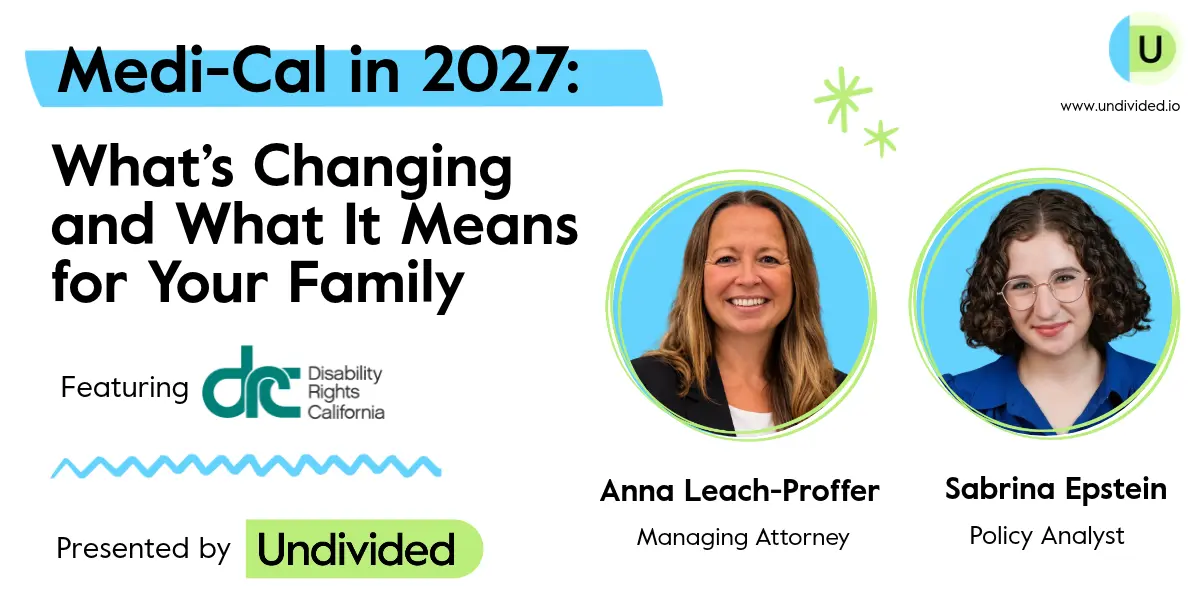
We are continually following up with experts in public benefits to see how upcoming changes affect California families, including a live Q&A with two attorneys from Disability Rights California on November 10. Check out the details and RSVP here.
You can also subscribe to our weekly newsletter and @undividedapp on social media to stay informed.


Unlock more with Undivided
Turn knowledge into action that benefits your child
Get Membership


Author