

Adaptive Equipment for Kids with Disabilities
What is adaptive equipment?
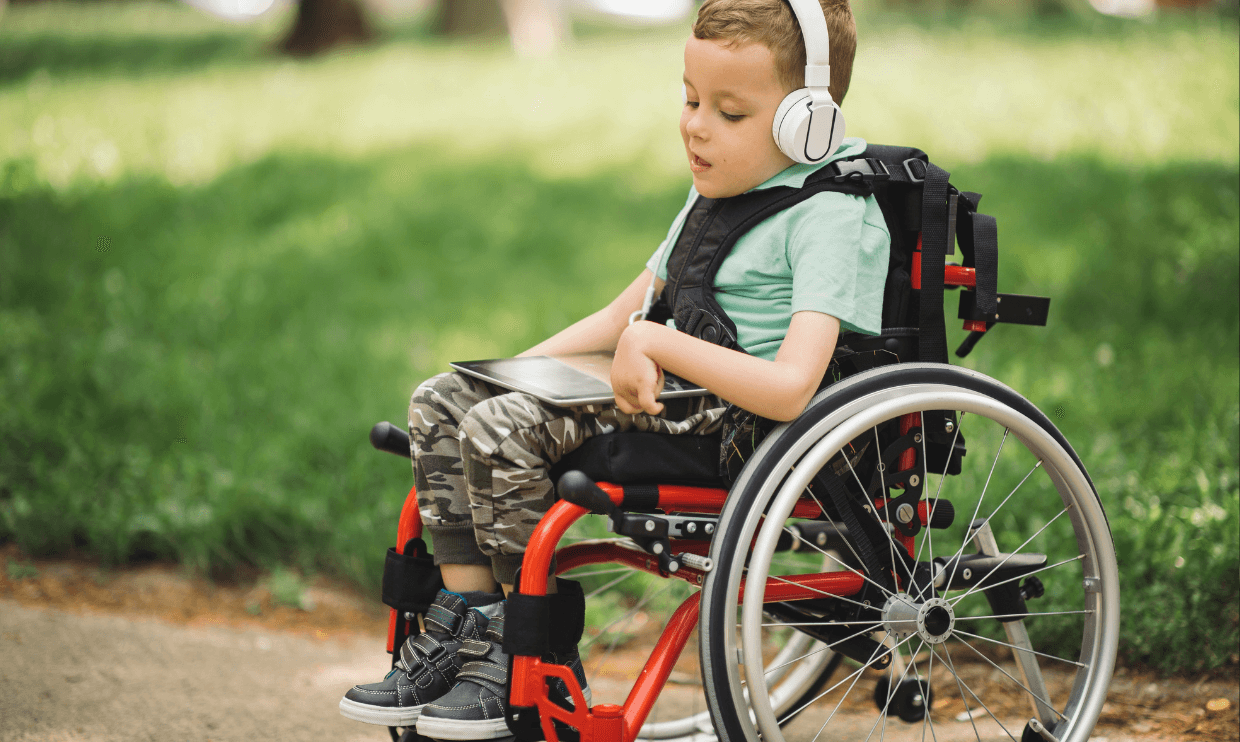
Adaptive equipment falls under the category of assistive technology. Broadly speaking, adaptive equipment is a device designed to help a person with disabilities complete activities of daily living. For kids with physical limitations, adaptive equipment helps increase functioning in areas where they need support. This might include:
- Mobility and stability equipment, like wheelchairs and strollers as well as devices for sitting and posture
- Visual equipment to support low vision
- Audio equipment to support low hearing
- Communication equipment, including AAC
- Devices to support fine motor abilities like writing or holding utensils
- Personal care equipment to assist with bathing or toileting
- Adaptive sports and recreation equipment
Why use adaptive equipment?
The Osteogenesis Imperfecta Foundation (OIF) says, “No matter what you use, the goal is always the same — to participate in more activities, as independently as possible, in a comfortable and safe manner.”
As we’re talking with our children’s doctors, IEP teams, and other people who support our kids, it’s important to reaffirm that our vision is for our kids’ inclusion and independence in as many areas of life as possible, not just now while they’re kids but as future adults. Getting our children the right adaptive equipment can help with those short-term and long-term goals.
How to choose adaptive equipment
OIF recommends considering not only your child’s physical capabilities but also their needs, wants, and desires. Where do they need support to accomplish tasks for their health, well-being, and interests? “As precisely as possible, describe what you want to do. Think creatively about how the task could be done. Describe the current limitations; describe the perfect solution. Try to bridge the two.”
A physical therapist, occupational therapist, speech therapist, or other member of your child’s care team can help you consider options depending on the area of need.
As you’re looking at adaptive equipment, here are some questions from OIF to think about:
- Will it be used at home, school, or another setting?
- Will it be in a car or other vehicle?
- Will the equipment be used indoors or outside?
- Will weather (rain, cold, snow, heat) be a factor?
- Will the equipment be needed for only a short while or permanently?
How to pay for adaptive equipment
Durable medical equipment can often be funded through health insurance. Undivided Public Benefits Specialist Lisa Concoff Kronbeck says, “If this is for use in the home, you always have to start with the medical insurance,” whether that’s primary health insurance or public health coverage like Medicaid. Common types of DME covered by health insurance and Medicaid include:
- Standers, walkers, and gait trainers
- Wheelchairs (manual and power)
- Adaptive seating (e.g., Rifton chair, tomato chair)
- Adaptive tricycles, bikes, and vehicles
- Adaptive bathing equipment
- Specialized writing tools and scissors
- Adaptive toileting options
- Switches and buttons for access
- Positioning alternatives such as prone wedges for children to explore a variety of positions
Fund durable medical equipment (DME)
For equipment that will help your child access school, talk to your IEP team about funding. The process usually starts with an assistive tech and/or AAC assessment to determine what your child’s areas of need are, followed by a team discussion of what items the school is responsible for providing to ensure the child has access to a free, appropriate public education. When school is providing equipment, be sure to request training for the child and their team (caregivers and teachers).
Most adaptive equipment and assistive technology that a child uses at school can also come home if they need that equipment to maintain their IEP goals. For plenty of ideas, see our articles IEP Assistive Technology Tools to Empower Students with Disabilities and Top 35 Adaptive School Supplies for Kids with Disabilities.
If health insurance and school deny funding, your state’s department of developmental disability services may be able to offer support. For example, California families may be able to bring their denial letters from insurance and school to Regional Center to try to get a piece of adaptive equipment funded.
Here are some common providers of adaptive equipment:
List of adaptive equipment
Mobility and stability support
Various supports can help kids move around their space at school or at home with greater ease and independence. Most people think of mobility aids like manual or power wheelchairs, but there are other types of adaptive equipment to assist with mobility and stability:
- Gait trainer: A wheeled device that promotes postural alignment during walking
- Orthotics and bracing: Equipment like orthotics, ankle braces, forearm crutches, shoe inserts, and support shoes can help improve a child’s mobility, stability, and strength. These devices can be worn on either a temporary or permanent basis to improve gait, strength, stability, and balance and reduce the chance of tripping, deformity, spastic movement, and dislocation of joints. Orthotics can also help reduce the need for surgery later on in a child’s life. Children undergo a physical assessment by a doctor or therapist to determine the best orthotics for their needs. The choice may vary depending on muscle tone, age, and risk of joint misalignment.
- Stander: This device allows kids with conditions like cerebral palsy to stand upright, even if they can’t do so on their own. Standing helps build bone strength and works muscles in the legs and core, which are super important for stability and everyday movement.
- Adaptive bike or trike
- Grabbers and reachers
- Adjustable-height furniture for safe transfers or play
- Smart watches allow for hands-free help. Many brands have a fall detection setting that is available and alerts an emergency contact system.
- Switches
- Bedside or wheelchair switches: Designed to attach to a bed frame or wheelchair, these switches can be activated by subtle movements of the head, shoulders, or even the voice to turn lights on and off or activate any other smart devices.
- Hand, finger, and body switches are common and helpful mobility aids. One of the most popular is the joystick handswitch, which can be programmed to turn on and off TVs, lights, iPads, or any other smart device.
You can also think about adapting your child’s environment to improve mobility. Here are some ideas from our article all about accessible home modifications:
- Built-in or portable ramps and Angled Entry Mats can be used to provide a smooth transition through doorways with raised thresholds. National Seating and Mobility confirmed that an interior built-in ramp is not a covered item under the durable medical equipment benefit on health plans, but a portable metal folding ramp that measures up to 12 feet in length is a covered DME item.
- Door modifications like T-pull levers help wheelchair or mobility aid users open and close doors. Sliding or bifold doors (similar to barn doors) make a doorway wider and easier to navigate than a hinged door. For a more high-tech (and pricier) option, you could invest in automatic or push-button door openers for indoor doors.
- Stairlifts have motorized chairs that travel along a rail attached to the staircase and can be operated with the push of a button and/or by remote control. Some families also explore the option of home elevators.
- Electric bedside lifts can help make transfers in and out of the bed easier and safer.
- Safety beds can provide additional support depending on your child’s mobility or medical needs. For example, SafetySleeper Beds and other adaptive types of safety sleep beds offer adjustable heights, rails for fall prevention, and head elevation to assist with breathing or congestion.
- Side rails and bumpers can add a form of soft protection to prevent rolling out of bed without feeling too restrictive.
- Motion-sensing lights can automatically turn on lights by sensing when someone enters a space.
Be sure to also see our full article about adaptive car modifications to make sure you can transport your child and any mobility equipment safely. Here are a few ideas:
- Transfer boards and straps can be used anywhere to help transfer your child into a proper seated position but are particularly helpful in the car.
- Door handle latches/attachments provide support moving in and out of the car.
- Vehicle safety steps help minimize the distance between the vehicle and the ground.
- A wheelchair lift or ramp
- Car seats with head support are available for children who need more neck and head support.
- Car seat vests can be fantastic for children with sensory issues or who require additional safety belts to keep them safe and secure. These vests typically use a three- to five-point harness.
- Pressure-point seat cushions, like postural covers, can be used anywhere but are made with a specific type of honeycomb material that helps distribute your child’s body weight more evenly to alleviate pressure points.
- Seat belt cushions can help soften the feel of the standard seat belts, which can sometimes dig into the skin.
- Seat belt extenders lengthen the reach of a standard seat belt, making them especially helpful for kids who need adaptive car seats or require additional positioning supports.
- Specialized wheelchair seat belts are designed for use in accessible cars and vans, where wheelchair users can secure their wheelchairs to the floor.
- Wheelchair tie-down and occupant restraint systems are specialized wheelchair seat belts that can be attached to the wheelchair itself to ensure the user is safely strapped in.
Feeding support
Here are a few options that can support more comfortable, independent feeding:
Adapted spoons:
- Weighted spoons with heavier handles can help kids with shaky or low-tone hands feel more stable while scooping and bringing food to their mouths.
- Textured spoons have bumps or ridges on the underside to offer extra sensory input, which can be helpful for kids with oral awareness or sensory needs.
- If needed, pack your kid's lunch or snack bag with adaptive flatware like EasieEaters Curved Utensils, which have angled handles to make self-feeding easier.
Adapted cups and plates:
- Bear straw cup: designed to teach straw drinking, this cup lets you control the flow of liquid so your child doesn’t get overwhelmed.
- Recessed lid cup: these have a small opening that helps your child learn to sip without tipping the cup too far.
- Nosey Cup: with a cut-out rim to make room for the nose, this cup lets kids sip without having to tilt their head back.
- Munchkin Weighted Straw Cup: the weighted straw moves with the liquid, so it works at any angle, even upside down.
- Ezpz bowl or sectioned plate: these silicone mats stick to the table and have built-in sections, which can reduce spills and help kids feel more organized at mealtime.
Learn more in our article all about feeding challenges and supports.
Personal care: dressing, bathing, and toileting
Adaptive clothing
Features such as magnetic closures or special zippers make it easier for children to dress themselves, helping them feel more independent and confident.
Bathroom accessibility
Adaptive seats, grab bars, and other bathroom modifications promote independence with toileting and encourage confidence in daily self-care.
- Grab bars can be installed anywhere, but common uses are in the bathroom – both in the shower to minimize the risk of slip-and-falls and near the toilet to help with standing and sitting.
- Non-slip materials such as non-slip flooring or anti-slip strips for the bathroom floor, tub, or shower.
- Accessible sinks and countertops, which means that there should be clearance above and below the sink to allow wheelchair users to roll into the handwashing area to wash their hands unobstructed.
- Touchless/motion sensor faucets and soap dispensers
Toileting supports
- A training seat helps prevent slipping, and the handles on each side provide extra support for mobility and safety.
- Toilet safety rails attach directly to the toilet and come in a variety of sizes and styles to meet your child’s changing needs. Another variation is toilet safety rails with a raised seat, which lifts the toilet higher and makes it easier for your child to sit and stand safely. Raised toilet seats come as easy-to-install attachments or as replacement seats, depending on what works best for your family’s setup.
- Toilet lifts are a more high-tech option for bathroom accessibility and can be especially helpful for individuals with significant mobility needs. One example is Dignity Lifts, a brand that offers motorized toilet seats. There are less expensive versions available like the EZ Access Tilt toilet lift.
- Toileting accommodations like splash guards to reduce mess or a urine funnel to assist individuals with improved aim and control.
- Toilet wiping alternatives such as a wiping tool, hand-held bidets with a sprayer-style attachment, or automatic bidets that come as toilet seats or toilet seat attachments. There are travel bidets as well that you can take on the road.
- Alternative toilet flushers such as automatic toilet flushers that use motion sensors to flush automatically, a foot flusherwhere you can press a pedal on the floor with your foot to flush, or push-button flushers that have a button instead of a traditional handle.
Shower and bathtub supports
- Roll-in showers and bathtubs designed for wheelchair users or people with mobility challenges
- Bathtub lift to help lift wheelchair users into and out of a bathtub or allow wheelchair users to navigate themselves from their wheelchair to a bath chair.
- Shower/bathtub gliding chairs allow someone to sit in a chair outside of the shower, and it glides over the barrier and places them in the shower/bathtub.
- A shower/bath chair allows individuals to bathe safely while seated, helping to reduce the risk of any potential slips or falls. There are also bathtub cushions that can help relieve any pressure points and help to keep your child more comfortable.
- Adjustable and accessible shower heads, often hand-held or mounted on a sliding bar, make it easier to control water flow and direction.
Vision support
For individuals with low vision or cortical vision impairment, adaptive equipment at school and home can help them participate safely and with as much independence as possible.
- White canes help people detect obstacles and changes in various terrain.
- Railing modifications: There are textured railings for anti-slip and to establish where you are, or railings made with contrasting colors for higher visibility. A noteworthy mention is that there are now handrails being made with braille on them to describe direction and scenery.
- High contrast school supplies:
- Glue sticks with blue glue color for visual contrast
- High-contrast, large-print keyboard stickers to help a student with low vision as they're learning to type.
- Magnification devices help students see things more clearly by enlarging text and images. Handheld magnifications are easy to carry and simple to use on the go. Stand magnifiers sit directly on top of reading material and often come with built-in lights for added clarity. They’re hands-free, which makes them especially helpful for longer reading sessions or completing assignments. Dome magnifiers are clear domes that glide right over a flat surface to magnify text underneath. Bioptic magnification glasses help students with low vision see more clearly by magnifying text and details.
- Stands or mounts like a ModularHose can hold iPads or materials in the right visual field. An All-In-One Board, a multi-platform, easily-adjustable board that can be used in the classroom for learning activities with students of all ages. You can even mount an iPad on it.
- Smart home hubs can be made more accessible by making the buttons larger or voice-activated.
For more, see our full article Tech, Equipment, Apps, and More for Low Vision and Blindness.
Communication support
For kids with hearing loss, adaptive equipment and assistive technology can include:
- Hearing aides or cochlear implants
- Hearing assistive technology, such as headsets or FM systems that amplify the speaker’s voice
- Real-time captioning devices or apps
- Schools can use speaker systems, carpeted floors, paneled ceilings or sound-softening tiles, and curtains to reduce echo and background noise.
- Visual alert systems for doorbells, phones, alarm clocks, and smoke detectors
See our full article Tech, Equipment, Apps, and More for Hearing Loss.
Communication support also includes adaptive equipment and assistive tech for kids who are non-speaking. Examples of AAC tools include:
- High-tech or low-tech picture boards
- Devices and apps that vocalize text
- Joystick or mouse devices
- Head pointing or eye gaze devices
See our full article Top Communication Tools, Apps, Assistive Technology, and More!
Fine motor support
Here are some common adaptive tools for all things fine motor development at school and at home:
- Click-top markers make it easier to start coloring than pens with caps.
- A directional locker lock or key-style lock may be easier to use for middle school and high school students working on fine motor skills.
- Easy-grip scissors come with a cover to support blade safety. Both right-handed and left-handed kids can use these.
- An easy-open pencil case without a zipper lets more kids access writing tools.
- Stock up on pencil grippers so that your child will have some at school and at home. The Grotto grip is another style your child might find useful.
- A weight pencil set can provide proprioceptive and tactile input for kids to support their handwriting. For older kids, you may want to try a weighted mechanical pencil set.
- Notebook paper with raised lines provides both sight and touch input for writing. Undivided parent Kelly also recommends notebook paper with darkened lines as well as the sky/ground paper that a lot of OTs use.
- Theraputty is useful for hand warm-ups prior to writing.
- The Functionalhand is a versatile assistive technology tool designed to help individuals of all ages independently grasp and hold objects, such as pencils and markers.
Sensory support
There are a lot of tools that can help kids with sensory challenges.
Flexible seating and movement:
- Flexible seating in the form of a wobble cushion, yoga ball chair, or chair wedge can provide sensory input and help kids focus.
- For PE and movement breaks, a scooter board can help kids get the wiggles out.
- Bouncy Bands use heavy-duty solid rubber bungee cord that can be attached to a desk, allowing kids to move their legs, strength, and more.
Pressure and weight:
- A compression sensory vest can be worn under or over clothing to provide therapeutic pressure.
- Have you heard of a body sock? It can can be a great tool for deep pressure.
- Weighted blankets, weighted lap pads, neck wraps, and stuffed animals. Southpaw resistance tools, vests, weighted toys, wraps and shawls provide plenty of options.
Tactile and fidget:
- Sensory objects like chewy necklaces and pencil tops can provide oral stimulation for kids who need it.
- Sensory tactile bookmarks that serve as a bookmark but also have different textured sections for different levels of tactile input.
- The Spike Silicone Fidget Tactile Pencil Gripper is a great sensory tool that combines a pencil grip with fidget functionality
Sound:
- Whisper phone or PVC pipe for helping with verbal stims in class
Noise-canceling headphones can work wonders in blocking out any sounds that might overstimulate your kiddos' senses.
For more information, head to our article Sensory Processing Disorder and Sensory Diets.
Recreation, creativity, and play
Recreation and play are just as important for our kids’ development as academics. Here are some ideas for adaptive equipment to use at school and at home for playing games or making art.
- Accessible gaming devices, like the Xbox Adaptive Controller
- Switch-compatible toys (e.g., switch-activated plush animals or light-up toys)
- Adapted board games with larger pieces or magnetic cards
- Accessible play equipment or alternatives (for example, a lighter/softer ball for sports activities or an adaptive tricycle if the playground and field are otherwise inaccessible)
- All-terrain mobility devices like strollers for recreation outdoors
- Accessible art supplies like grip-friendly pencils or crayons, foam stamp handles, weighted pens, and easy-grip scissors.
- Paint sponge brush sets can provide another way to make paint meet paper for artists who need something a bit more forgiving than a traditional paintbrush.
- Digital tablets can be equipped with accessibility features and tools
- Easel or table with adjustable height
It's just as important to create an adaptive working environment that fits how a kid likes to create, whether they prefer standing or sitting. Learn more in our article about art in therapy.


Unlock more with Undivided
Turn knowledge into action that benefits your child
Get Membership


Author